




A groundbreaking report from TDWI Research reveals a critical chasm separating enterprises that successfully derive extensive business value from artificial intelligence (AI) and those perpetually trapped in pilot purgatory. The fundamental differentiator, according to the new 2026 Blueprint report, is not merely the sophistication of AI models deployed, but rather the robust condition and strategic architecture of the data foundation underpinning those AI systems.
The report, titled "TDWI Blueprint Report | Building an AI-Ready Data Foundation," was meticulously authored by Fern Halper, Ph.D., TDWI vice president of research. Its central finding unequivocally states that organizations consistently reporting the most significant AI impact possess demonstrably stronger architectural, governance, and operational capabilities within their data ecosystems compared to their lower-impact counterparts. This insight underscores a pivotal shift in the AI narrative, moving the focus from algorithmic prowess to the often-overlooked bedrock of data quality and accessibility. TDWI, a venerable research and education organization, has long been a beacon for data, analytics, and AI professionals, providing essential training, insights, and best practices.
Dr. Halper articulated the report’s core message, stating, "Although many organizations have achieved localized successes, the findings in this Blueprint suggest that long-term AI success depends on the strength of the underlying data foundation." She further elaborated on the insidious nature of common data challenges, explaining how "fragmented data environments, inconsistent governance, weak semantic alignment, and poor data accessibility become major constraints as AI initiatives move from experimentation into production." This transition from isolated proof-of-concept to enterprise-wide deployment acts as a crucible, exposing any weaknesses in the data infrastructure that were perhaps tolerable in smaller, contained experiments.

The imperative for a strong data foundation is particularly heightened as advanced AI paradigms, including generative AI, sophisticated copilots, and autonomous agentic systems, increasingly transition from the experimental phase into full-scale production environments. The report’s download site at TDWI echoes this sentiment, emphasizing that the sustained success of these cutting-edge AI technologies is directly contingent upon a meticulously prepared and managed data substrate. Without this robust foundation, the promise of transformative AI risks being undermined by unreliable outputs, biased decisions, and operational inefficiencies.
Defining the AI-Ready Data Foundation: A Comprehensive Blueprint
The TDWI report provides a precise definition of what constitutes an "AI-ready data foundation." It is described as "the integrated set of capabilities that transforms raw, fragmented data into governed, contextualized, and accessible assets that can be used reliably to build, deploy, and scale AI applications." This definition moves beyond a mere collection of data to encompass a holistic system designed for the rigors of AI. The report meticulously breaks down these capabilities into several critical components, each playing an indispensable role in ensuring data readiness:
- Ingestion: This refers to the process of acquiring and bringing data into the data ecosystem from diverse sources. For AI, this often requires handling various data types (structured, semi-structured, unstructured), varying velocities (batch, streaming, real-time), and ensuring completeness and integrity at the point of entry.
- Integration: With data residing in countless silos across an enterprise, integration is paramount. This involves combining data from disparate sources into a unified view, often requiring complex ETL (Extract, Transform, Load) or ELT (Extract, Load, Transform) processes, API integrations, and robust data virtualization techniques to ensure a comprehensive and consistent dataset for AI models.
- Pipelines: Data pipelines are automated workflows that move and transform data through various stages, from raw ingestion to AI-ready formats. These pipelines must be scalable, reliable, and observable, capable of handling large volumes of data while ensuring data quality and timeliness for AI training and inference.
- Flexible Architectures: Modern AI demands architectural flexibility, moving beyond traditional data warehouses. This includes embracing data lakes for raw, unstructured data, data lakehouses that combine the flexibility of lakes with the governance of warehouses, and cloud-native platforms that offer scalability and elasticity. The architecture must be adaptable to evolving AI requirements and data volumes.
- Metadata: Often called "data about data," metadata is crucial for understanding, managing, and governing data assets. For AI, rich metadata provides context, describes data sources, explains transformations, tracks ownership, and facilitates data discovery, enabling AI developers to find and utilize relevant data efficiently and accurately.
- Lineage: Data lineage provides a clear audit trail of data’s journey, from its origin through all transformations and movements. This capability is vital for debugging AI models, ensuring data provenance, validating data quality, and meeting regulatory compliance requirements, offering transparency and trust in AI outputs.
- Semantic Context: This component focuses on establishing a shared understanding of data across the organization. It involves creating business glossaries, ontologies, and data dictionaries that define terms, relationships, and meanings. For AI, strong semantic context helps models interpret data correctly, reduces ambiguity, and enables more accurate and relevant insights.
- Governance: Data governance encompasses the policies, processes, and responsibilities for managing data assets. For AI, this means ensuring data quality, security, privacy, compliance (e.g., GDPR, CCPA), and ethical use. Robust governance frameworks prevent bias, protect sensitive information, and build trust in AI systems.
- Access Controls: While data democratization is desirable for AI innovation, secure and granular access controls are essential. This ensures that only authorized users and AI systems can access specific data sets, protecting sensitive information while facilitating responsible data sharing and collaboration.
High-Impact Organizations Treat Data as Table Stakes
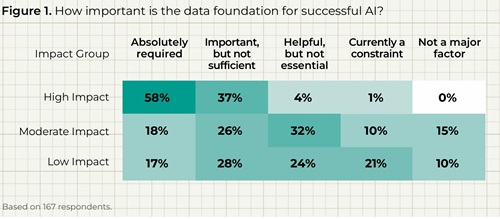
The report’s methodology involved segmenting respondents into three distinct groups based on their reported AI business impact: high-impact, moderate-impact, and low-impact organizations. The findings within these segments offer compelling evidence of the data foundation’s criticality. Among high-impact organizations, a striking 58% declared that a strong data foundation is "absolutely required" for successful AI initiatives. Another 37% deemed it "important but not sufficient alone," bringing the total to an overwhelming 95% of high-impact organizations viewing the data foundation as either absolutely required or profoundly important. This consensus within the most successful AI adopters underscores that they do not see data as a peripheral concern but rather as a foundational prerequisite—a non-negotiable "table stakes" for any serious AI endeavor.
The divergence becomes even more pronounced when comparing these high-impact organizations with their lower-impact counterparts. In stark contrast, only 18% of moderate-impact respondents and an even lower 17% of low-impact respondents considered the data foundation "absolutely required." This significant disparity highlights a fundamental difference in strategic perspective. Organizations struggling to realize substantial AI value often undervalue or misunderstand the foundational role of data, perceiving it perhaps as a technical overhead rather than a strategic enabler.
Furthermore, the report revealed a direct correlation between data foundation strength and perceived constraints. A substantial 21% of low-impact organizations reported their data foundation as a current constraint hindering their AI progress. This figure plummets to a mere 1% among high-impact respondents, indicating that those who prioritize and invest in their data foundation effectively mitigate this critical bottleneck. This data point is particularly telling, suggesting that organizations that fail to invest adequately in their data foundation are not only less successful with AI but are also acutely aware of this deficiency as a primary impediment.
Historical Context and the Evolution of Data Challenges

The challenges highlighted by the TDWI report are not entirely new; they represent an amplification of long-standing issues in data management. For decades, organizations have grappled with data silos, inconsistent data definitions, and varying levels of data quality. The rise of data warehousing in the 1980s and 90s sought to centralize and standardize data for reporting and business intelligence. Later, the "Big Data" era of the 2000s and 2010s introduced new complexities with the explosion of data volume, velocity, and variety, leading to the development of data lakes and distributed processing frameworks.
Even in the early days of machine learning (ML), data preparation consumed an inordinate amount of time—often 70-80% of a data scientist’s effort. While these early ML projects often focused on specific, well-defined problems with curated datasets, the ambition for enterprise-wide AI required a more systemic approach to data. The difference now is the scale, complexity, and criticality of data for AI. Where a small, imperfect dataset might yield acceptable results for a narrow ML model, the demands of broad, impactful AI applications, especially those requiring real-time interaction or deep contextual understanding, expose data weaknesses far more dramatically. The lessons learned from decades of data management struggles are now directly applicable, and indeed critical, to the success of AI.
The Generative AI Imperative: Amplified Data Demands
The advent of generative AI (GenAI), with its capacity to create new content, synthesize information, and power conversational interfaces, has not only raised the stakes but has also intensified the demands on the underlying data foundation. GenAI models, including Large Language Models (LLMs), often rely on vast datasets for training. However, for these models to be truly useful and trustworthy in enterprise settings, they must be grounded in an organization’s proprietary, accurate, and governed data.

Techniques like Retrieval Augmented Generation (RAG) allow GenAI models to access and incorporate up-to-date, factual information from an organization’s internal data stores, reducing "hallucinations" and improving relevance. Fine-tuning pre-trained models with specific enterprise data allows for specialization and improved performance on domain-specific tasks. Both RAG and fine-tuning are utterly dependent on the quality, accessibility, and semantic richness of the internal data foundation. If the underlying data is fragmented, inconsistent, or poorly governed, GenAI systems will inevitably reflect these flaws, leading to inaccurate outputs, biased responses, and a lack of trust. The "garbage in, garbage out" principle, a truism in data science, becomes even more critical with GenAI, where the outputs can be highly persuasive yet fundamentally flawed if based on weak data.
Strategic Implications for Business Leaders and Data Professionals
The TDWI report carries profound implications for business leaders, technology executives, and data professionals alike:
- Strategic Investment Priority: Organizations must view their data foundation not as a mere IT cost center but as a strategic asset and a foundational investment for future growth and competitive advantage. Prioritizing resources for data architecture, governance, and quality is no longer optional; it is essential for AI success.
- Organizational Alignment and Collaboration: Breaking down organizational silos between data teams, analytics teams, and AI/ML engineering teams is paramount. A unified strategy that recognizes the interdependence of these functions is necessary to build and maintain an AI-ready data foundation.
- Addressing the Skills Gap: There is an urgent need to invest in talent development for roles such as data engineers, data governance specialists, data architects, and MLOps engineers who possess a deep understanding of data lifecycle management and its implications for AI.
- Competitive Edge: Companies that successfully build robust data foundations will be better positioned to innovate faster with AI, derive deeper and more accurate insights, automate more processes reliably, and develop more trustworthy and impactful AI applications, thereby gaining a significant competitive edge.
- Risk Mitigation and Compliance: A strong data foundation, particularly robust data governance and access controls, is critical for mitigating risks associated with data privacy (e.g., GDPR, CCPA, HIPAA), security breaches, and ethical AI concerns like algorithmic bias. It enables organizations to ensure compliance and build public trust.
- Evolving Technology Stack: Businesses should evaluate and adopt modern data stack components, including cloud-native data platforms, advanced data catalogs, data observability tools, and automated data quality solutions, to build and manage their AI-ready data foundation effectively.
In conclusion, the TDWI Research 2026 Blueprint report delivers a clear and resonant message: the future of enterprise AI hinges not on the dazzling capabilities of its algorithms alone, but on the unyielding strength and meticulous craftsmanship of its data foundation. Organizations that grasp this fundamental truth and commit to building integrated, governed, and accessible data environments will be the ones that truly unlock the transformative power of AI, moving beyond localized successes to achieve broad, sustainable business value. For those that continue to neglect their data infrastructure, the promise of AI will likely remain an elusive, fragmented dream. The time has come for every organization aspiring to AI leadership to recognize that data is, unequivocally, the first and most critical step on the path to AI impact.