





The widespread integration of artificial intelligence into the modern workplace has sparked an unexpected and paradoxical crisis: while organizations increasingly demand advanced human capabilities such as critical thinking, independent judgment, and rigorous oversight, the very deployment of AI tools is actively eroding those skills among the workforce. This alarming disconnect is brought to light by a comprehensive global study recently published by the IBM Institute for Business Value (IBV). Titled "Designing the Thinking Organization," the research highlights a growing friction between corporate leadership and employees, centered around how human cognition is valued, maintained, and protected in an era dominated by automated systems.
The study’s findings point to a fundamental vulnerability in contemporary workforce strategies. As enterprises race to capture productivity gains from generative AI and machine learning, they are inadvertently dismantling the cognitive scaffolding required to manage these technologies safely and effectively. Rather than augmenting human intelligence in a balanced manner, rapid AI adoption is threatening to create a generation of workers who rely too heavily on automated outputs, gradually losing the capacity to question, validate, or override machine-generated decisions.
Methodology and Scope of the IBM Study

To understand the profound shifts occurring across the global labor market, the IBM Institute for Business Value partnered with Oxford Economics to conduct an extensive dual-survey initiative. Fielded between April and June 2026, the research captures the perspectives of two critical groups shaping the future of work: senior executive leadership and full-time rank-and-file employees.
The first segment of the research surveyed 1,500 Chief Human Resources Officers (CHROs) and senior executives who hold direct responsibility for workforce strategy, organizational design, and talent development. These leaders represented 21 distinct geographic regions and spanned 23 major industries, offering a macroeconomic view of executive priorities and corporate anxieties. The second segment surveyed 8,800 full-time employees across 28 countries, providing a ground-level perspective on how daily tasks, skill retention, and job satisfaction are actually evolving in real-time.
By comparing the responses of leadership against those of the everyday workforce, the study exposed stark perceptual gaps. While executives are acutely aware of the macro-level transformations required to remain competitive, they often underestimate the micro-level friction and cognitive atrophy experienced by employees whose daily responsibilities are being reshaped by algorithms.
The Acceleration of Workflow Disruption
One of the most revealing insights from the IBM study concerns the sheer velocity of workplace evolution compared to the deliberate pace of organizational restructuring. The data indicates that more than half of all surveyed employees—specifically 52 percent—experienced significant changes to their assigned tasks over the preceding twelve years, driven almost entirely by the integration of AI into daily operations.
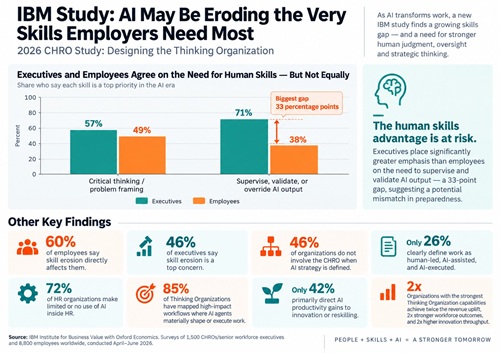
However, this organic transformation has largely occurred without structured oversight. Only 26 percent of organizations reported that they clearly define work across distinct operational categories, such as human-led, AI-assisted, and AI-executed activities. IBM characterizes this phenomenon as "work changing faster than organizations are redesigning it." Instead of implementing thoughtful, strategic frameworks for human-machine collaboration, companies are relying on ad-hoc adaptation by employees on the ground. This reactive approach leaves workers scrambling to navigate shifting responsibilities without clear guidance on where human accountability begins and ends.
The Executive-Employee Perceptual Divide on Critical Thinking and Judgment
At the heart of the "Designing the Thinking Organization" report is a troubling misalignment regarding the skills needed to govern AI successfully. While both executives and employees recognize critical thinking and problem framing as valuable assets, they diverge sharply when it comes to the specific competencies required to supervise advanced technologies.

When asked to rank the skills most critical for AI-enabled work, 57 percent of executives and 49 percent of employees placed critical thinking and problem framing near the top. Broadly speaking, both groups understand that the ability to conceptualize complex problems remains a uniquely human advantage.
Yet, a massive divide emerges when evaluating the day-to-day oversight of AI systems. Seventy-one percent of executives prioritize the ability of workers to actively supervise, validate, or override AI outputs. In stark contrast, only 38 percent of employees share this priority—representing a substantial 33-percentage-point gap. Furthermore, when isolating the specific capability of independent professional judgment, only 29 percent of employees rank it as a top priority.
This disconnect suggests that while leadership views human oversight as a non-negotiable safeguard against algorithmic error, hallucination, and bias, many employees view AI outputs with passive acceptance. Workers are increasingly inclined to trust automated systems implicitly, failing to recognize their own responsibility to critically interrogate the data and conclusions presented to them by software.
The Looming Crisis of Skill Erosion

Perhaps the most alarming revelation of the IBM study is the widespread acknowledgment of skill erosion—a phenomenon distinct from the traditional skills gap that has dominated HR discussions for the past decade. Traditional workforce development strategies focus on reskilling: teaching employees new capabilities to keep pace with technological advancements. However, skill erosion represents the silent loss of existing capabilities as algorithms take over the underlying mechanics of daily tasks.
The data reveals a profound awareness of this threat across all organizational levels, though employees feel the impact much more acutely than their leaders. Sixty percent of surveyed employees state that skill erosion directly affects them, while 46 percent of executives identify it as a top operational concern. Among the workers who expressed worry about skill degradation, critical thinking was cited most frequently as the capability experiencing the sharpest decline. Most notably, three out of four workers who fear skill erosion report that AI has already begun to diminish at least some of their core professional competencies.
Despite these warning signs, corporate responses remain misaligned. IBM’s research indicates that roughly 80 percent of enterprises have established formal reskilling roadmaps designed to help workers collaborate with new technologies. While these programs successfully address the acquisition of new skills, they largely fail to combat the atrophy of foundational cognitive skills. When automated systems handle drafting, calculating, analyzing, and initial problem-solving, workers are systematically deprived of the mental repetition required to maintain proficiency in those exact areas.
Implications for Workforce Strategy and Organizational Design
The implications of the IBM Institute for Business Value study extend far beyond human resources departments, signaling a critical juncture for corporate governance, operational risk management, and long-term economic productivity.
As organizations rush to reinvest the productivity gains achieved through artificial intelligence, leadership must radically rethink how work is structured. Relying on organic adaptation is no longer viable. Companies must transition from passive AI adoption to deliberate organizational redesign, establishing rigorous protocols that preserve human agency and cognitive engagement. This involves intentionally carving out spaces within daily workflows where human analysis, skepticism, and decision-making are required, rather than optional.
Furthermore, training programs must evolve. Enterprises can no longer treat reskilling as a one-time onboarding event or a module-based tutorial on software navigation. Instead, workforce development must incorporate continuous cognitive fitness practices—training employees not just how to use AI tools, but how to effectively challenge them. This includes cultivating a corporate culture that rewards healthy skepticism, rigorous validation, and ethical oversight.
Conclusion

The findings from the IBM and Oxford Economics study serve as an urgent wake-up call for the global business community. Artificial intelligence holds the undeniable potential to unlock unprecedented levels of efficiency and innovation, but it carries a hidden tax: the gradual atrophy of the human intellect required to steer it. If organizations fail to address the erosion of critical thinking, judgment, and oversight capabilities, they risk building highly automated enterprises governed by passive workforces—ultimately trading long-term resilience for short-term gains. To prevent this outcome, employers must intentionally design future workplaces where technology amplifies human capability rather than replacing the cognitive foundation upon which all modern business success depends.







