



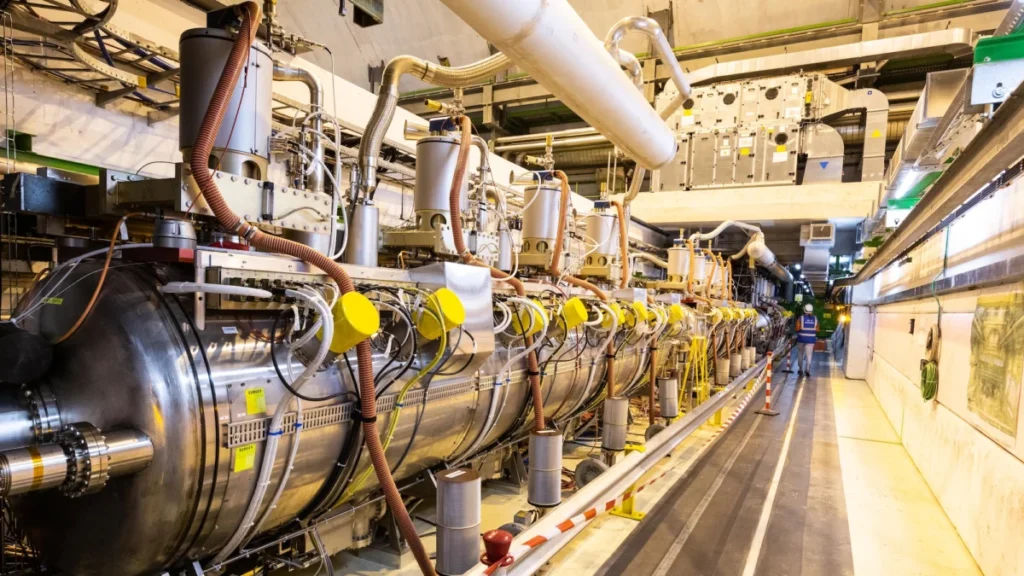
The European Organization for Nuclear Research, known globally as CERN, has officially commenced a transformative period in the history of experimental physics by initiating "Long Shutdown 3" (LS3). This milestone, announced on June 29, marks the formal conclusion of the Large Hadron Collider’s (LHC) original operational phase—an 18-year tenure that fundamentally reshaped the human understanding of the universe’s building blocks. While the cessation of beam operations might suggest an end to the world’s most famous particle accelerator, the move is actually the prologue to a massive engineering overhaul. The facility is currently being dismantled and rebuilt to emerge as the High-Luminosity Large Hadron Collider (HL-LHC), a successor capable of peering deeper into the subatomic realm than ever before.
Since it first saw a beam of protons in 2008, the 27-kilometer (16.7-mile) circular tunnel buried beneath the Franco-Swiss border has served as the vanguard of high-energy physics. Its achievements are legendary, most notably the 2012 discovery of the Higgs boson, the elusive "God particle" that explains how other particles acquire mass. However, the current hardware has reached its statistical limits. To find answers to the remaining mysteries of the Standard Model—such as the nature of dark matter, the prevalence of matter over antimatter, and the potential existence of extra dimensions—scientists require a machine with significantly higher "luminosity."
The Legacy of the Large Hadron Collider
To understand the necessity of this transition, one must look at the unprecedented success of the LHC since its inception. Built at a cost of approximately $4.75 billion, the collider was designed to test the predictions of different theories of particle physics. It functions by accelerating two beams of protons to nearly the speed of light in opposite directions before smashing them together at four intersection points, where massive detectors—ATLAS, CMS, ALICE, and LHCb—record the debris.
The 2012 confirmation of the Higgs boson was the crowning achievement of this era, filling the final gap in the Standard Model. Beyond the Higgs, the LHC has provided a wealth of data on the top quark, the heaviest known fundamental particle, and offered tantalizing hints of "new physics" through the study of muons. Muons, which are essentially heavier cousins of electrons, have shown behaviors in LHC experiments that do not perfectly align with theoretical predictions, suggesting the influence of undiscovered forces or particles. Furthermore, the LHC successfully measured the internal structure of antimatter, a feat crucial to understanding why the universe is composed of matter when the Big Bang should have produced equal amounts of both.
Despite these triumphs, the LHC has been limited by its collision rate. In the world of particle physics, rare events require a massive number of collisions to be observed with statistical certainty. This is where luminosity—a measure of the number of potential collisions per unit area and time—becomes the critical factor.
The Mechanics of Long Shutdown 3
Long Shutdown 3 is not merely a period of maintenance; it is a massive logistical and civil engineering undertaking. CERN officials estimate that approximately 1.2 kilometers (0.75 miles) of existing magnets and high-tech components will be entirely removed and replaced. This overhaul involves a global network of collaborators and a budget exceeding several hundred million dollars in additional upgrades.
The primary objective of LS3 is the installation of new, more powerful superconducting magnets made of a niobium-tin (Nb3Sn) compound. These magnets are significantly more powerful than the niobium-titanium magnets used in the original LHC. They will be used to "squeeze" the proton beams into much tighter bunches at the interaction points, dramatically increasing the probability of a collision.
Key projects during this four-year hiatus include:
- The North Area Consolidation: The Super Proton Synchrotron (SPS), which serves as the final injector for the LHC, will undergo a massive renovation to ensure it can handle the increased intensity of the new beams.
- Experimental North Cavern 3 (EHN3) Overhaul: This section will be converted into a high-intensity fixed-target area, allowing for a specialized suite of experiments that complement the main collider’s work.
- Neutrinos to Gran Sasso (CNGS) Deconstruction: The dismantling of older target areas will make room for the infrastructure required for the HL-LHC’s upgraded cooling and power systems.
- Crab Cavity Installation: These specialized radio-frequency cavities will "tilt" the proton bunches just before they collide, ensuring they hit head-on rather than at an angle, maximizing the luminosity.
Jean-Philippe Tock, the LS3 Coordination Team director, emphasized the scale of the project, noting that the logistical complexity of working 100 meters underground with sensitive, multi-ton equipment requires precision timing and international cooperation.
Technical Specifications and the High-Luminosity Era
The transition to the High-Luminosity LHC (HL-LHC) is defined by a tenfold increase in the machine’s integrated luminosity. In practical terms, this means the HL-LHC will produce roughly 15 million Higgs bosons per year, compared to the 1.2 million produced by the original LHC during its entire first decade of operation.
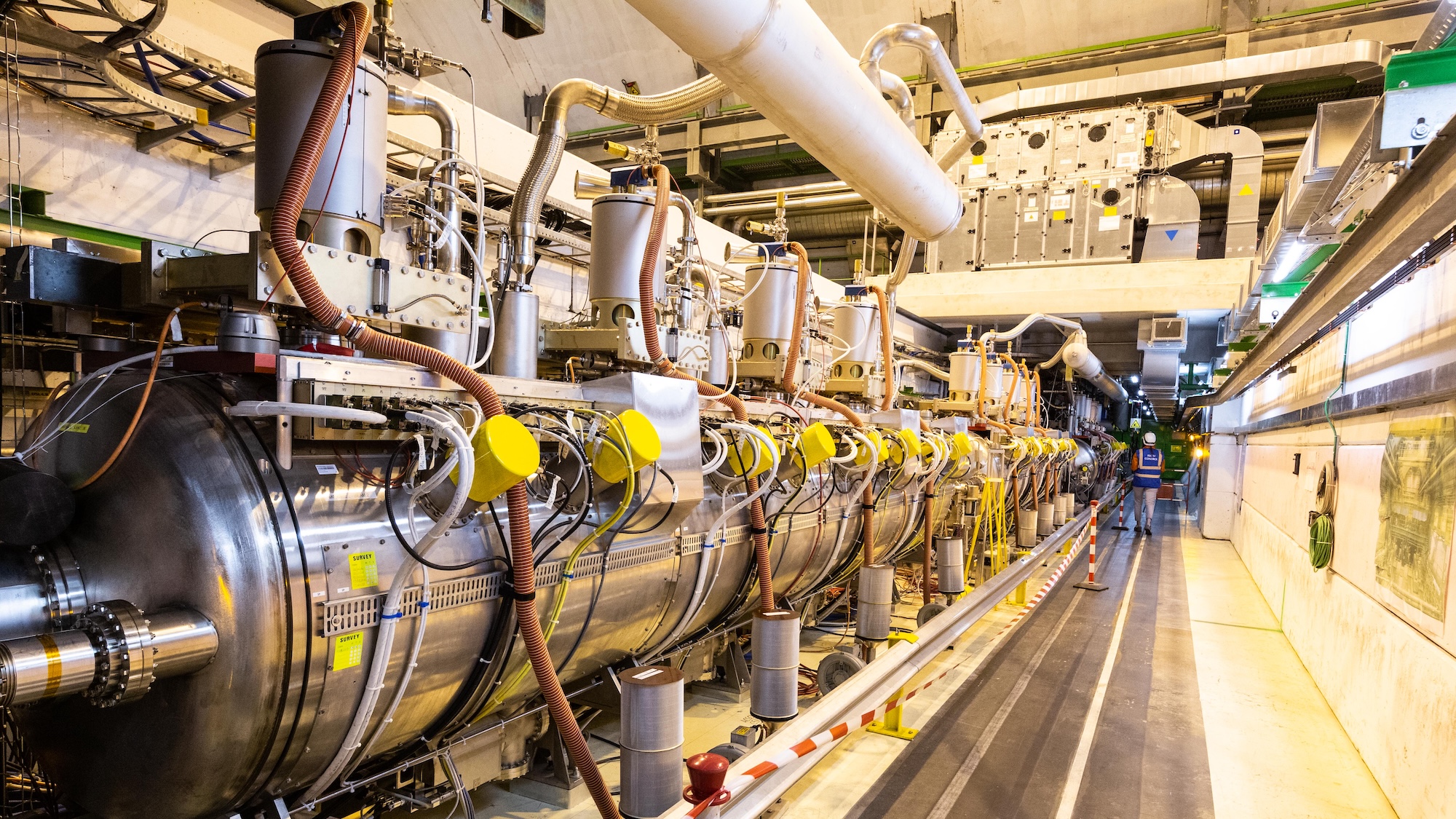
This surge in data will allow physicists to observe extremely rare processes that are currently hidden by statistical noise. For example, the HL-LHC will be used to study "Higgs self-coupling," a process that could reveal the stability of the universe’s vacuum state. It will also provide the sensitivity needed to look for Supersymmetry (SUSY) particles, which are candidates for the dark matter that makes up 27% of the universe but has never been directly detected.
The data processing requirements for the HL-LHC are equally staggering. The upgraded detectors will produce exabytes of data, necessitating a complete overhaul of the Worldwide LHC Computing Grid (WLCG). New artificial intelligence and machine learning algorithms are currently being developed to filter the useful collision data from the background noise in real-time.
A Chronology of Progress
The path to the HL-LHC has been a decades-long journey, marked by planned pauses for technological leaps:
- 1998–2008: Construction of the original Large Hadron Collider.
- September 2008: First beam circulation.
- 2012: Discovery of the Higgs boson announced.
- 2013–2015 (Long Shutdown 1): Upgrades to the magnet interconnects to allow for higher energy collisions (reaching 13 TeV).
- 2018–2022 (Long Shutdown 2): Installation of new injection systems and improvements to the LHC’s brightness.
- 2026–2029 (Long Shutdown 3): The current phase of major hardware replacement and transition to High-Luminosity.
- 2030: Full commencement of HL-LHC operations, expected to run until at least 2041.
Official Responses and Global Impact
The scientific community has reacted to the shutdown with a mixture of nostalgia and intense anticipation. Oliver Brüning, CERN’s Director for Accelerators and Technology, highlighted that the LHC has "exceeded every expectation," but noted that the move to HiLumi is essential to keep the European facility at the forefront of global science.
The project is a testament to international diplomacy. CERN, while based in Europe, involves 23 member states and thousands of scientists from over 100 countries, including the United States, China, and India. The upgrades are being funded and built by a coalition of international laboratories, including Fermilab in the U.S., which is contributing the state-of-the-art superconducting magnets mentioned earlier.
The economic and technological "spin-offs" of this project are also significant. The cryogenics, vacuum technologies, and superconducting materials developed for the LHC have found applications in medical imaging (MRI), cancer therapy (hadron therapy), and even the aerospace industry. The push for the HL-LHC is expected to drive further innovations in high-speed computing and material science.
Future Frontiers and Broader Implications
As the LHC goes dark for its four-year transformation, the focus of the physics world shifts from data collection to data analysis and engineering. Thousands of researchers are still sifting through the "Run 3" data collected before the shutdown, hoping to find a discovery that might guide the hardware configurations of the new machine.
The implications of the HL-LHC extend beyond just confirming existing theories. If the machine fails to find evidence of Supersymmetry or dark matter, it may force a fundamental rethink of how we view the laws of nature. Conversely, a single unexpected discovery could open the door to a "Theory of Everything" that unites gravity with the other three fundamental forces.
Even as LS3 begins, CERN is already looking toward the 2040s and beyond. Plans are being discussed for the Future Circular Collider (FCC), a 100-kilometer ring that would dwarf the LHC and reach energies of 100 TeV. However, the success of such future endeavors depends entirely on the technological breakthroughs achieved during this current shutdown.
In the words of the CERN leadership, the LHC is "dead" in its current form, but its rebirth as the HL-LHC ensures that the "scientific adventure" will continue for decades. The next four years will be a period of intense labor in the tunnels beneath Switzerland, as engineers build the machine that will eventually tell us what the universe is truly made of.