



The 2026 FIFA World Cup has reached a critical juncture, providing sports scientists and analysts with a wealth of data regarding the tactical evolution of international soccer. Among the most striking revelations to emerge from the tournament is a significant shift in the utilization and effectiveness of the header. According to a comprehensive study by Northeastern University’s Network Science Institute (NetSI) Sport researchers, the frequency of header-assisted goals has seen a marked decline over the past eight years, signaling a potential transformation in how the world’s most popular sport is played at its highest level.
Data compiled through the 2026 Round of 16 indicates that header-assisted goals accounted for only 17.9 percent of the total scoring output. This represents a notable decrease from the 2018 World Cup in Russia, where headers were responsible for 23.7 percent of goals. Despite this downward trend in overall scoring contribution, the header remains a vital, albeit more specialized, tool in the modern tactical arsenal. The research highlights that while the "classic" header goal may be becoming rarer, the strategic application of aerial duels for possession and playmaking is undergoing a renaissance.
The Statistical Landscape of the 2026 Tournament
The Northeastern University study offers a granular look at the efficiency of aerial play in the current tournament. Through the first four rounds of competition, the overall accuracy of headers—defined as a player successfully directing the ball to a teammate or toward the goal—sits at approximately 33.5 percent. While this may seem low compared to foot-based passing, the impact of successful headers is profound. Approximately 11 percent of all headers in the 2026 tournament have resulted in successful team possession conversions, allowing teams to transition from defensive stances to offensive pressure.
The discrepancy between the 2018 and 2026 figures suggests a shift toward "low-block" defending and a greater emphasis on technical, ground-based build-up play. However, the 2026 tournament has introduced a statistical anomaly that has intrigued analysts: a sharp rise in header assists. During the entirety of the 2018 and 2022 World Cups combined, researchers recorded only two instances of a header directly assisting a goal. In contrast, the 2026 tournament has already seen 10 header assists with five matches still remaining in the competition.
Experts suggest that this increase in assists is the result of refined international club strategies being imported to the national stage. Modern managers are increasingly utilizing "knock-downs" and pre-planned aerial flick-ons during set-piece scenarios, such as throw-ins and corner kicks. Rather than attempting to score directly with a header against increasingly tall and athletic goalkeepers, players are being coached to use their height to create opportunities for teammates positioned in the "second ball" zone.
Tactical Chronology and the Pressure of the Clock
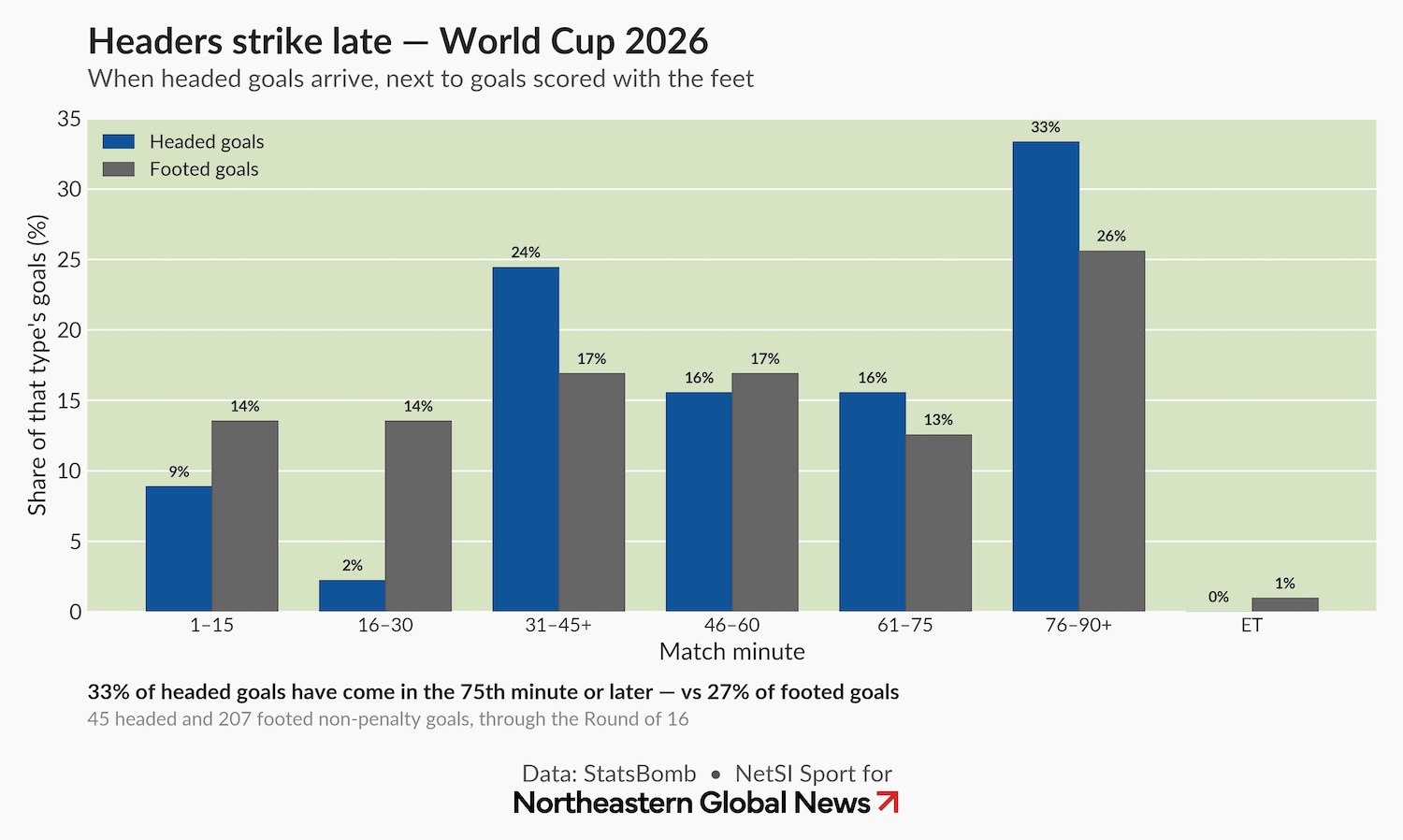
The timing of header goals during the 2026 World Cup provides insight into the psychological and physical demands of the tournament. The NetSI Sport data reveals that 57 percent of all headed goals have occurred toward the end of either the first or second half. This temporal clustering suggests that headers become a primary weapon when tactical discipline begins to fray or when desperation sets in.
"Teams tried to get higher-quality scoring chances toward the end of the halves by moving players higher up the pitch toward the net," the Northeastern researchers noted in their analysis. This maneuver serves two primary purposes: gaining psychological momentum with a goal just before the halftime whistle or attempting to force a result in the closing minutes of regulation.
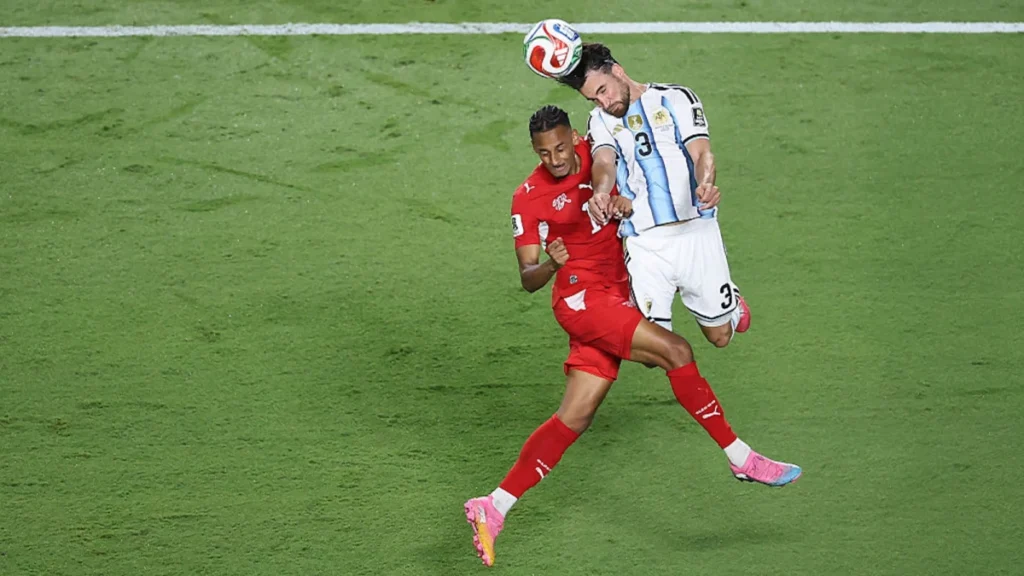
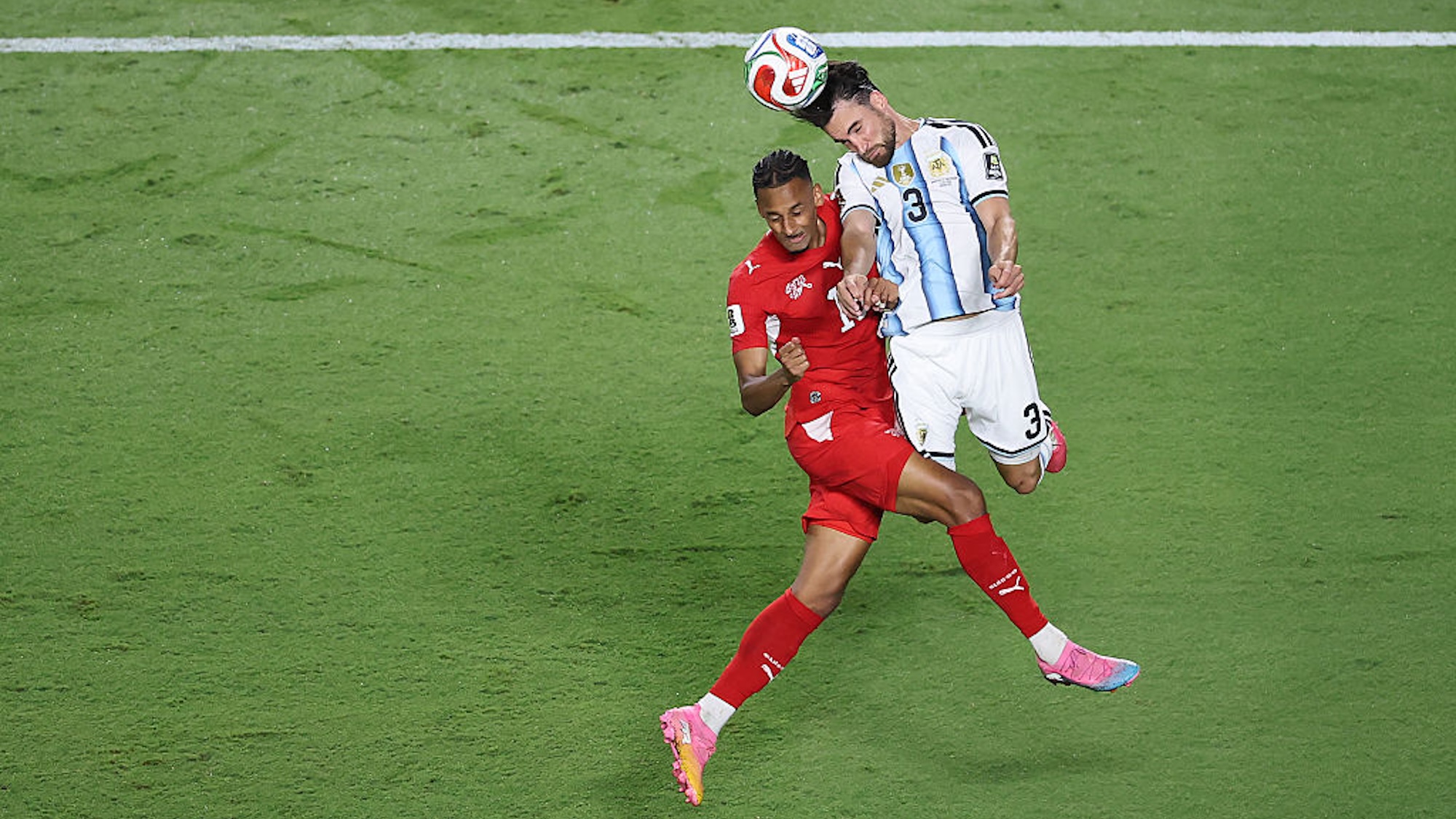
As players fatigue, defensive marking often becomes less stringent, allowing specialists to find space in the box. Furthermore, the "long ball" approach, often criticized for its lack of aesthetic appeal, becomes a pragmatic necessity in the final ten minutes of a knockout match. The 2026 Quarter-Final match between Argentina and Switzerland at Kansas City Stadium served as a prime example of this intensity. Nicolas Tagliafico’s aerial duel against Djibril Sow epitomized the physical toll of these late-game exchanges, where the win or loss of a single header can determine a nation’s advancement.
Set Pieces and the Science of the Setup
The 2026 tournament has seen a renewed focus on the "dead ball" era of soccer. With the expansion of the World Cup to 48 teams, the diversity of tactical styles has increased, yet the set piece remains the great equalizer. Teams that may lack the technical prowess to break down an opponent through 30-pass sequences often rely on the height and timing of their center-backs during corners.
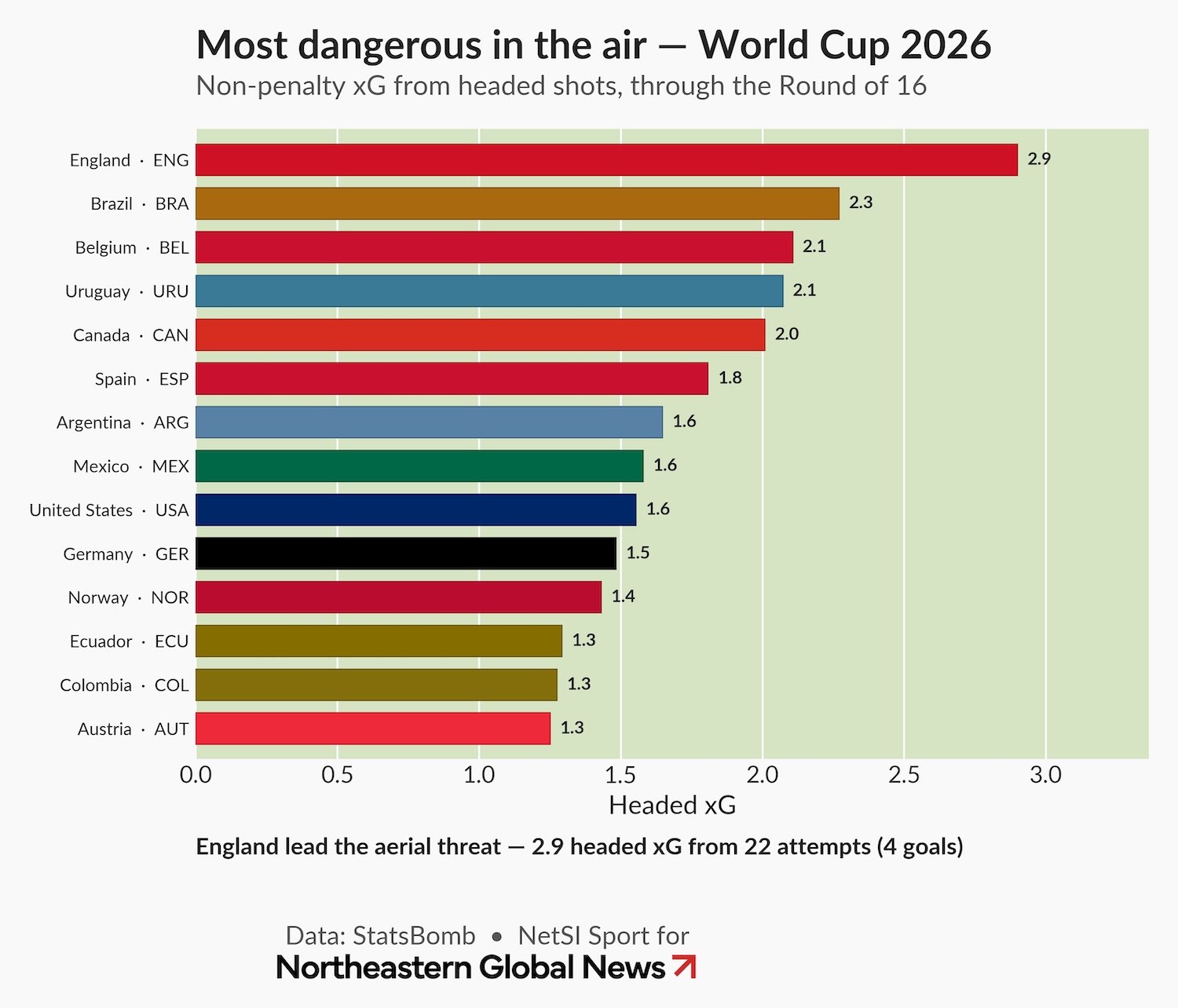
England has emerged as a statistical leader in this category, averaging 2.9 non-penalty headed shots per game through the Round of 16. This reliance on aerial dominance reflects a broader trend among European and North American teams to exploit physical advantages. The data suggests that while the total percentage of header goals is down, the attempt rate remains high for specific squads that prioritize verticality.
The increase in header assists also points to a sophisticated understanding of "expected goals" (xG). Analysts have found that a header directed toward the goal from the edge of the six-yard box has a lower probability of scoring than a header flicked to a striker’s feet three yards out. This "unselfish" use of the head is a defining characteristic of the 2026 tactical landscape.
Health Concerns and the Future of the Header
While the Northeastern University study focuses on the tactical and statistical aspects of the game, the decline in header-assisted goals cannot be divorced from the broader conversation regarding player safety. In recent years, FIFA and various national football associations have implemented stricter protocols regarding concussions and sub-concussive impacts.
In youth academies across Europe and the United States, heading drills have been significantly restricted for players under certain ages. This shift in early-career training is beginning to manifest at the professional level. Players are increasingly developed to prioritize ball control and spatial awareness on the ground. While the 2026 World Cup still features elite aerial specialists, the "all-around" player of the future may be less inclined to engage in high-velocity aerial collisions unless absolutely necessary.
Furthermore, the introduction of more advanced ball technologies has altered the physics of the header. Modern match balls are designed for speed and "knuckling" effects when struck by the foot, which can make their flight paths less predictable for players attempting to meet them with their foreheads. This unpredictability contributes to the 33.5 percent accuracy rate cited by researchers.
Broader Implications for the Final Rounds
As the 2026 World Cup moves into the Semi-Finals and the Final, the role of the header will likely be magnified. History suggests that World Cup Finals are often decided by the narrowest of margins—a single set piece, a deflected cross, or a moment of individual brilliance in the air.
The decline from 23.7 percent to 17.9 percent in header goals may indicate a more "refined" version of soccer, but it also highlights the scarcity and value of a successful aerial attack. For the remaining teams, the ability to convert on that 11 percent possession-conversion rate could be the difference between a podium finish and a premature exit.
The researchers at Northeastern University’s NetSI Sport emphasize that soccer is a fluid sport, where data often lags behind the intuition of the world’s best coaches. If the 2026 tournament concludes with a flurry of headed goals in the final matches, the statistical average may shift back toward historical norms. However, for now, the evidence suggests a sport that is keeping its head but moving the ball with its feet more than ever before.
The 2026 FIFA World Cup has not only been a showcase of athletic excellence but a laboratory for the evolving science of the game. As the tournament draws to a close, fans and analysts alike will be watching the skies above the pitch, waiting to see if the next iconic moment arrives via a clinical strike to the bottom corner or a towering, gravity-defying header that etches a player’s name into the annals of sporting history. Regardless of the outcome, the data from this year’s competition will serve as a benchmark for the next generation of players, coaches, and sports scientists seeking to master the delicate balance between the ground and the air.