




For over a century, the corporate world has invested heavily in leadership training, yet many organizations continue to struggle with a persistent disconnect: the failure of professional development programs to translate into measurable improvements in business performance. Despite the proliferation of competency models and digital learning platforms, the efficacy of these initiatives remains inconsistent. Industry data suggests that while global companies spend upwards of $370 billion annually on corporate training, a significant portion of this expenditure fails to produce a tangible return on investment because the programs are often treated as isolated events rather than systemic business interventions.
The Evolution of Management Training
The history of corporate training began in the early 20th century, heavily influenced by Frederick Taylor’s scientific management theories, which focused on efficiency and standardized processes. In the post-World War II era, the focus shifted toward interpersonal dynamics and emotional intelligence, as popularized by management thinkers like Peter Drucker. By the 1990s and 2000s, the rise of the competency model era sought to codify leadership traits into measurable behaviors.
However, the modern challenge lies in the "copy-paste" fallacy. Many organizations attempt to implement standardized, off-the-shelf management curricula without adapting them to their unique operational context. This often results in a generic experience that fails to address the specific pain points of the business. Evidence indicates that when programs are divorced from a company’s strategic objectives, participant engagement drops, and the application of new skills in the workplace is minimal. True leadership is rarely innate; it is a product of deliberate, systematic development that aligns individual growth with organizational requirements.
A Systemic Framework for Impact
Analysis of programs spanning more than 1,200 leaders across 15 large and medium-sized enterprises reveals that success is not the result of a single workshop or seminar. Rather, it is the product of an interconnected, systemic approach. Organizations that achieve the highest performance gains are those that design their training programs with a focus on business outcomes, not just content delivery.
The design phase must begin with a clear definition of business objectives. Before a single training module is drafted, stakeholders must define the management actions required to meet these objectives, identify the target leadership groups, and establish the KPIs that will track success. When programs are designed as a disparate collection of popular management topics, they lack the logical flow necessary to drive behavioral change. Each module must build upon the last, moving from foundational concepts to complex applications, ensuring that every session answers a critical question: How does this specific change in behavior contribute to the bottom line?
Measuring Success: The Kirkpatrick Model
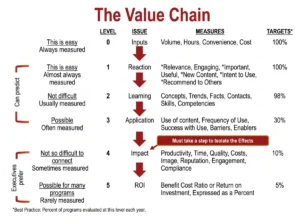
To move beyond anecdotal evidence, organizations are increasingly adopting the Kirkpatrick Model as the gold standard for evaluation. This four-level framework provides a structure for measuring the true ROI of leadership development:
- Reaction: Assessing how participants felt about the training experience.
- Learning: Measuring the increase in knowledge or capability.
- Behavior: Evaluating the extent to which participants apply their new skills on the job.
- Results: Analyzing the impact on business metrics, such as revenue growth, cost reduction, or employee retention.
By defining these metrics during the design stage, rather than as an afterthought, organizations create a roadmap for accountability. If the training does not lead to a shift in business results, the program is fundamentally flawed, regardless of how well it was received by the participants.
The Role of Internal Business Coaches
One of the most effective strategies for ensuring relevance is the deployment of internal business coaches. Unlike external consultants who may lack deep institutional knowledge, internal coaches possess a granular understanding of the company’s culture, historical challenges, and specific market nuances.
By utilizing internal experts, organizations eliminate the common resistance of the "that won’t work in our industry" variety. Internal coaches can ground theoretical concepts in the reality of the company’s day-to-day operations, facilitating a smoother transition from classroom theory to practical application. This approach reduces the friction associated with transferring knowledge across different business sectors and ensures that training content is directly applicable to the company’s current operational landscape.
Leadership Alignment and the Multi-Level Approach
The involvement of senior management in the training of their subordinates is a critical, yet often overlooked, success factor. When senior leaders participate in the same training modules as their direct reports, it serves three strategic purposes:
- Empathy and Mindset Alignment: It provides senior leaders with firsthand insight into the mental models and management techniques being introduced to their teams.
- Shared Language: It fosters a unified management vocabulary across different levels of the hierarchy, preventing misunderstandings and ensuring that everyone is operating from the same set of principles.
- Strategic Modeling: It allows line managers to observe their own supervisors applying these new behaviors, effectively creating a "learning loop" where the management environment itself becomes a vehicle for development.
Practical Application and The "Hand-Written" Requirement
A significant challenge in modern training is the "AI-effect," where participants rely on automated tools to complete assignments, thereby bypassing the cognitive effort required for true learning. To combat this, leading programs are reintroducing the requirement for certain tasks—such as mind maps, personal reflections on management errors, and goal-setting commitments—to be completed by hand.
This is not a Luddite approach; it is a cognitive strategy. Writing by hand engages the brain in a way that typing does not, aiding in the retention of information and the consolidation of complex management theories. Furthermore, by assigning participants the responsibility of teaching what they have learned to their own teams, they are forced to master the material at a deeper level. This pedagogical approach not only reinforces the learning but also builds the leader’s authority and strengthens the overall management culture of the firm.
The Necessity of Executive Advocacy
The ultimate success of any leadership initiative depends on the visible, active support of top management. Executives must provide the ideological and financial backing necessary to sustain the program through its inevitable periods of adjustment. When top management views training as a strategic pillar rather than a discretionary expense, the organization is more likely to provide the resources and bureaucratic support required to see the project through to maturity.
The Broader Implications for Business Strategy
In the current economic climate, leadership development can no longer be viewed as a standalone HR initiative. It must be treated as an essential component of the corporate strategy. Organizations that treat training as a strategic partnership between the L&D department and business units gain a competitive advantage in talent retention, operational agility, and long-term profitability.
As companies navigate an increasingly complex and volatile global market, the ability to build, maintain, and evolve a leadership team is the single greatest determinant of success. By moving away from fragmented, off-the-shelf training and toward a systematic, data-driven, and fully integrated development architecture, companies can ensure that their leaders are not only prepared for the challenges of today but are also capable of steering the organization through the uncertainties of tomorrow. When properly executed, this approach ceases to be a burden and becomes a natural, high-impact component of the company’s growth trajectory.