


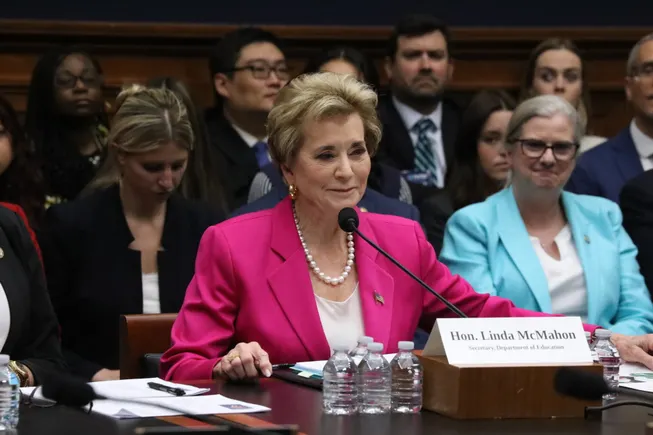
WASHINGTON D.C. – U.S. Education Secretary Linda McMahon presented a robust defense of the Department of Education’s K-12 initiatives during a contentious House hearing on Thursday, highlighting federal block grants aimed at bolstering reading and math achievement. However, her testimony was met with sharp criticism from Democratic lawmakers who questioned the agency’s track record, particularly concerning proposed funding reductions and the slow pace of addressing discrimination complaints. The hearing, which spanned nearly four hours, delved into the Department’s policies, priorities, and its fiscal year 2027 budget proposal, revealing a stark ideological divide between the Republican and Democratic members of the House Education and Workforce Committee.
Secretary McMahon opened her remarks by emphasizing a strategic redirection of resources, stating, "We’ve cut unproductive program funding and redirected those resources to revitalize literacy, invigorate workforce development and support our most vulnerable students." She pointed to state block grants as a cornerstone of this strategy, designed to empower local districts to tailor interventions for reading and math improvement. This approach, she argued, represents a more efficient and effective use of federal funds compared to existing, more prescriptive programs.
The proposed FY2027 budget, which seeks a 3% cut from the FY2026 funding of $79 billion, emerged as a central point of contention. While the proposal aims to maintain Title I funding at $18.4 billion and increase special education funding by $539 million to $16 billion, it also includes plans to consolidate numerous education grant programs into block grants. This consolidation, according to the Department, is intended to streamline federal support and reduce administrative burdens, allowing states greater flexibility in allocating resources. Republicans on the committee largely supported this move, viewing it as a necessary step towards fiscal responsibility and devolving power to the state and local levels.
However, ranking member Bobby Scott (D-Va.) voiced significant concerns, stating, "Today’s hearing has made clear that this administration is amending the Department of Education without regard to the consequences for students and families." His remarks were echoed by other Democrats who challenged the rationale behind program cuts and the perceived weakening of federal oversight in critical areas.
Realigning the Department’s Footprint: Efficiencies or Erosion of Federal Role?
A significant portion of the hearing focused on the Education Department’s use of interagency agreements to transfer certain responsibilities to other federal agencies. The Department has established ten such agreements with five other federal departments, including the Department of Labor and Health and Human Services, to oversee programs related to K-12 academic supports and career and technical education (CTE).
Secretary McMahon defended these agreements as a means to enhance efficiency. She cited the initial agreement with the Department of Labor for CTE activities as already yielding positive results. "We are seeing efficiencies and a more streamlined approach to delivering these vital services," McMahon asserted.
Conversely, Democratic lawmakers, led by Representative Suzanne Bonamici (D-Ore.), characterized these arrangements as potentially "illegal" or "unconstitutional," labeling them as "bureaucracy expansion agreements." Bonamici specifically questioned whether the Department intended to outsource special education responsibilities, a possibility McMahon acknowledged was still under consideration. This prospect drew sharp criticism, with opponents arguing that such a move would undermine federal protections for students with disabilities.
Committee Chair Tim Walberg (R-Mich.) offered a contrasting perspective, commending Secretary McMahon’s efforts. "I appreciate the fact that you are finding creative ways, I believe, totally legal ways, to run your department… with creativity, austerity, with transparency, and with the ability to say we’re going to get the job done," Walberg stated, aligning with the Republican consensus that these actions represent prudent management and a reduction in federal overreach.
Addressing the Civil Rights Backlog: A Deepening Divide
The handling of civil rights complaints within the Office for Civil Rights (OCR) also emerged as a major point of contention. Lawmakers pressed Secretary McMahon on the substantial backlog of cases and the Department’s progress in resolving them.
Earlier testimony indicated that the OCR held approximately 19,000 outstanding civil rights complaints at the beginning of 2025. While McMahon reported that 4,000 of these cases had been addressed, a recent report from the office of Senator Bernie Sanders (I-Vt.) presented a more stark picture, finding that OCR had reached agreements in only 1% of pending cases in 2025. This statistic significantly fueled Democratic concerns about the agency’s effectiveness in upholding civil rights protections.
Representative Mark Takano (D-Calif.) directly challenged McMahon on this issue, questioning the rationale behind laying off OCR employees when such a backlog existed. "You came into office unprepared and didn’t know the importance of OCR, did you?" Takano asked pointedly. "You didn’t rescind this decision until 10 months later." Secretary McMahon responded by affirming her understanding of OCR’s importance.
Further scrutiny arose regarding the FY27 budget proposal’s recommendation to reduce staffing within OCR from 530 in FY25 to 271 in FY27. McMahon clarified that this figure represented a "floor for hiring," suggesting that actual staffing levels might be higher. She reiterated that OCR is "moving expeditiously" to resolve cases, a claim met with skepticism by some committee members. The implications of reduced staffing and a slow resolution rate for civil rights complaints could disproportionately affect marginalized students and educational institutions, potentially leading to prolonged periods of unresolved discrimination.
The Rise of School Choice: Empowering Families or Undermining Public Education?
On the other side of the policy spectrum, Republican lawmakers lauded the introduction of the first nationally available federal private school choice program, scheduled to commence in January. This initiative, supported by the IRS, allows individual taxpayers to make charitable donations that families can then use for K-12 services, including private school tuition and supplementary public school expenses like tutoring.
According to the IRS, nearly 30 states have expressed interest in opting into this program. Secretary McMahon described the tax incentive program as "an opportunity for students and for parents to be able to make sure that their children are not in failing schools." This framing aligns with the administration’s broader emphasis on parental empowerment and market-based solutions in education.
However, Democratic concerns were raised regarding the program’s equity and accessibility. Representative John Mannion (D-N.Y.) inquired whether the federal school choice program would specifically include scholarships designated for low-income families, minority families, or public institutions. Secretary McMahon indicated that states would have the autonomy to establish rules for the scholarship-granting organizations that would administer these programs within their borders, suggesting a decentralized approach to program design and implementation. Critics of school choice programs often point to potential issues such as increased segregation, diversion of funds from public schools, and a lack of accountability for private institutions. The long-term impact of this federal initiative on the public education system and student outcomes remains a subject of ongoing debate and observation.
The hearing underscored the deep partisan divisions on education policy, with Republicans advocating for reduced federal intervention, greater state and local control, and expanded school choice, while Democrats emphasized the need for robust federal oversight, equitable access to resources, and strong protections for civil rights. The coming fiscal year will reveal how these competing visions will shape the landscape of American education.