




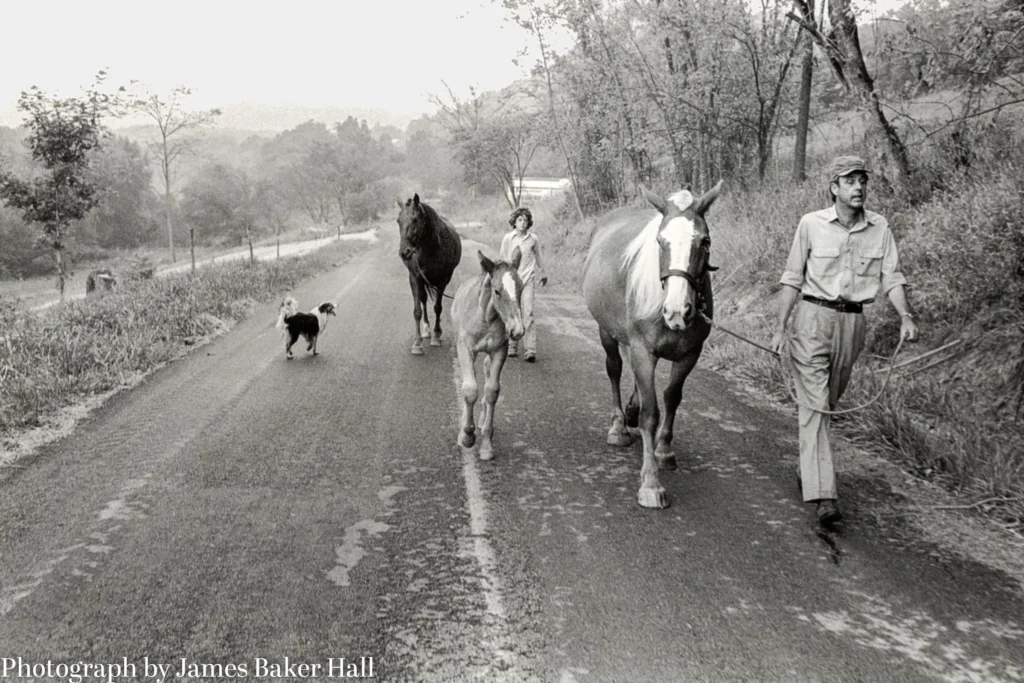
The passing of Wendell Berry at his Port Royal, Kentucky home at the age of 92 marks the conclusion of a life defined by an uncompromising commitment to the soil, traditional craftsmanship, and deliberate simplicity. Over a literary and agrarian career spanning more than seven decades, Berry established himself as one of the preeminent critics of industrial agriculture and a lyrical chronicler of rural American life. Operating largely offline, writing his manuscripts by hand in a non-electrified cabin, and farming his ancestral land using draft horses rather than heavy machinery, Berry presented a radical counter-narrative to modern technological acceleration. Beyond his specific critiques of corporate farming and urban displacement, his life’s work offers a broader philosophical framework for contemporary individuals seeking purpose, intentionality, and depth in an increasingly automated and digitally mediated world.
Chronology and Intellectual Evolution
Born in 1935 in Henry County, Kentucky, Berry’s early trajectory pointed decisively toward the heights of the American academic and literary establishment. He pursued his undergraduate and master’s degrees in English at the University of Kentucky before moving west to Stanford University to study creative writing under the tutelage of prominent literary figures. His early promise was further recognized through a prestigious Guggenheim Fellowship, which enabled him to travel extensively through Italy and France.
Upon returning to the United States, Berry secured an academic post as a professor of English at New York University’s Bronx campus. By all conventional metrics of the era, the young academic was well on his way to securing a permanent place in the upper echelons of metropolitan intellectual life. He had established a family, secured a coveted position in a major New York institution, and gained critical acclaim for his early writing.
However, the trajectory shifted dramatically in 1964. At the age of 29, Berry made the consequential decision to resign from his professorship at NYU and return permanently to Henry County, Kentucky, reconnecting with the agrarian roots of his family, who had farmed the region for generations.
The resignation meeting with his department chair has since entered modern literary folklore. As documented by contemporary commentators and literary historians, Berry’s supervisor attempted to dissuade the young academic from discarding an elite career path. Invoking Thomas Wolfe’s famous dictum that "you can’t go home again," the senior faculty member warned Berry that retreating to rural Kentucky amounted to intellectual suicide—an effective banishment from the cultural centers of the metropolis. Berry, however, remained unmoved. Driven by a deep-seated conviction that authentic writing about human community and landscape required direct, physical engagement with a specific place, he permanently departed the urban academy.
Contextualizing the Agrarian Critique
Berry’s return to Kentucky was not merely a lifestyle preference; it was the foundation for an extensive body of essays, poetry, and fiction that interrogated the systemic costs of industrialization. Throughout the latter half of the 20th century and into the 21st, Berry published dozens of works—including The Unsettling of America: Culture and Agriculture (1977)—in which he argued that the depopulation of rural communities and the rise of corporate agribusiness were degrading not only the American landscape, but the American character.
His insistence on staying rooted was explicitly tied to the integrity of his work. In a 2018 interview with The New York Times, Berry reflected on this decision, noting that physical proximity to his subject matter acted as an essential check on intellectual honesty. By living among neighbors across all walks of life in Henry County, he insulated himself from the abstract theorizing common in metropolitan literary circles, maintaining a direct, empirical connection to the realities of manual labor, local commerce, and ecological stewardship.
Contemporary Implications and the Digital Paradox
Berry’s departure from the metropolitan center in 1964 serves as a striking historical parallel to modern cultural anxieties surrounding digital saturation, alienation, and occupational burnout. In the contemporary landscape, individuals navigate a daily reality shaped by automated convenience, algorithmic curation, and ubiquitous connectivity.
Modern white-collar labor has increasingly evolved into what observers term administrative theater—an endless cycle of digital messaging, virtual meetings, and redundant documentation that generates high levels of cognitive fatigue while producing minimal tangible value. Simultaneously, political discourse has largely migrated to social media platforms, reducing complex structural challenges to performative tribalism. Consumer technology, designed to eliminate friction and cognitive strain, has frequently resulted in widespread psychological numbness and pervasive anxiety.
Berry’s philosophy directly confronts this contemporary condition. Rather than viewing friction, physical labor, and difficulty as hardships to be engineered out of existence, Berry argued that meaningful human agency requires grappling directly with the material world. His rejection of electricity in his writing cabin and his reliance on traditional farming methods were not mere romantic gestures of nostalgia, but deliberate strategies to maintain autonomy over his time, attention, and labor.
Broader Impact and Legacy
The passing of Wendell Berry has prompted widespread reflections from literary critics, environmentalists, and cultural commentators regarding the enduring relevance of his thought. While few individuals possess the specific background or opportunity to abandon urban environments and return to subsistence farming, cultural analysts suggest that Berry’s core lesson transcends geography.
The primary takeaway from Berry’s ninety-two years is the viability of intentional living—the deliberate construction of a life anchored in values larger than career advancement, social status, or digital consumption. By establishing firm boundaries against the rapid technological and economic shifts of his era, Berry demonstrated that deep satisfaction is found not in the continuous accumulation of conveniences, but in sustained fidelity to community, craft, and place.
As modern institutions grapple with the psychological tolls of hyper-connectivity and the erosion of local community ties, Berry’s life stands as a rigorous, enduring reminder of the human scale. His legacy challenges subsequent generations to examine the structural compromises of modern existence and to seek out, within their own spheres of influence, the grounding principles of a deeper, more deliberate life.