



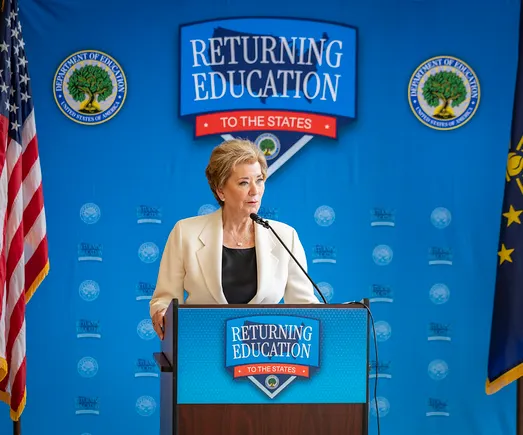
As the federal government continues to systematically reduce its direct footprint in local and state educational policy, the U.S. Department of Education has introduced a new strategic framework designed to assist states in self-directed problem-solving and institutional modernization. Titled the Learning Agenda Playbook, this newly released resource aims to equip state education agencies with the data-driven tools, templates, and methodologies needed to define, track, and achieve localized academic goals independent of heavy-handed federal intervention.
The rollout of the playbook arrives at a critical juncture in American public education. With the executive branch actively pursuing strategies to decentralize authority—and in some cases, exploring avenues to dissolve the Department of Education entirely—states are facing unprecedented responsibilities. The new toolkit is intended to fill a structural gap, providing state-level administrators with structured guidance on literacy initiatives, teacher retention, and inter-agency alignment. By offering adaptable, evidence-based frameworks, federal education officials hope to empower local leaders to optimize funding allocations and improve student outcomes through empirical self-evaluation.
Core Objectives and Structure of the Learning Agenda Playbook
Unveiled during a press briefing by Kirsten Baesler, assistant secretary for elementary and secondary education, the Learning Agenda Playbook provides a structured methodology for state education agencies to formulate strategic questions, gather empirical evidence, and execute policy adjustments. Baesler emphasized that the overarching objective is to grant states the autonomy "to ask and answer their own questions of issues and goals and matters that are most important to those states and local communities."
Unlike rigid federal mandates of past educational eras, the playbook is entirely optional and highly adaptable. It incorporates a wide array of implementation guides, including detailed case studies, administrative templates, and evaluation frameworks. These resources are specifically tailored to assist state departments of education in three primary domains: measuring longitudinal student progress, assessing the efficacy of targeted financial investments, and structuring internal agency operations to better serve local school districts.
The development of the playbook was not an isolated bureaucratic exercise. Over the course of the preceding year, the Department of Education collaborated closely with a diverse cohort of eight pilot states: Arkansas, Georgia, Idaho, Kansas, New Hampshire, Tennessee, Utah, and Wisconsin. These states served as testing grounds for the framework, utilizing the methodologies to address distinct, pressing challenges within their respective educational ecosystems.
In Georgia, for example, state education officials focused the pilot program on identifying and scaling the institutional supports necessary to retain special education teachers—a demographic experiencing severe shortages nationwide. By leveraging administrative data through the playbook’s evaluative models, Georgia’s education staff were able to quantitatively measure the impact of retention initiatives and direct funding toward the most effective programs. Meanwhile, Idaho directed its pilot toward holistic student well-being, utilizing the framework to identify systemic gaps, foster cross-agency collaboration, and align priority areas with available state resources.
Debbie Critchfield, Idaho’s superintendent of public instruction, noted in a September statement that the pilot fundamentally improved communication across various state education teams. According to Critchfield, the structured approach ensured that ongoing initiatives remained focused, coordinated, and directly beneficial to students across the state.
Beyond state-level agencies, the Department of Education anticipates that the playbook will serve as an invaluable asset for technical assistance providers, including the Comprehensive Center Network, Regional Educational Laboratories, and independent educational research organizations. These entities frequently partner with state governments to diagnose operational inefficiencies and design remedial interventions.
Background Context: Shrinking the Federal Educational Footprint
The debut of the Learning Agenda Playbook occurs against a backdrop of profound administrative transformation within the federal government. For decades, the U.S. Department of Education has operated as a central pillar of federal policy, wielding significant influence through the administration of Title I funding, civil rights enforcement, and nationwide academic standards. However, the political landscape has shifted dramatically.
During the second Trump administration, federal policy regarding public education has pivoted toward aggressive decentralization. While the complete dissolution of the Department of Education requires an act of Congress—as the agency was established by statute via the Department of Education Organization Act of 1979—the executive branch has exercised its administrative authority to drastically downsize the agency. Over the past year, the department has reduced its workforce by approximately 50%, eliminating hundreds of positions previously dedicated to technical assistance, grant administration, and national educational research.
In tandem with workforce reductions, the department has issued widespread waivers exempting numerous states from stringent federal accountability benchmarks and fiscal maintenance-of-effort requirements. Furthermore, the administration has formalized 14 interagency agreements designed to transfer day-to-day operational responsibilities—such as federal grant management, specialized program monitoring, and localized technical support—to six other federal agencies, including the Department of Health and Human Services and the Department of Labor.
While the Department of Education retains formal statutory responsibility for the programs being outsourced, the practical administration of federal education policy has fractured across multiple bureaucratic lines. Proponents of these sweeping changes argue that interagency partnerships will ultimately foster better coordination, yielding improved academic, career, and life outcomes for students by treating education as one component of holistic youth development.
Stakeholder Perspectives and Bipartisan Collaboration
The creation of the playbook itself involved broad cooperation between federal officials and external education policy experts. Heather Boughton, associate director of state policy at the Alliance for Learning Innovation, participated directly in the working group that helped draft the resource. The Alliance operates as a bipartisan coalition comprising more than 150 organizations dedicated to advancing rigorous education research and development.
Boughton highlighted a structural vulnerability common to most state education agencies: the near-total absence of dedicated, in-house research and development departments. Unlike private corporations or large municipal governments, state departments of education are frequently understaffed and reactive rather than proactive in their policy design. The playbook, Boughton explains, provides a systematic workaround by guiding agencies through the process of formulating precise questions, drafting execution plans, and translating findings into actionable policy.
"It’s important for states to be transparent about what they’re learning, to be open about that with their communities, and then having those answers at hand allows them to make strategic targeted investments where their schools and districts and students need it most," Boughton stated during discussions surrounding the playbook’s release. She underscored that bridging the gap between state agencies, local stakeholders, and academic research partners is essential for long-term academic recovery.
Critical Analysis: Implications and Systemic Concerns
Despite the optimistic framing provided by federal officials and contributing policy groups, the broader implications of the Department of Education’s strategic retreat have generated intense debate among educators, civil rights advocates, and federal lawmakers.
Critics of the administration’s downsizing strategy argue that shifting complex administrative duties to states—while simultaneously dismantling federal oversight and technical support—creates a dangerous vacuum. A central concern voiced by several major education organizations and Democratic lawmakers is that the vast majority of state education agencies simply lack the institutional capacity, specialized personnel, and financial resources to duplicate the services traditionally rendered by the federal government.
For decades, the Department of Education served as a clearinghouse for best practices, civil rights compliance, and specialized technical expertise, particularly in vulnerable areas such as special education and Title I funding for low-income districts. Civil rights groups have expressed deep apprehension that the dilution of federal oversight will exacerbate educational inequities, leaving marginalized student populations without adequate federal safeguards against systemic funding disparities or discriminatory practices.
Moreover, the rapid transition of program administration to other federal agencies has triggered significant administrative confusion within the K-12 public school system. School districts accustomed to dealing with a single federal point of contact now navigate a fragmented landscape involving multiple agencies, each with differing compliance standards and bureaucratic protocols. In response to these growing concerns, bipartisan legislation has been introduced in the House of Representatives aimed at halting or restricting the ongoing outsourcing of special education and federal grant management responsibilities.
Legal challenges have also emerged, with various coalitions filing lawsuits to contest the legality of certain waivers and interagency transfers executed by the executive branch. Plaintiffs in these legal battles argue that bypassing established statutory procedures to alter the operational scope of the Department of Education violates administrative law.
The Road Ahead for State-Led Education Reform
As the dust settles from these sweeping federal realignments, the success of initiatives like the Learning Agenda Playbook remains to be seen. For states that possess robust administrative infrastructures and sophisticated data systems, tools like the playbook may serve as welcome catalysts for localized innovation, granting leaders the flexibility to tailor programs to specific regional needs without navigating burdensome federal red tape.
Conversely, for under-resourced states with chronic teacher shortages, underfunded rural districts, and overburdened administrative staffs, the transition toward radical self-reliance may prove exceedingly difficult. Without robust technical assistance and sustained financial backing, the freedom to "ask and answer their own questions" risk becoming an empty exercise for states struggling simply to maintain daily operational continuity.
Ultimately, the release of the Learning Agenda Playbook encapsulates the defining tension of contemporary American education policy: a high-stakes experiment in decentralization that promises unprecedented local autonomy while simultaneously stripping away the traditional safety nets and infrastructural supports upon which generations of public school systems have relied.