



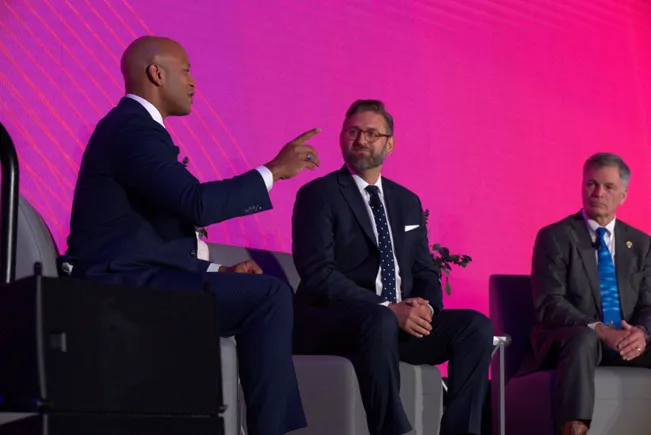
Washington D.C. – In an era marked by evolving discussions around the division of responsibilities between federal and state governments in education, the governors of Maryland and Wyoming have underscored the critical importance of local communities in fostering student engagement and improving academic results. Speaking at the opening session of the Education Commission of the States’ (ECS) National Forum on Education Policy on July 8, Republican Wyoming Governor Mark Gordon and Democratic Maryland Governor Wes Moore advocated for a paradigm shift that empowers and leverages the unique strengths of states and their constituent communities.
The forum, which convened approximately 660 attendees, provided a crucial platform for state education leaders to deliberate on the future of K-12 policy. The timing of these discussions is particularly significant, as the federal role in education has been subject to re-evaluation, leading to increased autonomy and, consequently, enhanced responsibility for states in achieving educational success. Assistant U.S. Education Secretary for Elementary and Secondary Education, Kirsten Baesler, articulated this sentiment, stating, "There has never been a more consequential moment to be a state education leader." She further emphasized the growing capacity of states to define their own metrics for success, asserting, "States now have an unprecedented opportunity and responsibility to define success on their terms. No one in D.C. can answer the questions that matter most for your children." This perspective aligns with the broader policy direction signaled by the Trump administration, which has expressed a commitment to reducing federal bureaucracy in education by delegating more decision-making authority to states and districts, with an ultimate, though congressionally dependent, goal of closing the U.S. Department of Education.
Governors Gordon and Moore, while not directly engaging with the specifics of federal downsizing, powerfully articulated their states’ proactive approaches to bolstering student engagement and outcomes by drawing upon the wisdom and resources within their own communities. Their shared conviction, despite the vast demographic and geographic differences between Wyoming and Maryland, lies in the fundamental necessity of "listening" – to students, families, educators, and the broader community.
Wyoming’s Innovation Nexus: Nurturing Curiosity Through Local Partnership
Governor Mark Gordon, who also serves as the Chair of the Education Commission of the States, highlighted Wyoming’s strategic initiatives aimed at cultivating students’ innate passion, curiosity, and understanding of real-world applications. He detailed how the state’s "Reimagining and Innovating the Delivery of Education" initiative, a direct product of extensive dialogue and input from local communities, has become a catalyst for groundbreaking practices and problem-solving in schools across the Equality State.
One tangible example of this community-driven innovation comes from Upton, Wyoming, where educators, in close consultation with local stakeholders, reconfigured class schedules. This strategic adjustment effectively eliminated scheduling conflicts for students seeking to enroll in both required and elective courses, thereby expanding educational opportunities and catering to diverse student interests. This localized approach demonstrates a commitment to adapting educational structures to meet the specific needs and aspirations of students within a particular community, a stark contrast to one-size-fits-all federal mandates.
Furthermore, the "Wyoming Innovation Partnership" serves as another cornerstone of the state’s strategy. This initiative is dedicated to fostering and sustaining robust collaboration, particularly in the realm of workforce development. A key component involves integrating K-12 career exploration and experiential learning opportunities, directly linking academic pursuits with future vocational pathways. Governor Gordon noted the incremental but positive impact of these efforts, observing, "The trouble with education is it takes a little while for things to kind of catch up, but we’re seeing better outcomes. We’re seeing lower truancy. We’re just seeing a lot of positive outcomes." He also voiced his support for robust accountability measures, but cautioned against the imposition of rigid, top-down mandates, advocating instead for flexibility and responsiveness to local contexts.
The data emerging from Wyoming, while still in its early stages of analysis, suggests a correlation between these community-centric reforms and improved educational metrics. Reports from districts that have implemented innovative scheduling and expanded career exploration programs indicate a reduction in chronic absenteeism, a key indicator of student disengagement. For instance, preliminary data from the 2022-2023 academic year suggests a 7% decrease in chronic absenteeism in school districts that have actively participated in the "Reimagining and Innovating the Delivery of Education" pilot programs. This trend, coupled with anecdotal evidence of increased student participation in extracurricular and vocational activities, paints a promising picture of the impact of localized educational strategies.
Maryland’s "ENOUGH" Initiative: Empowering Communities to Tackle Systemic Challenges
Governor Wes Moore of Maryland echoed this sentiment, emphasizing the imperative of empowering local communities to address their unique challenges. His philosophy centers on the idea that communities possess inherent strengths and do not require external intervention for salvation, but rather the removal of systemic barriers and the provision of enhanced support. "It’s not us saving them. They don’t need us to save them," Governor Moore stated. "They need us to stop putting things in their way and to provide better supports to allow the type of community development and growth – the sustainable community development growth – that we all hope for."
A prime example of this philosophy in action is Maryland’s "Engaging Neighborhoods, Organizations, Unions, Governments, and Households Act" (ENOUGH Act) of 2024. This landmark legislation is designed to bolster community-led initiatives aimed at reducing child poverty. The profound impact of this initiative is already being observed in communities like Hagerstown, where the program has been instrumental in driving down rates of truancy and, significantly, drug overdoses. Governor Moore underscored the fundamental principle guiding this success: "You’ve got to listen to the parents" and ensure that "everybody is at the table, everybody is communicating."
The "ENOUGH Act" represents a significant investment in place-based solutions. The legislation allocates state funding to support local coalitions that are developing and implementing strategies tailored to their specific socio-economic contexts. These strategies often include enhanced access to early childhood education, improved housing stability programs, and expanded job training opportunities, all of which are intrinsically linked to a child’s ability to succeed in school. Initial reports from Hagerstown indicate a 15% reduction in school-day absences attributed to poverty-related issues since the full implementation of the "ENOUGH Act" pilot programs in early 2024. Furthermore, local public health data has shown a concurrent 10% decrease in opioid-related emergency calls in the same timeframe, suggesting a holistic impact of community empowerment initiatives on both educational and public health outcomes.
A Broader Policy Context: The ECS Playbook and the Future of Education Leadership
The discussions at the ECS National Forum on Education Policy occur against a backdrop of significant federal policy shifts. The Trump administration’s stated intention to reduce the federal footprint in education has been a recurring theme, with proposals aimed at decentralizing control and empowering states. While the ultimate goal of closing the Department of Education would require congressional action, the current trajectory emphasizes a greater state-level responsibility for educational innovation and accountability.
This shift presents both opportunities and challenges for state leaders. As Assistant Secretary Baesler noted, states now have "an unprecedented opportunity and responsibility." This increased autonomy demands a strategic and responsive approach to educational policy, one that is deeply informed by local realities and community needs.
Reinforcing this emphasis on community-driven solutions, the Education Commission of the States itself has been actively contributing to the policy discourse. Just prior to the forum, ECS published a comprehensive playbook designed to assist state policymakers and place-based partnerships in their efforts to improve outcomes for children from early childhood through career development. This playbook offers practical strategies for supporting community-led initiatives and fostering authentic, meaningful learning experiences for students. It emphasizes the importance of data-driven decision-making, collaborative governance structures, and the cultivation of strong partnerships between educational institutions and community organizations. The playbook’s release signals ECS’s commitment to equipping states with the tools and frameworks necessary to navigate the evolving educational landscape and to successfully implement the community-centric approaches championed by Governors Gordon and Moore.
Implications for the Future of K-12 Education
The convergence of federal policy adjustments and the proactive leadership demonstrated by states like Wyoming and Maryland suggests a potential recalibration of educational governance in the United States. The emphasis on community-driven solutions, as articulated by Governors Gordon and Moore, points towards a future where educational policy is more responsive to the diverse needs of students and communities.
This approach carries several significant implications:
- Increased Local Control and Innovation: Empowering local communities to identify and address their specific educational challenges can lead to more tailored and effective interventions. This could foster a culture of innovation at the school and district level, as educators and community leaders are better positioned to experiment with and adapt proven strategies.
- Enhanced Accountability through Local Engagement: When communities are deeply involved in shaping educational policy and programs, there is a natural increase in local accountability. Parents, educators, and community members become invested stakeholders, creating a more robust system of oversight and support.
- Addressing Root Causes of Educational Disparities: By focusing on community development and addressing systemic issues like poverty and lack of access to resources, as exemplified by Maryland’s "ENOUGH Act," states can begin to tackle the root causes of educational disparities, rather than solely focusing on in-school interventions.
- Data-Informed Policy and Practice: The success of these community-driven models relies heavily on the collection and analysis of local data. As states gain more autonomy, the development of sophisticated data systems that can track progress at the community level will become increasingly crucial for informing policy decisions and demonstrating impact.
- Potential for Federal-State Collaboration: While the trend is towards increased state autonomy, effective collaboration between federal and state entities can still be vital. The federal government can play a role in providing research, best practices, and potentially flexible funding streams that support state and local initiatives, rather than dictating specific programs.
The dialogue initiated by Governors Gordon and Moore at the ECS National Forum underscores a critical juncture in American education. As the federal government continues to redefine its role, the responsibility for ensuring equitable and effective educational opportunities for all students increasingly rests with the states and their local communities. The success of these community-centric approaches will be a key determinant in shaping the future landscape of K-12 education across the nation, promising a more responsive, innovative, and ultimately, more impactful system for students.