


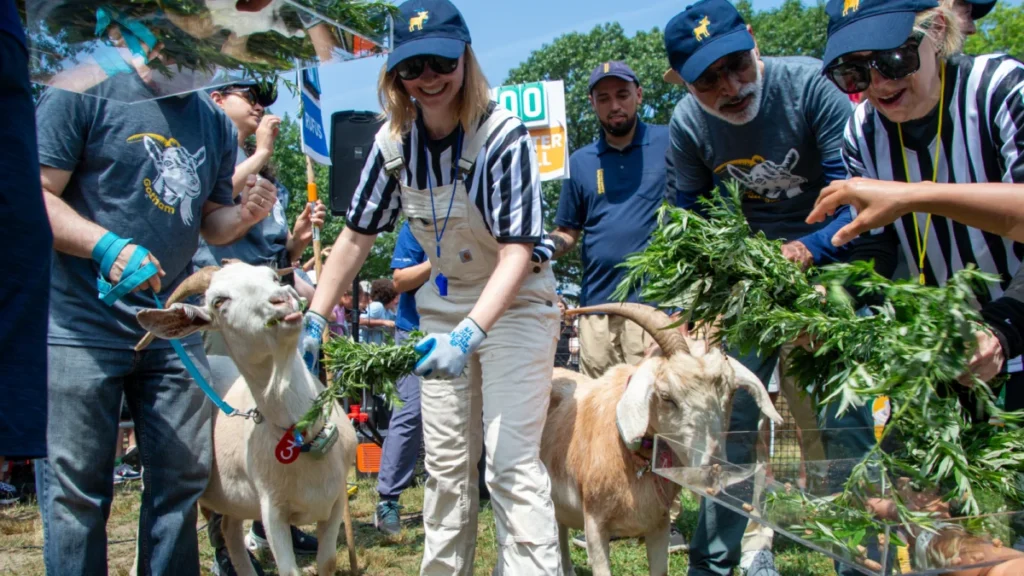
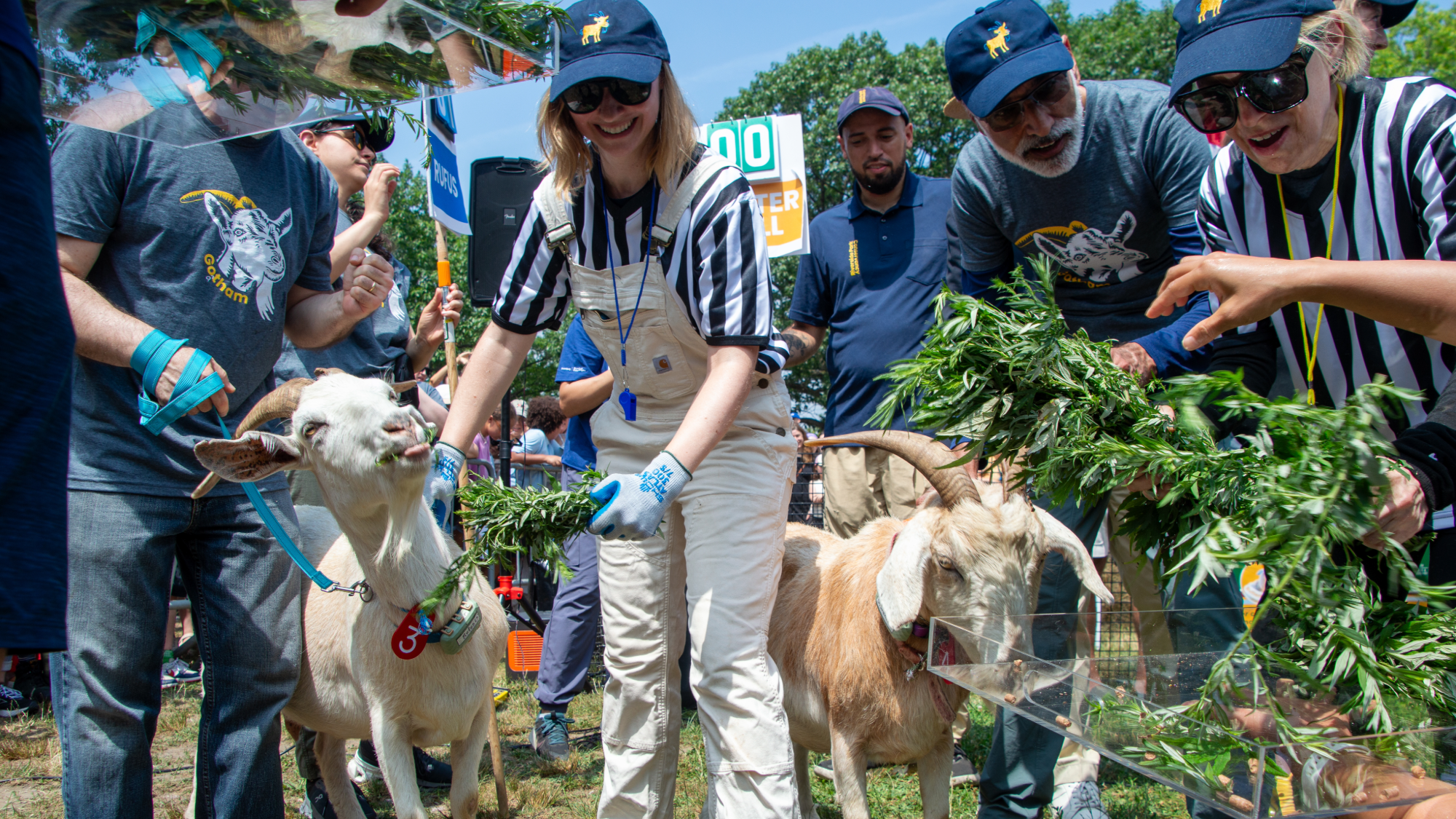
The competitive eating circuit in the United States reached a unique milestone this July as the Riverside Park Conservancy hosted the second annual Great Goat Graze-Off in West Harlem. In a display of biological efficiency and focused consumption, the returning champion, a goat named Mallomar, successfully defended his title against a field of formidable contenders, including challengers Romeo and Big Buddy. According to official statistics released by the Riverside Park Conservancy, Mallomar consumed 1.5 packets of invasive weeds within a strictly timed three-minute window, solidifying his reputation as the premier "G.O.A.T." (Greatest of All Time) in the world’s only professional goat-eating competition.
The event, held against the backdrop of Manhattan’s scenic Hudson River waterfront, was moderated by George Shea, the long-time host of the world-famous Nathan’s Famous Fourth of July International Hot Dog Eating Contest. Shea brought his signature theatrical flair to the proceedings, elevating the ecological management task into a high-stakes sporting event that drew crowds of local residents, environmentalists, and curious tourists. While the atmosphere was celebratory, the underlying purpose of the Graze-Off serves a critical function in the ongoing restoration of New York City’s urban forest and parkland.
Chronology of the 2025 Graze-Off and the "Goatham" Initiative
The Great Goat Graze-Off is the centerpiece of a larger land management strategy known as "Goatham," which the Riverside Park Conservancy launched several years ago to address the proliferation of invasive plant species. The 2025 season began in early summer when a "herd" of goats was transported to the park to begin their seasonal work. Unlike traditional lawn maintenance, which relies on gas-powered machinery and human labor, the goats are deployed to specific, hard-to-reach zones within the park’s 150-acre footprint.
The competition itself took place in mid-July, strategically timed when invasive vegetation is at its peak growth. The three finalists—Mallomar, Romeo, and Big Buddy—were selected based on their performance during the preliminary grazing weeks. On the day of the Graze-Off, the goats were presented with controlled portions of invasive greenery. Mallomar’s victory was attributed not just to speed, but to a "calm, steadfast nature," as described by park officials. While other goats might be distracted by the cheering crowd or the presence of cameras, Mallomar remained focused on the task, a trait the Conservancy notes provides a sense of security and leadership for the rest of the herd.
Following the competition, the goats do not return to a farm immediately; rather, they continue their "employment" through the remainder of the summer. This sustained grazing is essential for the long-term eradication of hardy invasive species that have plagued the park’s ecosystem for decades.
The Science of Biological Control: Why Goats are Essential
The use of goats for land management, a practice formally known as prescribed grazing or targeted grazing, is a form of biological control that offers several advantages over mechanical or chemical interventions. Riverside Park features a unique and challenging topography, including steep rock outcroppings and "Manhattan schist" cliffs that are inaccessible to standard mowing equipment and dangerous for human groundskeepers to navigate.
Invasive species such as Japanese knotweed, porcelain berry, English ivy, and multiflora rose have historically dominated these slopes. These plants are notorious for their rapid growth and ability to choke out native flora, reducing local biodiversity. The goats, however, are natural climbers with a preference for these specific types of vegetation.
The Riverside Park Conservancy explains that the goats’ impact is cumulative. Throughout the season, the animals consume the weeds down to the root level. This process forces the plants to exhaust their stored energy reserves to regrow. When the goats return to eat the new growth, the plants are further weakened. Over several consecutive seasons, this cycle of consumption stunts the plants’ normal growth trajectory to the point where they can no longer compete with native species. Eventually, the invasive population is either significantly reduced or eliminated entirely, allowing for the reintroduction of native trees and shrubs.
Furthermore, goats possess a unique digestive system that is particularly well-suited for this task. As ruminants, their multi-chambered stomachs and the high heat of their digestive tracts are capable of neutralizing the seeds of many invasive plants. While other animals might spread weeds through their waste, goats effectively "sterilize" the material they consume. Additionally, their manure serves as a high-quality, natural fertilizer that enriches the soil with nitrogen and organic matter, fostering a healthier environment for future native plantings.
Economic and Environmental Impact Data
The shift toward "Goatham" represents a move toward more sustainable and cost-effective urban park management. While the initial costs of transporting and fencing the goats are notable, they are often offset by the reduction in labor hours and the elimination of expensive, synthetic herbicides.
Data from various urban forestry initiatives suggest that biological grazing can reduce the need for chemical applications by up to 80% in targeted areas. In a densely populated environment like New York City, the elimination of glyphosate and other herbicides is a significant public health benefit, ensuring that the soil and groundwater remain free of toxic runoff.
The Riverside Park Conservancy has noted that the goats’ presence also allows human staff and volunteers to reallocate their time toward more complex restoration tasks, such as "forest bathing" initiatives, trail maintenance, and the careful planting of native saplings. The goats act as a "first-wave" force, clearing the path for human-led ecological refinement.
Official Responses and Community Engagement
The success of the 2025 Graze-Off has garnered praise from city officials who see the program as a model for innovative urban governance. Tricia Shimamura, the NYC Parks Commissioner, emphasized the dual benefit of the program in a statement following the event.
"At NYC Parks, we’re always looking for innovative ways to care for our green spaces, and these goats have certainly earned their place on the team," Shimamura stated. "Whether they’re competing in the Graze-Off or hard at work clearing invasive plants, they’re making our parks healthier while giving New Yorkers a reason to smile."
The "reason to smile" aspect is not merely a sentimental observation. The Goatham project has become a significant tool for community engagement and environmental education. The Conservancy uses the goats to teach local students about ecology, life cycles, and the importance of biodiversity. The goats serve as "charismatic megafauna" that bridge the gap between urban residents and the natural world, making the abstract concept of "invasive species management" tangible and entertaining for the public.
Broader Implications for Urban Land Management
The Great Goat Graze-Off is part of a growing trend across North America where municipalities are rediscovering ancestral agricultural techniques to solve modern environmental problems. Cities like San Francisco, Chicago, and Atlanta have also experimented with "goat-scaping" to manage fire-prone brush and invasive weeds in public spaces.
The success of Mallomar and his peers in Riverside Park demonstrates that biological solutions can be integrated into even the most densely populated urban centers. As cities face the dual challenges of climate change and budget constraints, the "Goatham" model provides a blueprint for resilient, low-impact land management.
Analysis of the program suggests that its success relies on three pillars:
- Targeted Application: Using goats specifically for terrain and plant species where they have a natural advantage.
- Public Integration: Turning maintenance into a public event to build support and funding for park conservancy.
- Iterative Restoration: Recognizing that ecological health is a multi-year process that requires consistent pressure on invasive populations.
As Mallomar returns to his duties in the quieter corners of Riverside Park, his victory serves as a reminder of the power of nature-based solutions. The 2025 Great Goat Graze-Off was more than a spectacle; it was a demonstration of a working partnership between the city’s human stewards and its four-legged workforce. The Riverside Park Conservancy plans to continue the program into the 2026 season, with Mallomar expected to return to defend his title for a third consecutive year, continuing his reign as the champion of West Harlem’s greenery.