


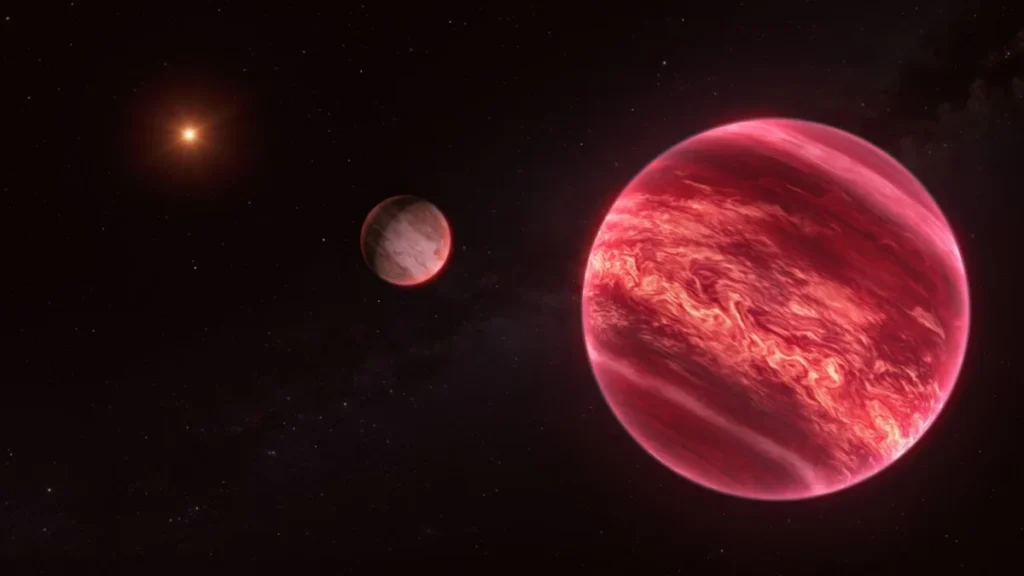
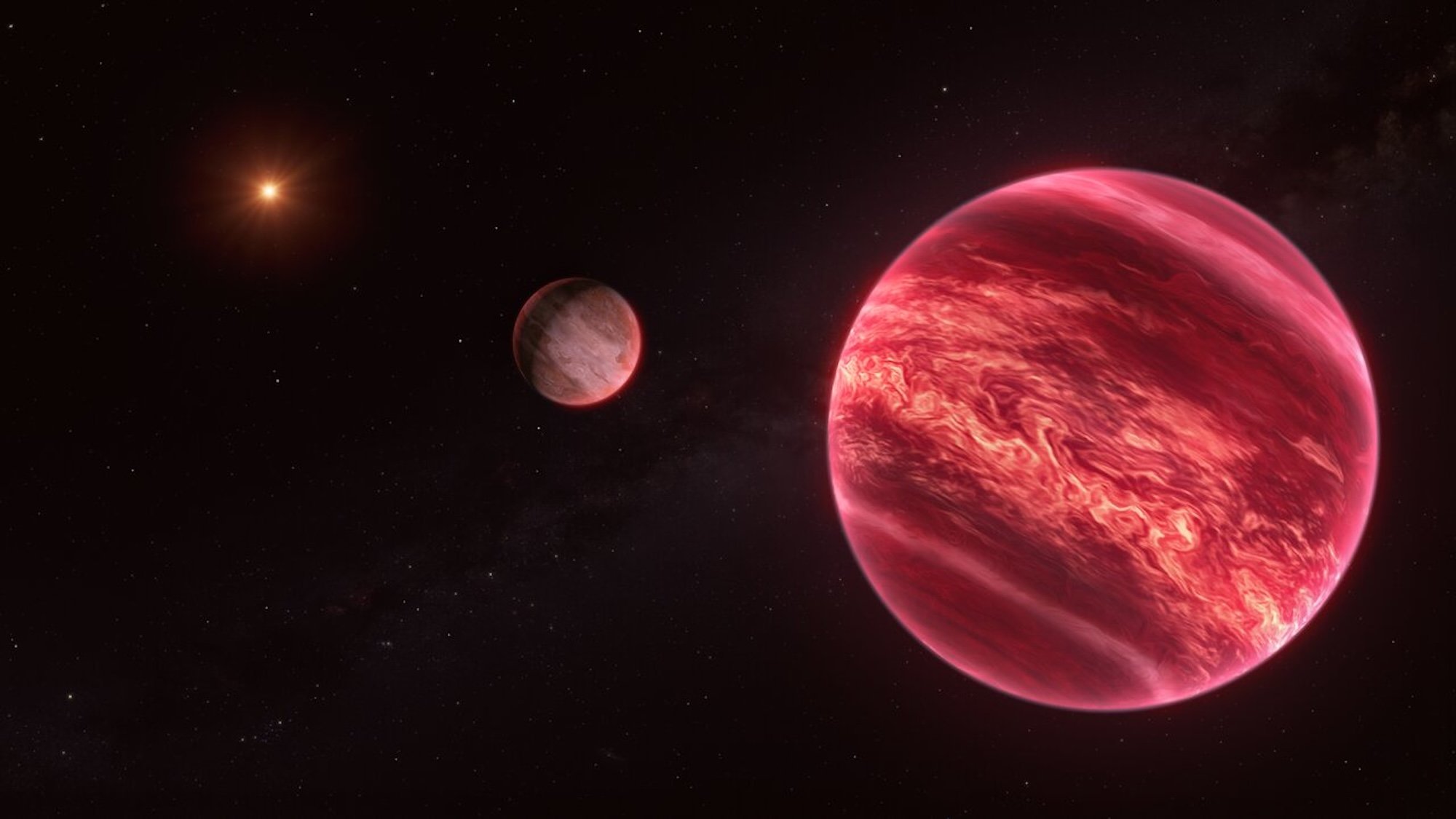
The discovery of a celestial arrangement located approximately 72 light-years from Earth has prompted a significant reassessment of how astronomers define planets, moons, and stars. Utilizing the European Southern Observatory’s Very Large Telescope (VLT), an international team of researchers has identified a system centered on the star CD-35 2722 that defies the standard hierarchical structures observed within our own solar system. The system features a primary star orbited by a massive brown dwarf, which is itself orbited by an object with the mass of Jupiter. This configuration, described by lead researchers as "super weird," represents what may be the first confirmed detection of an exosatellite—a moon existing outside our solar system—though its immense scale challenges the very definition of the term.
The findings, recently published in the journal Nature, highlight the complexities of deep-space observation and the limitations of current astronomical nomenclature. Led by Kevin Hoy of Chile’s Universidad Diego Portales and the Millennium Nucleus of Young Exoplanets and their Moons (YEMS), the study suggests that the universe is capable of producing gravitational relationships far more diverse than the Sun-planet-moon model familiar to humanity.
Architectural Overview of the CD-35 2722 System
To understand the uniqueness of CD-35 2722, one must first look at the scale of its components. The primary star is a relatively young M-dwarf, possessing roughly half the mass of our Sun. While M-dwarfs are the most common type of star in the Milky Way, the objects trapped in its gravitational influence are far from ordinary.
The first companion, CD-35 2722B, is a brown dwarf. In the spectrum of celestial bodies, brown dwarfs occupy a "middle ground" between the largest gas giant planets and the smallest stars. They are often referred to as "failed stars" because, while they are massive enough to undergo deuterium fusion, they lack the requisite mass to sustain the hydrogen fusion that powers stars like the Sun. This specific brown dwarf is estimated to be approximately 37 times more massive than Jupiter.
The breakthrough discovery involves the third object in this hierarchy: a companion orbiting the brown dwarf. This tertiary body possesses a mass roughly equivalent to Jupiter. In any other context, an object of this mass orbiting a star would be classified unequivocally as a planet. However, because it orbits a brown dwarf—which is itself orbiting a primary star—it technically occupies the orbital niche of a moon.
Chronology of the Discovery and Methodology
The identification of the CD-35 2722 system was the result of a multi-year effort involving high-contrast imaging and precision spectroscopy. The timeline of the discovery reflects the increasing capabilities of ground-based observatories.
- Initial Surveying: The star CD-35 2722 was first noted in wide-field surveys as a young, nearby M-dwarf, making it a prime candidate for exoplanet hunting due to its proximity and the relative ease of spotting large companions around smaller stars.
- Brown Dwarf Identification: Earlier observations confirmed the presence of the 37-Jupiter-mass brown dwarf. At the time, the system was viewed as a standard binary arrangement consisting of a star and a substellar companion.
- VLT Integration: Kevin Hoy and his colleagues utilized the European Southern Observatory’s Very Large Telescope, located in the Atacama Desert in Chile. By employing the VLT’s advanced imaging instruments, which are designed to filter out the overwhelming light of a primary star to see the much dimmer objects nearby, the team detected a faint signature near the brown dwarf.
- Data Verification: Over several observation cycles, the team confirmed that the smaller object was gravitationally bound to the brown dwarf rather than the primary star. This distinction is what moved the object from the category of "planet" to "exosatellite."
- Publication: Following rigorous peer review, the team’s findings were published in Nature in early 2026, officially introducing the "super weird" system to the broader scientific community.
Supporting Data and Technical Analysis
The detection of exomoons has long been a "holy grail" for astronomers. While more than 6,000 exoplanets have been confirmed since the 1990s, exomoons have remained elusive due to their smaller size and the difficulty of distinguishing their signal from that of their host planet.
In the case of CD-35 2722, the "moon" was detectable primarily because of its massive scale. A Jupiter-mass object is significantly easier to image than a rocky, Earth-sized or Moon-sized satellite. According to the data provided by YEMS, the gravitational relationship between the brown dwarf and its Jupiter-mass companion is stable, but it raises questions about the formation of such systems.
In our solar system, moons typically form in one of three ways: co-accretion (forming from a disk of gas and dust alongside the planet), capture (a passing object being pulled in by gravity), or giant impact (debris from a collision coalescing into a satellite). The Jupiter-mass object orbiting CD-35 2722B is so large that it may have formed through a process more akin to how binary stars form—collapsing from a single cloud of gas that fragmented into two distinct pieces.
Official Responses and Scientific Semantics
The ambiguity of the system has sparked a lively debate among astrophysicists regarding classification. Kevin Hoy noted that the system is difficult to define using "solar system-based words." The term "exosatellite" is technically accurate, as the object orbits a secondary body rather than the primary star, yet the mass of the object suggests it is a planet in its own right.
Alice Zurlo, the director of YEMS and co-author of the study, emphasized that the discovery blurs the lines between stars, planets, and moons. "In the CD-35 2722 system… the whole thing becomes more complicated to describe," Zurlo stated. She further explained that while the scientific community might want to call it a moon because it is the "third wheel" in the system, it bears no physical resemblance to the small, rocky moons like those orbiting Earth or Mars.

Other researchers in the field, while not directly involved in the study, have reacted with cautious optimism. Many suggest that this system might be better classified as a "triple substellar system" or a "binary planet system orbiting a star," rather than a star-planet-moon system. However, the consensus remains that this is the most plausible detection of an exosatellite to date, surpassing previous candidates that relied on less direct evidence.
Broader Impact and Future Implications
The discovery of the CD-35 2722 system has profound implications for our understanding of planetary formation and the potential for life in the universe. If a brown dwarf can host a Jupiter-mass companion, it stands to reason that other substellar objects could host smaller, Earth-sized moons.
In recent years, the concept of "habitable moons" has gained traction. While a brown dwarf does not emit the same level of heat or light as a sun-like star, the gravitational tidal forces exerted on a moon can generate internal heat, potentially allowing for liquid water. While the Jupiter-mass object in this system is a gas giant and unlikely to host life as we know it, its existence proves that massive satellites can and do exist around substellar hosts.
Furthermore, this discovery sets the stage for future observations using the James Webb Space Telescope (JWST) and the upcoming Extremely Large Telescope (ELT). These instruments will be able to analyze the atmosphere of the Jupiter-mass companion, looking for chemical signatures that could reveal how it formed.
As astronomers continue to probe the depths of the galaxy, the CD-35 2722 system serves as a reminder that the universe is not obligated to conform to the categories humans have created. The "super weird" arrangement 72 light-years away is a testament to the diversity of cosmic architecture and a significant milestone in the ongoing quest to map the complexities of the Great Beyond. For now, the scientific community will continue to monitor the system, seeking to refine the definitions that currently struggle to contain the reality of this extraordinary discovery.