

The German verb haben, translating to "to have," functions as the foundational cornerstone of the German language. Beyond its role as a lexical verb denoting possession, it serves as the primary auxiliary verb required to construct the Perfekt tense—the most prevalent method for expressing past events in both formal and colloquial German. For learners and linguists alike, internalizing the conjugation and usage of haben is not merely an academic exercise; it is a prerequisite for communicative fluency. Because haben appears in nearly every conversation, mastering its irregular forms and specific idiomatic applications provides the necessary framework to navigate the complexities of German syntax.
The Historical and Linguistic Context of Haben
The evolution of haben is a case study in linguistic economy. As a high-frequency verb, it has undergone significant phonetic erosion over centuries, leading to the irregular patterns observed in modern standard German. Linguistically, haben is categorized as a "mixed" verb. While it adopts the weak-verb dental suffix (-t) for its past tense and participle forms, the internal stem vowel shift differentiates it from strictly regular weak verbs.
This evolution mirrors trends found in other Germanic languages, including English. For instance, the English "have" becomes "has" in the third-person singular, rather than "haves." This contraction is a natural byproduct of usage frequency; as speakers utilize a word repeatedly, the phonetic structure is streamlined to facilitate faster speech. In German, the loss of the "-b-" in the du and er/sie/es forms of the present tense (du hast, er hat) represents this exact phenomenon. Understanding this historical context assists learners in recognizing that these irregularities are not arbitrary, but rather evidence of a language evolving toward efficiency.
Chronology of Conjugation: The Present and Past Tenses
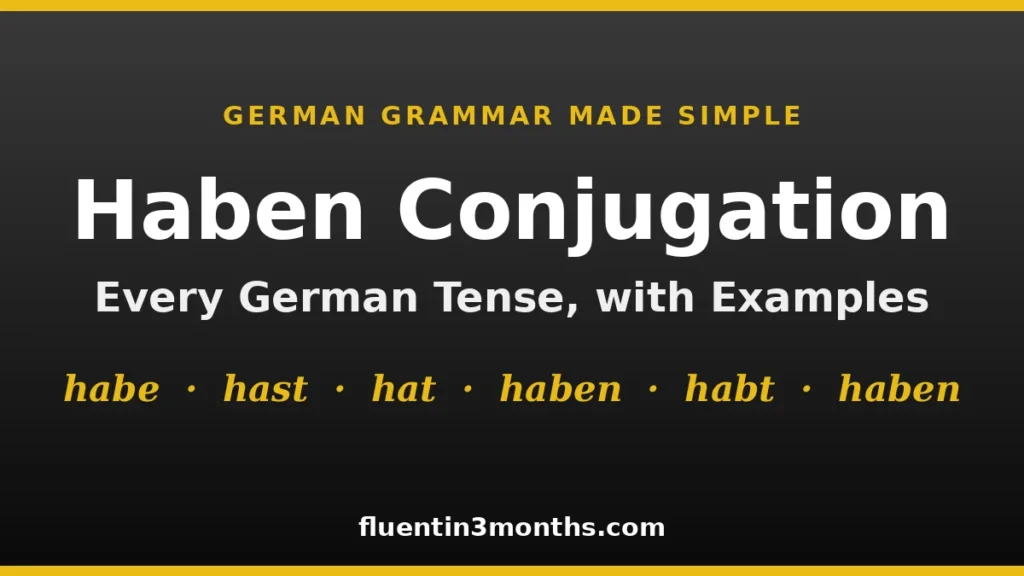
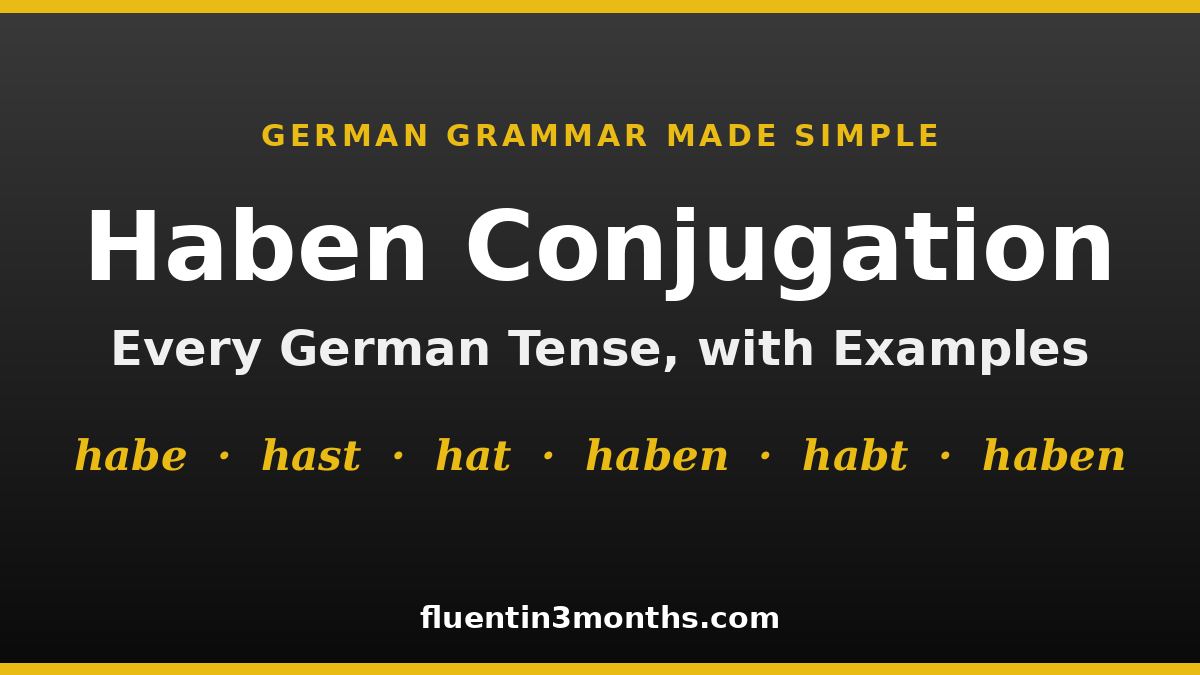
To achieve proficiency, one must prioritize the present tense (Präsens), which serves as the workhorse for daily interaction. The following table illustrates the standard present tense, noting the crucial contraction of the stem:
| Pronoun | Präsens |
|---|---|
| ich | habe |
| du | hast |
| er/sie/es | hat |
| wir | haben |
| ihr | habt |
| sie/Sie | haben |
The past tense in German is split between the Präteritum (narrative past) and the Perfekt (conversational past). Interestingly, haben—along with sein (to be)—defies the standard convention where speakers prefer the Perfekt for past actions. Even in casual conversation, native speakers predominantly use the Präteritum form (ich hatte) rather than the compound Perfekt (ich habe gehabt).
Comparative Tense Table
| Pronoun | Präteritum | Perfekt | Plusquamperfekt |
|---|---|---|---|
| ich | hatte | habe gehabt | hatte gehabt |
| du | hattest | hast gehabt | hattest gehabt |
| er/sie/es | hatte | hat gehabt | hatte gehabt |
| wir | hatten | haben gehabt | hatten gehabt |
| ihr | hattet | habt gehabt | hattet gehabt |
| sie/Sie | hatten | haben gehabt | hatten gehabt |
Analytical Framework: Haben vs. Sein
A frequent point of confusion for students is the selection of the auxiliary verb. German utilizes either haben or sein to construct the Perfekt tense. Data suggests that haben is the auxiliary for the vast majority of verbs, including those that take a direct object (transitive verbs).
Conversely, sein is strictly reserved for a specific subset: verbs denoting a change of state (e.g., werden—to become, aufwachen—to wake up) or movement from one location to another (e.g., gehen—to go, fahren—to drive). A failure to distinguish between these categories results in significant syntactic errors. Linguists emphasize that while learners may find the sein rules restrictive, they should default to haben in cases of ambiguity, as the statistical probability of haben being the correct choice is significantly higher.
Idiomatic Usage and Cultural Implications
The usage of haben extends into complex idiomatic territory. Many concepts that are expressed using "to be" in English are expressed using "to have" in German. Examples include:
- Hunger haben: To be hungry (Literally: to have hunger).
- Durst haben: To be thirsty (Literally: to have thirst).
- Angst haben: To be afraid (Literally: to have fear).
These expressions are not mere translations; they reflect the German conceptualization of physical and emotional states as possessions or conditions that one "holds." One notable exception that often traps learners is the expression of age. While French (avoir) and Spanish (tener) use "to have" to describe age, German adheres to the English "to be" structure: Ich bin 25 Jahre alt (I am 25 years old). This contrast is vital for those transitioning from Romance languages, where the instinct to use "have" for age is deeply ingrained.
The Konjunktiv Mood: Hypotheticals and Politeness
The Konjunktiv II mood of haben—hätte—is perhaps the most vital tool for polite social interaction. Using ich hätte gern (I would like) is the standard protocol for ordering in restaurants or making requests in professional environments. It replaces the more aggressive ich will (I want), which can be perceived as demanding or impolite in German culture.
The Konjunktiv I form is less frequently utilized in daily conversation but is ubiquitous in journalistic writing and reported speech. It is the mechanism by which media outlets attribute claims to third parties, making it a prerequisite for anyone attempting to read German newspapers or official government reports.
Strategic Recommendations for Language Acquisition
Educational researchers often suggest a "chunking" method for mastering irregular verbs like haben. Rather than rote memorization of tables, learners are advised to integrate these forms into functional phrases. For example, learning ich hatte within the context of a story, or hätte gern while role-playing a service encounter, reinforces the neural pathways associated with the verb’s usage.
Furthermore, the integration of digital tools such as Anki—which utilizes spaced repetition software (SRS)—has been shown to increase the retention rate of irregular verb conjugations by up to 40% compared to traditional flashcard methods. By focusing on the "mixed" nature of the verb—the shift from hab- to hatt-—learners can categorize haben alongside other mixed verbs like bringen (to bring) and denken (to think), creating a mental grouping that simplifies the memorization of past-tense stems.
Broader Impact on German Proficiency
The mastery of haben serves as a gateway to the broader German verbal system. Because haben acts as the auxiliary for most compound tenses, its correct usage is the foundation upon which one builds complex sentences, reports, and narratives.
Ultimately, the goal of understanding haben is to move beyond the literal definition of possession and into the realm of grammatical fluency. Whether navigating the complexities of the Konjunktiv for formal discourse or simply mastering the Präteritum for daily storytelling, the learner who achieves mastery over this single verb effectively unlocks the capacity to express almost any past or future event in the German language. By treating haben as an essential structural component rather than a simple vocabulary item, students position themselves for a deeper, more nuanced engagement with the German-speaking world. The transition from the beginner’s "habst" mistake to the natural, effortless use of "hast" signifies a fundamental shift in the learner’s ability to process and produce the language with the precision required for professional or academic success.