


The landscape of modern leadership is undeniably intricate, marked by the relentless pace of technological advancement, seismic shifts in workforce dynamics, pervasive economic uncertainty, and evolving employee expectations. In this demanding environment, leaders find themselves in a perpetual quest for solutions to increasingly multifaceted challenges. However, a deep dive into executive coaching sessions, leadership development programs, and team conflict resolution reveals a recurring pattern: many of these complex leadership predicaments stem from a surprisingly fundamental oversight – the neglect of core leadership responsibilities.
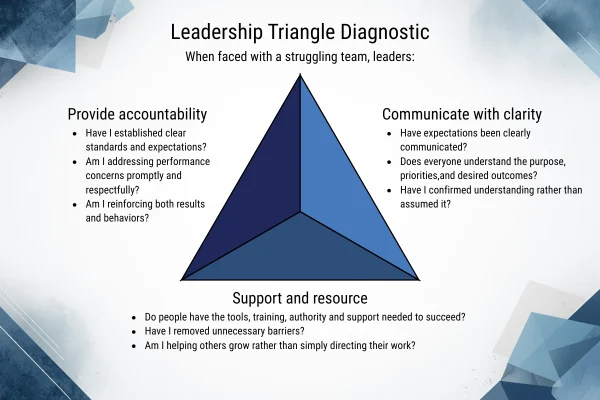
This article explores a practical and enduring framework, conceptualized by Dr. Justin Irving and referred to as the "leadership triangle," which distills effective leadership into three indispensable competencies: clear communication, robust support and resourcing, and decisive accountability. While these components may appear self-evident, their consistent and balanced application is the crucial differentiator between effective and ineffective leadership. Furthermore, this model offers Chief Learning Officers (CLOs), talent management professionals, and all leaders a tangible roadmap for cultivating individuals capable of mastering complexity, fostering trust, and elevating team performance.
Understanding the Leadership Triangle: A Diagnostic Tool
The leadership triangle functions not merely as a theoretical model but as a potent diagnostic instrument. When teams falter, conflict escalates, or performance wanes, leaders can often pinpoint the root cause to a neglected facet of this foundational triad. By systematically examining each vertex of the triangle, organizations can identify and address the systemic issues that hinder progress.
Vertex 1: Communicating with Clarity
The foundational responsibility of any leader is to establish and maintain clarity through effective communication. Without a clear understanding of expectations, employees are unable to align their efforts, contribute meaningfully to overarching priorities, or make informed decisions. The absence of clear direction fosters an environment of ambiguity, which research consistently links to increased anxiety, diminished engagement, and impaired productivity. A 2022 study by Gallup, for instance, found that highly engaged teams, which often benefit from clear communication, are 21% more profitable than those with lower engagement.
Leaders often err by assuming that their spoken words equate to understood messages. Communication, however, is not measured by the act of speaking but by the comprehension of the audience. Effective communication empowers individuals to answer critical questions: "What is expected of me?" "How does my work contribute to the larger goals?" "What are the priorities and how have they been decided?" "What is the status of key initiatives and potential changes?" "What support is available if I encounter obstacles?"
In leadership development settings, reflections on frustrating leadership experiences frequently highlight communication breakdowns: vague expectations, shifting priorities without adequate explanation, conflicting directives, or a lack of transparency during periods of organizational change. A survey by the Society for Human Resources Management (SHRM) in 2023 indicated that communication gaps were a primary driver of employee dissatisfaction and turnover. Leaders often overestimate the clarity of their messaging, perceiving their repetition as thoroughness, while employees may find it insufficient.
For CLOs and talent development professionals, this underscores a critical opportunity. Communication is a multifaceted leadership discipline encompassing expectation setting, active listening, constructive feedback, compelling storytelling, and the cultivation of shared understanding. Organizations that deliberately invest in developing these communication proficiencies will empower their leaders to better align teams, navigate change initiatives successfully, and foster sustained employee engagement. When leaders communicate with clarity, they dismantle ambiguity and forge alignment; conversely, their absence creates a vacuum readily filled by confusion and doubt.
Vertex 2: Supporting and Resourcing
While clarity is paramount, it is insufficient on its own. Once expectations are clearly articulated, leaders must actively ensure that their teams possess the necessary support and resources to achieve those objectives. This competency is intrinsically linked to Dr. Irving’s research, which emphasizes the leader’s role in enabling follower success. Effective leaders recognize that their mandate extends beyond mere direction; it involves creating an environment where individuals can flourish.
This perspective aligns with a growing body of leadership scholarship positing that long-term organizational success is less about individual leader accomplishments and more about the collective achievements enabled by their leadership. Unfortunately, many organizational structures inadvertently promote individuals who excel at setting goals but struggle to dismantle barriers for their teams. Employees may receive directives such as "Increase market share by 15%," "Improve customer satisfaction scores by 10 points," or "Launch the new product by Q3," yet they are frequently provided with inadequate guidance, insufficient training, limited time, or insufficient authority to meet these demands. The predictable outcome is frustration, disengagement, and eventual burnout, a phenomenon exacerbated by the ongoing "Great Resignation" trend, where employees are increasingly prioritizing supportive work environments.

Support and resourcing manifest in various forms: providing necessary tools, technology, and training; offering constructive feedback and coaching; allocating sufficient time and budget; empowering individuals with appropriate autonomy; and actively removing bureaucratic obstacles. For CLOs and talent management leaders, this competency is especially significant. Leadership development should not solely focus on self-improvement but also on cultivating leaders who are adept at developing others.
A crucial mindset shift for leaders involves transitioning from asking, "How can I achieve better results?" to "How can I help my people succeed?" This reflects a core tenet of servant leadership, where a leader’s success is inextricably linked to the growth and triumphs of those they lead. When leaders effectively support and resource their teams, they cultivate environments where individuals are empowered to contribute, learn, and thrive, leading to enhanced innovation and problem-solving capabilities, as evidenced by studies showing a strong correlation between supportive leadership and innovation output.
Vertex 3: Providing Accountability
The third pillar of the leadership triangle is often perceived as the most challenging. Many leaders adeptly communicate expectations and demonstrate genuine care for their team members, yet they falter when it comes to establishing and enforcing accountability. They may shy away from difficult conversations, postpone performance discussions, or hope that issues will resolve themselves – a strategy rarely effective in practice.
Accountability, fundamentally, is not about punishment; it is about stewardship. Effective accountability ensures that individuals understand whether their actions and performance align with agreed-upon standards. It provides essential feedback, reinforces organizational values, and fosters continuous growth. The absence of accountability breeds several detrimental outcomes: it can lead to a decline in performance standards, foster resentment among high-performing individuals who carry the burden of underperformers, create a perception of unfairness, and erode overall trust in leadership. Ironically, the avoidance of accountability often perpetuates the very conflicts leaders seek to prevent.
Accountability should not be viewed as antithetical to support. In healthy leadership systems, these two elements are complementary. Leaders provide the necessary resources for success and then hold individuals responsible for their effective utilization. This equilibrium is particularly vital in leadership development. While empathy, coaching, and relationship-building are indispensable leadership skills, they become incomplete when leaders lack the courage to address performance concerns directly. The most effective leaders exhibit both care and candor, challenging individuals because they believe in their potential. When practiced constructively, accountability becomes an act of respect, demonstrating a commitment to individual and collective growth.
From Competency to a Systemic Approach
The enduring appeal of the leadership triangle for CLOs lies in its ability to transcend individual leader behavior and be integrated into the fabric of an organization’s talent management systems. Frequently, organizations develop leaders in one area while inadvertently neglecting another. Leadership programs might emphasize communication skills but offer minimal training in coaching and resourcing others. Performance management systems may heavily focus on accountability while failing to equip leaders with the tools to support employee success. Succession planning discussions often prioritize results without scrutinizing the methods by which those results were achieved.
The leadership triangle provides a unifying language that can be embedded across leadership selection, onboarding, coaching, performance management, succession planning, and broader leadership development initiatives. Imagine leaders throughout an organization evaluating their effectiveness through a common lens: "Have I clearly communicated expectations?" "Have I provided the necessary support and resources?" "Have I held individuals accountable for their performance and behaviors?" When these questions become integral to an organization’s leadership culture, leadership development evolves from a collection of disparate programs into a cohesive and impactful system.
The Enduring Significance of the Triangle
The leadership triangle’s utility is amplified by its dual function as a development framework and a practical leadership checklist. When leaders encounter challenges, they can pause and ask three fundamental questions: "Is the issue rooted in a lack of clarity?" "Is it a consequence of insufficient support or resources?" "Is it related to a failure in accountability?" Experience suggests that most leadership failures stem from the neglect of one or more sides of this triangle. Leaders may hold individuals accountable for expectations that were never clearly articulated, establish ambitious goals without providing necessary resources, or communicate effectively and offer extensive support but fail to address underperformance.
The leadership triangle serves as a potent reminder that true leadership effectiveness is rarely found in a single competency. It emerges from the deliberate and balanced integration of all three. As organizations continue to grapple with escalating complexity, leaders will inevitably face difficult decisions, challenging conversations, and periods of significant transformation. In these moments, the most effective response may not be the adoption of a novel leadership technique, but rather a return to these fundamental principles. By consistently reinforcing and practicing clear communication, robust support, and decisive accountability, leaders can build resilient teams, foster enduring trust, and successfully navigate the intricate challenges of the modern business landscape. This foundational approach ensures that organizations are not only prepared for the complexities of today but are also building a sustainable foundation for the leaders of tomorrow.