



For years, organizations have treated artificial intelligence primarily as a skills challenge. The corporate logic has been consistent: AI evolves, jobs shift, and the human resources apparatus responds with comprehensive reskilling, upskilling, and AI literacy programs. While these initiatives remain necessary, they are increasingly insufficient. As enterprises pivot from simple generative AI to agentic AI—systems capable of autonomous planning, multi-step decision-making, and execution—a deeper, more systemic problem emerges. AI is not merely changing the knowledge requirements for modern roles; it is potentially dismantling the very training grounds where professional mastery is forged.
Professional capability is rarely the product of classroom lectures or digital modules. It is an experiential phenomenon, built through the "friction" of real work: navigating exceptions, interpreting ambiguous data, making high-stakes judgment calls, and absorbing the tacit patterns that only experienced practitioners recognize. When organizations automate the granular, repetitive tasks that serve as the foundation for junior roles, they may inadvertently be eroding the pipeline of future leadership. Workplace learning has quietly transformed from a professional development goal into a critical business continuity issue.
The Shift in AI Governance
The recognition of this risk is moving from academic theory to formal policy. A pivotal development occurred with the release of the Singapore Model AI Governance Framework for Agentic AI. This framework explicitly warns that when AI agents assume entry-level responsibilities, organizations risk long-term skill degradation. By removing the "scaffolding" of entry-level tasks, firms create a capability gap. If an agent fails or an edge case arises that the system cannot parse, the organization may find that its human workforce lacks the foundational experience to intervene effectively.
This signals a paradigm shift in how corporations must view AI implementation. Historically, technology adoption focused on ROI and productivity. Now, governing bodies are advising firms to treat capability retention as a risk management function, similar to how they approach cybersecurity or financial resilience.
A Chronology of the Capability Crisis
The trajectory of this issue follows the rapid evolution of AI tools over the last decade.
- 2015–2020: The Era of Augmentation. Early AI tools, such as predictive analytics and basic chatbots, largely functioned as productivity aids. They did not replace the worker; they required the worker to interpret outputs. Research, including the landmark 2023 study by Erik Brynjolfsson, Danielle Li, and Lindsey Raymond, demonstrated that these tools disproportionately benefited less-experienced workers by providing expert-quality guidance. In this "cognitive apprenticeship" model, the human remained the final arbiter, maintaining the loop of practice and feedback.
- 2021–2023: The Rise of Generative AI. As Large Language Models (LLMs) moved into the mainstream, the "co-pilot" model became the standard. Productivity gains were substantial, but the nature of work began to shift toward reviewing and editing AI-generated content rather than original creation.
- 2024–Present: The Agentic Transition. We are currently in the early stages of agentic AI adoption. Unlike co-pilots, these systems act independently across workflows. This transition marks the point where "doing" is increasingly offloaded to machines, and "approving" becomes the primary human activity. This shift is where the risk of skill atrophy becomes acute.
Data-Driven Implications for the Workforce
The economic evidence regarding this shift is sobering. Research by Brynjolfsson, Bharat Chandar, and Ruyu Chen into "canaries in the coal mine" occupations—those highly exposed to AI—indicates that the impact of automation is not primarily felt through mass layoffs of existing staff. Instead, it is manifesting as a significant reduction in hiring for entry-level roles.
The implication is clear: if organizations stop hiring at the entry level to reduce costs and automate the remaining tasks, they are effectively closing the "on-ramp" for talent development. In five to ten years, when senior practitioners retire, the talent pool will be empty because the mid-level and junior levels were bypassed by automation. This creates a structural deficit in expertise that no amount of late-stage reskilling can solve.
The Role of Learning and Development (L&D)
For L&D teams, this represents an existential challenge. Historically, these departments have operated in the realm of training design—digital courses, workshops, and simulations. However, the current environment demands that L&D move "upstream" into the design of work itself.
If L&D professionals do not have a seat at the table during technology implementation, they are essentially managing the symptoms of a problem that technology teams are inadvertently creating. When an IT department decides to automate a financial reconciliation process, they are often focused on speed and error reduction. They rarely calculate the loss of the "analytical muscle" developed by an accountant who manually reconciles those figures.
A New Framework for Capability Preservation
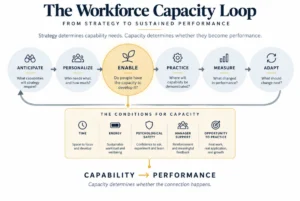
To navigate this transition, organizations must adopt a four-pillar strategy to safeguard their intellectual capital:
1. Granular Capability Mapping
Standard competency frameworks are too abstract to address this issue. Organizations must move toward task-level mapping. By identifying exactly which tasks build "diagnostic skill" or "pattern recognition," companies can categorize tasks into those that are safe to automate and those that must be preserved as "human-led" for developmental purposes.
2. Establishing a Capability Reserve
Just as companies maintain operational redundancy for server outages, they should establish a "capability reserve." This involves designating specific workflows where humans must remain in the loop, even if AI could perform the task faster. This is not about maintaining inefficiency; it is about maintaining the organization’s ability to function when the technology is unavailable or fails.
3. Engineering Deliberate Experience
Where automation is unavoidable, organizations must manufacture alternative development paths. This could take the form of "shadowing" agents, where junior employees are required to predict the agent’s output before it is displayed, or using simulated outages where employees must manually execute a process to ensure their skills remain sharp. The objective is to replace the "accidental learning" of daily work with "deliberate practice."
4. Integrating Governance with Capability Metrics
AI governance data is a goldmine for talent development. Metrics such as "override rates"—how often a human rejects an AI suggestion—provide a clear window into workforce competence. A very low override rate is often interpreted as a success of AI implementation, but it could also signal a dangerous level of "automation bias," where employees have ceased to critically evaluate the machine’s output. By monitoring these metrics, L&D can intervene before skills deteriorate.
The Strategic Mandate
The real productivity equation for the next decade will not be defined by how much work can be automated, but by how much human capability can be preserved during the transition. The risk of failing to solve this is not just an operational slowdown; it is the loss of the tacit knowledge that sustains long-term organizational survival.
As organizations accelerate their adoption of agentic AI, they face a dual imperative. They must pursue the undeniable efficiency gains that this technology offers, while simultaneously answering a harder question: What must humans continue to experience to remain the masters of their own processes?
Leaders who prioritize this balance will build organizations that are not only efficient in the short term but resilient in the long term. Those who ignore the erosion of capability in favor of immediate, automated productivity may find themselves in the precarious position of owning powerful, efficient systems that they no longer know how to manage, fix, or evolve. The future of work will belong to those who redesign their workflows not just for the sake of output, but for the sake of the people who make that output possible.