


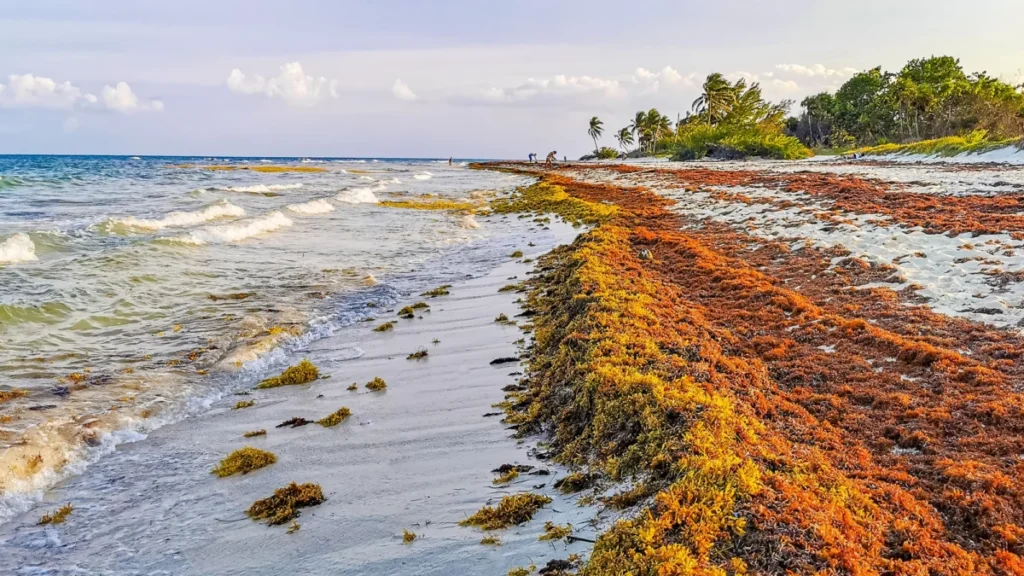
Marine biologists and oceanographers are sounding the alarm as the Great Atlantic Sargassum Belt, a massive sprawl of floating brown algae, reaches unprecedented levels of biomass for the early 2026 season. Recent satellite imagery and oceanographic modeling indicate that the bloom is not only larger than in previous record-setting years but is also migrating toward coastal regions significantly earlier than historical norms. Current estimates from the University of South Florida’s Optical Oceanography Laboratory suggest that over 9.3 million tons of the seaweed are already circulating in the Atlantic, fueled by a combination of rising sea surface temperatures, nutrient-rich agricultural runoff, and anomalous wind patterns.
This phenomenon represents a burgeoning ecological and economic crisis for the Caribbean, the Gulf of Mexico, and the eastern coast of Florida. While Sargassum serves as a vital habitat for marine life in the open ocean, its arrival in shallow coastal waters and onto sandy beaches triggers a cascade of negative consequences. As the biomass decomposes, it releases toxic gases, smothers coral reefs, and threatens the multi-billion dollar tourism industries that sustain island nations and coastal municipalities.
The Biological Profile of Sargassum
Sargassum is a genus of holopelagic brown macroalgae, primarily consisting of two species: Sargassum natans and Sargassum fluitans. Unlike many other types of seaweed that grow attached to the seafloor, Sargassum spends its entire life cycle floating on the water’s surface. This buoyancy is made possible by pneumatocysts—small, berry-like, gas-filled sacs that act as natural flotation devices.
In the open ocean, these floating "golden forests" are essential components of the marine ecosystem. They provide a nursery and foraging ground for more than 100 species of fish, including mahi-mahi and tuna, as well as several species of sea turtles and crabs. The Sargasso Sea, located in the North Atlantic, was historically the primary hub for this seaweed. However, since 2011, a new distribution pattern has emerged, stretching from the West African coast to the Gulf of Mexico, creating what is now known as the Great Atlantic Sargassum Belt (GASB).
The Evolution of the Great Atlantic Sargassum Belt: A Timeline
The emergence of the GASB marks a significant shift in Atlantic oceanography. Historically, Sargassum was largely confined to the Sargasso Sea, trapped by the North Atlantic Gyre. However, a series of climatic and environmental shifts over the last 15 years has altered this dynamic permanently.
- 2011: Researchers first identified a massive, anomalous bloom of Sargassum extending across the tropical Atlantic. This was the first time such a large-scale event was recorded outside the traditional Sargasso Sea boundaries.
- 2013: A brief and unexplained reprieve occurred where Sargassum levels dropped significantly, though this would prove to be an outlier in the long-term trend.
- 2015-2018: The blooms returned with increasing intensity. In 2018, a then-record 20 million tons of Sargassum blanketed the Atlantic, causing states of emergency in several Caribbean nations.
- 2022-2023: Biomass levels continued to climb, with the 2023 season seeing an early surge that overwhelmed beaches in the Florida Keys and the Mexican Riviera Maya.
- 2025: The belt reached a staggering record of 37.5 million tons, creating a continuous biomass chain thousands of miles long.
- 2026 (Projections): Current data suggests that 2026 is on track to eclipse the 2025 record. The presence of 9.3 million tons in the early months of the year indicates a growth trajectory that could lead to a summer peak exceeding 40 million tons.
Drivers of Exponential Growth
Scientists point to a "perfect storm" of anthropogenic and natural factors driving this proliferation. The primary catalyst is the influx of nutrients into the Atlantic Ocean. Large-scale deforestation and intensive industrial agriculture in the Amazon and Mississippi River basins have led to massive amounts of nitrogen and phosphorus leaching into the sea. These nutrients act as fertilizer for the Sargassum, allowing it to double its biomass in as little as 11 days under ideal conditions.
Climate change further exacerbates the issue. Warmer ocean temperatures increase the metabolic rate of the algae, accelerating growth. Furthermore, changes in atmospheric pressure systems and trade winds have become more pronounced. In early 2026, particularly strong eastern trade winds have acted as a conveyor belt, pushing the massive rafts of seaweed westward toward the Caribbean and Florida much faster than in previous decades.
Ecological Impact: From Life-Giver to Life-Taker
While beneficial in the deep sea, the arrival of Sargassum in coastal zones is ecologically devastating. When the seaweed accumulates in thick mats near the shore, it blocks sunlight from reaching the seabed. This prevents native seagrasses from photosynthesizing, leading to "dead zones" where local flora and the fauna that depend on them perish.
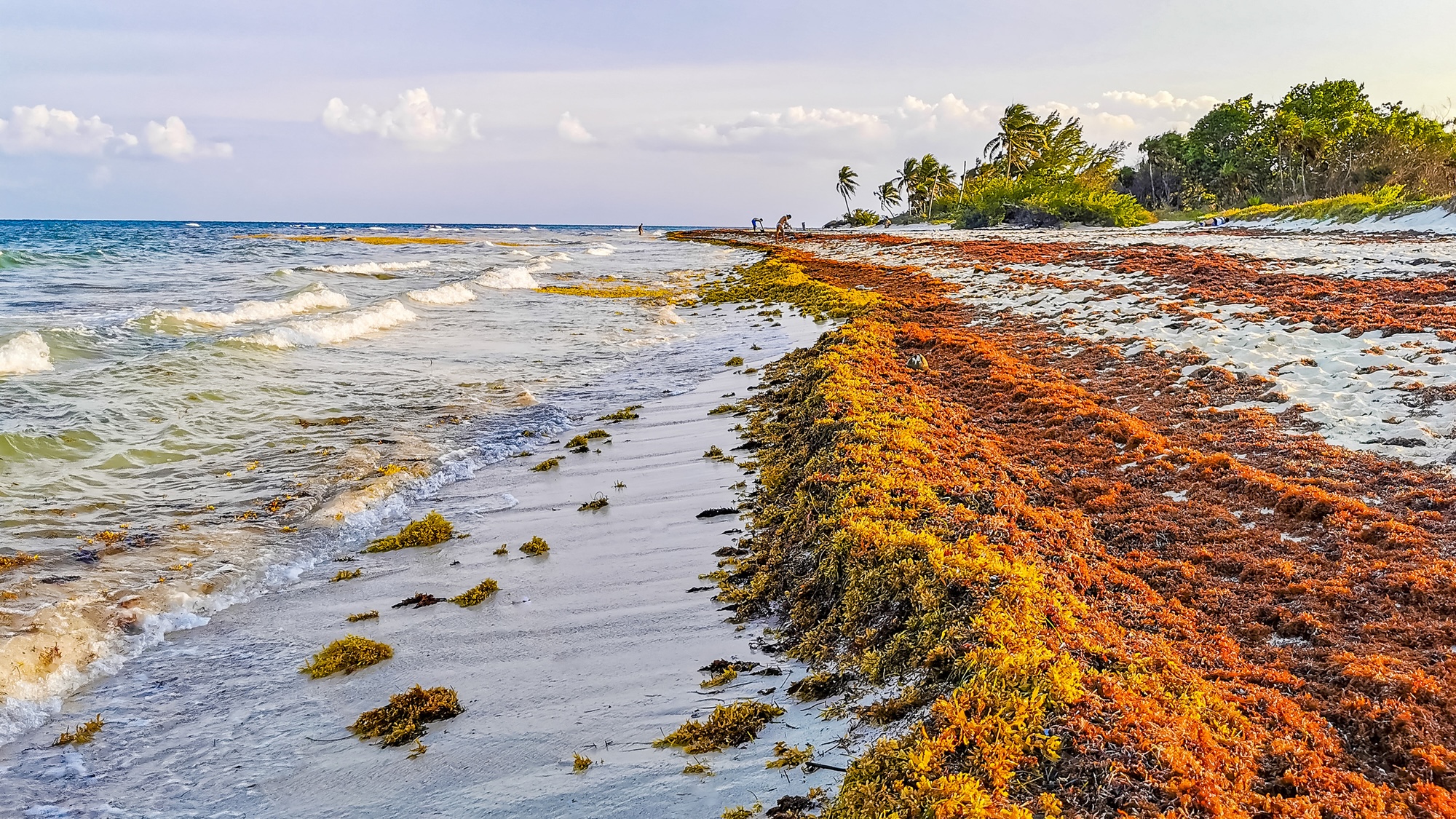
One of the most critical impacts is on sea turtle populations. Florida and the Caribbean are major nesting grounds for Loggerhead, Green, and Leatherback turtles. Dense piles of Sargassum on beaches create physical barriers that prevent mother turtles from reaching nesting sites. Even more tragically, hatchlings attempting to reach the ocean can become trapped in the tangled seaweed, where they succumb to exhaustion or predation.
Furthermore, as the Sargassum dies and sinks in nearshore waters, it consumes vast amounts of dissolved oxygen. This "hypoxia" can lead to massive fish kills and the death of coral colonies, which are already struggling with rising temperatures and ocean acidification.
Public Health and the "Rotten Egg" Problem
The most immediate concern for human populations is the chemical decomposition of the seaweed. As Sargassum rots on the beach, it produces hydrogen sulfide ($H_2S$) and ammonia. Hydrogen sulfide is easily identifiable by its pungent "rotten egg" odor.
For residents and tourists, exposure to these gases is more than a nuisance; it is a health hazard. High levels of $H_2S$ can cause respiratory distress, particularly in individuals with asthma or other chronic lung conditions. Symptoms of short-term exposure include nausea, headaches, and irritation of the eyes, nose, and throat. In some Caribbean coastal communities, clinics have reported an uptick in respiratory-related visits during peak Sargassum inundation periods.
The Economic Burden of Removal
The financial toll of the Sargassum crisis is staggering. For coastal municipalities, the cost of "beach grooming"—the mechanical removal of seaweed—is a massive unbudgeted expense. Miami-Dade County in Florida has previously estimated its annual Sargassum management costs at approximately $35 million. These funds are spent on heavy machinery, labor, and the logistics of transporting the wet, heavy biomass to landfills.
The tourism sector, the backbone of many Caribbean economies, faces a double-edged sword. Hotels must pay for daily cleanup to keep their beaches usable, yet the persistent smell and unsightly appearance of the seaweed often lead to canceled bookings and a decline in property values. Small-scale fisheries also suffer, as the thick mats of algae can damage boat engines and make it impossible to cast nets, disrupting the food supply and livelihoods of local communities.
Monitoring and the Path Forward
In response to this perennial threat, organizations like the National Oceanic and Atmospheric Administration (NOAA) and the University of South Florida (USF) have developed sophisticated monitoring systems. Using NASA satellite data, these groups provide weekly "Sargassum Outlooks," allowing local governments to prepare for incoming blooms weeks in advance.
However, monitoring is only the first step. The long-term management of Sargassum requires international cooperation. There is ongoing research into "valorizing" the seaweed—turning it into a resource rather than a waste product. Potential uses include the production of biofuels, compostable plastics, and construction materials. However, these efforts are complicated by the fact that Sargassum often contains high levels of heavy metals, such as arsenic and cadmium, which it absorbs from the ocean. This makes it difficult to use as fertilizer for food crops without extensive and expensive processing.
Conclusion
The 2026 Sargassum season serves as a stark reminder of the changing state of the global oceans. What was once a localized phenomenon in the Sargasso Sea has transformed into a trans-Atlantic crisis that bridges the gap between environmental science and economic policy. As the record-breaking belt approaches the shores of Florida and the Caribbean, the focus shifts from observation to mitigation. Without global efforts to reduce nutrient runoff and address the underlying causes of ocean warming, the "Great Atlantic Sargassum Belt" is likely to remain a permanent and growing fixture of the Atlantic landscape, necessitating a fundamental shift in how coastal societies interact with their environment.