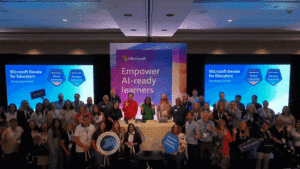



As the digital landscape undergoes a radical transformation driven by generative artificial intelligence, Safer Internet Day 2026 has emerged as a pivotal milestone for global education systems. This year’s observance, centered on the theme AI Aware: Safe, Smart, In Control, marks a significant shift in how schools, families, and technology providers approach digital citizenship. Microsoft Education has taken a leading role in this transition, unveiling a comprehensive suite of resources designed to move beyond traditional internet safety and toward a sophisticated model of AI literacy. The initiative seeks to empower the next generation of learners to navigate an ecosystem where AI is no longer a peripheral tool but a foundational element of the learning experience.
The 2026 event arrives at a time when educational institutions are grappling with the dual nature of AI: its unprecedented potential to personalize learning and its capacity to introduce new risks regarding data privacy, misinformation, and algorithmic bias. By prioritizing "AI awareness," the program encourages a proactive stance where students are taught to understand the mechanics of the technology they use daily. This involves recognizing the influence of AI in learning platforms, creative tools, and social interactions, ensuring that the human element remains at the center of the digital experience.
The Historical Evolution of Safer Internet Day and the 2026 Pivot
Safer Internet Day (SID) began in 2004 as an initiative of the EU SafeBorders project and was subsequently taken up by the Insafe network as one of its earliest actions. Over the past two decades, it has expanded far beyond its European roots, now involving more than 190 countries and territories worldwide. Historically, the focus of SID remained on traditional concerns such as cyberbullying, social media privacy, and password hygiene. However, the period between 2023 and 2026 saw an exponential rise in the integration of Large Language Models (LLMs) and generative media in classrooms, necessitating a fundamental rewrite of the safety playbook.
The chronology of this movement shows a clear trajectory. In the early 2010s, the focus was on mobile safety; by 2020, the emphasis shifted to remote learning security during the global pandemic. By 2024, the conversation turned toward the ethical use of AI. Now, in 2026, the objective is "Control." This evolution reflects a maturing digital society that recognizes safety is not merely the absence of harm but the presence of agency. Microsoft’s involvement in 2026 underscores this shift, moving from defensive posture—blocking threats—to offensive education—building the critical thinking skills required to interrogate AI outputs and maintain data sovereignty.
Analyzing the AI-Aware Framework: Safe, Smart, and In Control
The "AI Aware" framework introduced this year is structured around three core competencies that Microsoft Education argues are essential for modern digital citizenship. The first, being "Safe," involves understanding the data-sharing implications of AI. Students are taught to recognize that every prompt provided to a generative engine is a data point that may be used for model training or stored in a cloud repository. Safety in 2026 is defined by the ability to protect one’s intellectual property and personal identity within an automated environment.

The second pillar, "Smart," focuses on the verification of information. As AI-generated content becomes indistinguishable from human-created media, "Smart" learners are those who practice lateral reading and source verification. This involves a healthy skepticism of "hallucinations"—factual errors produced by AI—and an understanding of how training data can perpetuate societal biases.
Finally, the "In Control" aspect addresses the psychological and ethical dimensions of AI. It empowers students to decide when AI is an appropriate tool for a task and when it might hinder their own cognitive development. By integrating these competencies into the K-12 curriculum, educational leaders aim to produce graduates who are not just passive consumers of technology but informed architects of their own digital futures.
Data-Driven Necessity: Why Cybersecurity in Education is Non-Negotiable
The push for enhanced safety protocols is backed by sobering data regarding the vulnerability of the education sector. According to cybersecurity reports from 2025, educational institutions remained one of the most targeted industries for ransomware and data breaches. This is largely due to the "open campus" nature of school networks, which must balance the need for collaborative research and accessibility with the requirement to protect sensitive information.
Schools manage a vast repository of high-value data, including:
- Personally Identifiable Information (PII) of students and staff.
- Proprietary academic research and intellectual property.
- Financial records and donation databases.
- Health information and counseling records.
A single breach can have catastrophic consequences, ranging from identity theft to the total disruption of the academic calendar. Microsoft’s Education Security Toolkit, released in conjunction with Safer Internet Day 2026, addresses these risks by reframing security as an enabler of innovation rather than a barrier. The toolkit provides IT administrators with a roadmap for adopting "Zero Trust" architectures, which assume that threats could originate from both outside and inside the network, requiring constant verification of every user and device.
Gamifying Digital Safety: The Impact of Minecraft Education’s CyberSafe Series
One of the most significant developments for Safer Internet Day 2026 is the expansion of the Minecraft Education CyberSafe series. Recognizing that traditional lectures on digital safety often fail to resonate with younger audiences, Microsoft has utilized the immersive environment of Minecraft to create a "rehearsal space" for real-world digital challenges. The latest module, titled Bad Connection?, is specifically tailored for students aged 11 to 14, a demographic that is increasingly active in online gaming and social media.

The Bad Connection? module simulates scenarios involving manipulative interactions, suspicious messages, and peer pressure in digital spaces. By navigating these challenges in a sandbox environment, students can practice their responses without real-world consequences. This pedagogical approach is supported by research indicating that gamified learning leads to higher retention rates and better application of knowledge in practical situations. The curriculum aligns with standards from the Computer Science Teachers Association (CSTA) and Cyber.org, ensuring that the "play" has a rigorous academic foundation.
Stakeholder Reactions and the Collaborative Path Forward
The initiatives launched for Safer Internet Day 2026 have drawn praise from various sectors of the educational community. Digital safety advocates have noted that the inclusion of AI literacy is a long-overdue acknowledgment of the current technological reality. "We can no longer teach internet safety as if the web is a static library," stated one technology director at a major urban school district. "The web is now a conversation with an algorithm, and Microsoft’s tools help students understand who—or what—is on the other side of that conversation."
IT professionals have also welcomed the new security frameworks. The emphasis on "resilient digital learning ecosystems" acknowledges that schools often lack the massive IT budgets of corporate entities. By providing ready-to-use resources and training, Microsoft is helping to bridge the "security gap" between affluent and under-resourced districts. Furthermore, family engagement guides included in the 2026 rollout recognize that digital safety does not end at the school gates. By providing parents with the language to discuss AI risks at home, the program creates a unified front between educators and caregivers.
Broader Implications: Shaping the Future Workforce
The long-term impact of the Safer Internet Day 2026 initiatives extends beyond the classroom. As the global economy increasingly demands "AI fluency," the students who master these safety and awareness skills today will be the leaders of tomorrow’s workforce. The ability to ethically and effectively manage AI tools is becoming a primary differentiator in the job market.
Moreover, the focus on cybersecurity creates a pipeline for future professionals in a field that currently faces a massive talent shortage. By introducing cybersecurity concepts through engaging platforms like Minecraft, schools are demystifying the profession and encouraging a diverse range of students to consider careers in digital defense.
In conclusion, Safer Internet Day 2026 represents a transformative moment in the history of digital education. Through the combined efforts of Microsoft Education and global school communities, the focus has shifted toward a holistic understanding of AI and a robust commitment to cybersecurity. By equipping learners with the tools to be AI-aware, safe, and smart, the educational sector is ensuring that the digital world remains a space for curiosity, collaboration, and secure innovation. The success of these initiatives will be measured not just in the absence of incidents, but in the confidence and control with which the next generation navigates an AI-shaped world.