



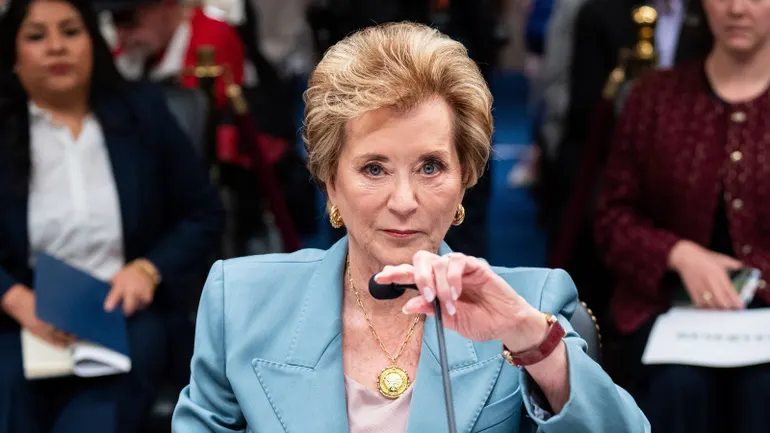
A year into her tenure as U.S. Education Secretary, Linda McMahon presented the Trump administration’s fiscal year 2027 budget proposal before a Senate subcommittee, asserting it represents a significant stride toward dismantling "bloated bureaucracy" and empowering state and local leaders with greater educational decision-making authority. Appearing before the Senate Subcommittee on Labor, Health and Human Services, Education and Related Agencies on Tuesday, McMahon championed the proposal as a fulfillment of long-standing aspirations for educational reform. "Today, I can confidently attest that we are delivering on the vision of educational renewal that, for decades, many promised but none have delivered," she stated.
However, the hearing, primarily focused on the forthcoming budget, quickly evolved into an examination of significant policy shifts implemented under McMahon’s leadership over the past year. Democratic members raised pointed questions regarding the withholding of federal K-12 grant funding in the previous summer, reductions in the workforce within the Office for Civil Rights (OCR), and the outsourcing of various Education Department activities to other federal agencies. Senator Tammy Baldwin, D-Wis., the ranking member of the subcommittee, voiced strong criticism, declaring, "Secretary McMahon, instead of working collaboratively towards solutions to help our students and families, you have undertaken a politically motivated campaign to undermine the work of the Department of Education. This has been to the detriment of our students and, if allowed to continue, will have consequences long into the future."
"Make Education Great Again" Initiative at the Forefront of FY2027 Budget Proposal
The Trump administration’s fiscal year 2027 budget request allocates $76.5 billion to the U.S. Department of Education, marking a 3% reduction from the FY 2026 enacted level of $79 billion. This proposal maintains Title I funding at $18.4 billion, a critical federal program designed to support disadvantaged students, while simultaneously increasing funding for special education by $539 million, bringing the total to $16 billion. This increase for special education, while welcomed by some advocates, is viewed with caution by others concerned about accountability measures within the proposed framework.
This fiscal blueprint echoes previous attempts by the Trump administration, notably in its FY26 proposal, to eliminate or consolidate existing grant programs. The core of this strategy involves consolidating multiple grant streams into broader funding mechanisms that states would then administer. These proposed changes, however, faced significant opposition from Congress in the previous budget cycle, which ultimately approved a final budget that did not incorporate these consolidations.
A prime example of this consolidation strategy within the FY27 proposal is the "Make Education Great Again" grant program. This initiative seeks to merge 17 existing K-12 grant funding streams, valued at $6.5 billion, into a single $2 billion program. The stated intent is to provide states and local districts with enhanced flexibility to allocate funds towards priority areas identified by their specific needs. Secretary McMahon articulated this vision, stating, "We’ve been clear: Shifting authority back to the states will not come at the expense of essential federal programs for support, much of which predate the department itself."
In response to inquiries about how the proposed budget would address student achievement, McMahon highlighted the "Make Education Great Again" program’s requirements. Under this initiative, states would be mandated to dedicate at least 25% of the allocated funds to literacy initiatives and an additional 25% to mathematics instruction. The remaining funds could then be utilized by states for any activities currently permissible under the 17 formula and competitive K-12 grant programs slated for elimination.
The proposal garnered support from several Republican subcommittee members, who expressed approval for measures that would transfer greater fiscal authority to states and local districts. Subcommittee Chair Shelley Moore Capito, R-W.Va., framed the debate as a critical juncture for the nation’s education system. "We find ourselves at a crossroads," Capito stated. "Do we stay the course with our education system as it is, hoping that more money and federal intervention will solve our problems? Or do we, as you have suggested, ask the difficult questions and consider innovative solutions that can actually turn the tide?"
Interagency Agreements: Navigating a Shifting Landscape
While the FY27 budget proposal does not explicitly detail further moves to transfer responsibilities from the Education Department to other federal agencies, Secretary McMahon faced questions regarding the progress of ten interagency agreements already in motion. These agreements represent a significant reorientation of programmatic oversight.
When questioned by Senator Patty Murray, D-Wash., the vice chair of the full Senate Appropriations Committee, about the potential relocation of special education programming, McMahon affirmed that no final decisions had been made. However, she acknowledged that the department was exploring the possibility of housing certain programs supporting the Individuals with Disabilities Education Act (IDEA) within the U.S. Department of Labor and others within the U.S. Department of Health and Human Services. Senator Murray shared her receipt of a petition signed by thousands of parents, educators, and advocates protesting the proposed transfer of IDEA services. "I can assure you that the intent of this administration is not to put these students at risk in any way whatsoever," McMahon responded, seeking to allay concerns.
Regarding the existing interagency agreements, McMahon conceded that there had been some "hiccups" during the transition process. Nevertheless, she emphasized that the same Education Department employees who previously managed specific grant programs continue their work, albeit in different federal facilities. Discussing the agreement between the Education and Labor departments for certain Elementary and Secondary Education Act (ESEA) programs, McMahon expressed optimism, stating, "this is a program that I believe will help our students as they go from K through 12 into higher education be prepared for the workforce of today and the demands of the workforce of tomorrow."
Senator Mike Rounds, R-S.D., voiced his support for the Education Department’s efforts to establish interagency agreements, aligning with the administration’s broader decentralization agenda. "I like the idea that those decisions should be made at the local level," Rounds commented. "And I think there’s a number of areas within the Department of Education that we’ve been working on through legislation, trying to divvy back out again to the departments that they were in before the department was ever created." This sentiment reflects a recurring theme among Republican lawmakers who advocate for returning federal functions to their pre-departmental origins, arguing for greater efficiency and local control.
Scrutiny Over the Office for Civil Rights (OCR)
Democratic lawmakers also pressed Secretary McMahon on the agency’s performance in addressing complaints within the Office for Civil Rights (OCR). The FY27 budget proposal includes a significant reduction in OCR staffing, from 530 positions in FY25 to 271 in FY27, accompanied by a budget decrease from $140 million to $91 million over the same period.
Prior to the hearing, Senator Bernie Sanders, I-Vt., released a report detailing alleged inaction at the OCR. The report indicated that despite maintaining the same budget in 2025 as in the preceding year, the OCR provided resolutions in only 1% of its 11,985 pending cases. Furthermore, the report highlighted a substantial decline in disability resolution agreements, with a nearly 79% decrease in 2025 compared to the previous year.
During the hearing, Senator Chris Murphy, D-Conn., questioned McMahon about the current status of OCR complaints. McMahon acknowledged a backlog of 19,000 OCR complaints at the beginning of the previous year. She also indicated that the department was in the process of rehiring many lawyers who had previously worked on OCR cases and were impacted by an agency-wide reduction-in-force the year prior. "There was a time when we were not processing cases as quickly as we should, but we are now focused on doing that and moving forward," McMahon stated. "We expect to see progress."
The budget approval process is multi-faceted, with the House version of the FY27 Labor, Health and Human Services, Education and Related Agencies bill scheduled for markup by the full Appropriations Committee on June 9. Fiscal year 2027 officially commences on October 1. The ongoing debates and proposed changes underscore a fundamental divergence in approaches to federal education policy, with the Trump administration prioritizing decentralization and fiscal consolidation, while critics express concerns about potential erosion of essential protections and equitable access for students. The coming months will be crucial in determining the ultimate shape of the federal government’s role in education for the next fiscal year.