

Microsoft has announced a comprehensive update to its Education AI Toolkit, transitioning the resource from a preliminary guide to a robust framework designed to help education leaders scale artificial intelligence from small-scale pilots to institution-wide implementation. As primary schools, districts, and higher education institutions increasingly move past the experimental phase of generative AI, the updated toolkit provides structured guidance for achieving systemic impact while maintaining rigorous standards for responsibility, security, and pedagogical integrity. The redesign reflects a year of feedback from global educators who have shifted their focus from understanding what AI is to determining how it can be deployed sustainably across complex organizational structures.
The Evolution of AI Integration in Global Education
The release of the updated Microsoft Education AI Toolkit arrives at a critical juncture in the digital transformation of the academic sector. Since the surge of interest in large language models in late 2022, educational institutions have undergone a rapid three-stage evolution. The first stage was characterized by curiosity and caution, as administrators grappled with academic integrity concerns. The second stage saw a proliferation of "pilot programs," where individual teachers or departments experimented with tools like Microsoft 365 Copilot for lesson planning or administrative drafting.
The current third stage, which this toolkit addresses, is the move toward "systemic innovation." In this phase, the goal is no longer just individual productivity but the creation of institutional capacity. Primary schools are now deploying custom chatbots to provide personalized literacy support, while universities are utilizing agentic AI to manage student services and enrollment workflows. Microsoft’s update aims to provide a roadmap for this transition, ensuring that as AI scales, it does so within a framework of secure IT governance and proven instructional strategies.
Structural Enhancements and User Experience
The redesigned toolkit features a streamlined, landscape-oriented layout intended to facilitate collaborative planning among leadership teams. It is organized into five distinct modules: Overview, AI Navigators, Plan, Implement, and Research. This structure is designed to be non-linear, allowing institutions at different levels of maturity to access the specific resources they need, whether they are just forming an AI leadership committee or are ready to deploy sophisticated agentic solutions.

A key addition to the toolkit is the "AI Navigators" section, which has been reimagined to focus on actionable strategies rather than theoretical use cases. These navigators provide detailed profiles of successful implementations, highlighting critical decision points and strategies used by institutions like Auburn University. By presenting these as blueprints, Microsoft allows other leaders to adapt proven models to their unique cultural and budgetary contexts.
Distinguishing Individual Use from Institutional Capacity: AI Sparks
One of the most significant conceptual shifts in the updated toolkit is the introduction of "AI Sparks." While the previous version focused on "AI Snapshots"—which detailed how individual practitioners could use AI for tasks like creating accessible content—AI Sparks focus on team-level and department-level implementations.
For example, where a Snapshot might guide a single teacher in using a chatbot to summarize a text, a Spark illustrates how a district-wide literacy team can integrate Learning Accelerators, such as Reading Coach and Reading Progress, across all K-3 classrooms to improve early literacy outcomes systematically. In a higher education context, a Spark might detail how an entire IT department uses Microsoft Copilot Studio analytics to identify recurring helpdesk issues and proactively update resources, thereby reducing the volume of support tickets across the campus. This distinction emphasizes that true transformation occurs when AI is embedded into the workflows of teams rather than remaining the siloed practice of "early adopters."
The Rise of Agentic AI and Autonomous Workflows
The toolkit introduces a dedicated focus on "Agentic AI," a frontier in technology where AI systems move from being passive assistants to active agents capable of executing multi-step tasks with varying degrees of autonomy. For education leaders, this represents a significant opportunity to reduce the administrative "drudge work" that often leads to staff burnout.
The toolkit outlines two primary pathways for implementing agentic AI:

- Microsoft Copilot Studio: A low-code/no-code environment that allows departments to create custom agents for specific tasks, such as routing student inquiries or automating departmental scheduling.
- Azure AI Foundry: A more advanced platform for developers to build sophisticated, custom AI solutions that integrate deeply with institutional data systems.
A notable case study included in the toolkit is the University of Leicester, which developed an AI-powered digital coach. This agent reduced the workload on human staff by providing students with 24/7 access to essential university information, demonstrating how agentic AI can enhance the student experience while simultaneously optimizing operational efficiency.
Security, Governance, and the Simplified IT Pillar
As AI adoption grows, so does the complexity of the underlying IT infrastructure. Microsoft has identified "Simplify and Secure IT" as one of the three core themes of the toolkit, alongside Student Success and Institutional Innovation. This pillar addresses the urgent need for robust data governance and threat detection.
The toolkit provides specific guidance on using Microsoft Security Copilot to protect institutional data. As schools handle sensitive student information, the toolkit emphasizes that AI implementation must be grounded in privacy practices that comply with international standards. By integrating security directly into the implementation roadmap, Microsoft aims to help institutions build "trusted AI" environments where stakeholders—including parents and boards—can feel confident in the safety of the technology.
Data-Driven Implementation: Action-Ready Checklists
To move from the planning phase to execution, the toolkit now includes "action-ready checklists." These are designed to turn high-level guidance into assignable tasks for various stakeholders, including IT directors, curriculum coordinators, and administrative leads. These checklists cover the full lifecycle of AI adoption:
- Assessment: Evaluating current infrastructure and readiness.
- Stakeholder Alignment: Ensuring that faculty, students, and administrators are moving toward a shared vision.
- Phased Rollout: Implementing AI in manageable waves to allow for feedback and adjustment.
- Sustainable Monitoring: Establishing metrics to measure the impact of AI on learning outcomes and operational costs.
Building a Global Network through Microsoft Elevate
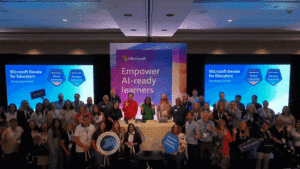
Recognizing that technology alone is insufficient for transformation, the toolkit highlights "Microsoft Elevate for Educators." This initiative expands upon existing programs like the Microsoft Innovative Educator Expert (MIEE) community. By fostering a global network, Microsoft enables leaders to share "field notes" on what works and what doesn’t.

This community-centric approach is vital for solving the "blank page" problem many administrators face when drafting AI policies. Through Elevate, leaders can access peer-reviewed policies, training modules, and collaborative spaces that accelerate the learning curve for everyone involved.
Fostering AI Literacy: The Hour of AI
Parallel to the institutional toolkit, Microsoft continues to emphasize the importance of foundational AI literacy for students. The toolkit features resources for the "Hour of AI," a collaboration with Code.org launched in late 2025. Building on the global success of the "Hour of Code," this initiative introduces learners to the mechanics of AI through gamified experiences like Minecraft Education’s "Generation AI" lesson.
The inclusion of these resources within a leadership toolkit underscores a vital point: institutional transformation is only successful if the students themselves understand the technology shaping their future. AI literacy is framed not just as a technical skill, but as a core competency for modern citizenship.
A Strengthened Research Foundation
The updated toolkit is grounded in the latest pedagogical and technical research. The Research section has been categorized to help teams find evidence-based support for their strategies. This is particularly useful for leaders who must present to boards of directors or address faculty concerns regarding the efficacy of AI tools.
By citing current research on learning outcomes and operational efficiency, the toolkit allows administrators to ground their AI strategy in data rather than hype. This evidentiary approach is crucial for securing long-term funding and institutional buy-in, moving AI from a "special project" to a core component of the institutional budget.

Analysis of Implications: From Adoption to Transformation
The shift from "adoption" to "transformation" signaled by this toolkit update suggests that the "Wild West" era of AI in education is coming to a close. As Microsoft provides more structured frameworks, the expectation for education leaders will shift from mere experimentation to demonstrable results.
The focus on agentic AI and institutional "Sparks" indicates that the next two years will likely see a significant reduction in administrative overhead for schools that successfully implement these tools. However, the toolkit also makes it clear that the human element—leadership, community, and literacy—remains the most critical factor. The redesigned Microsoft Education AI Toolkit serves as both a compass and a toolkit for this journey, providing the technical and strategic scaffolding necessary to build a future where AI supports, rather than replaces, the human-centric mission of education.
As institutions download and implement these resources, the global education landscape will likely see a widening gap between "AI-ready" institutions and those that remain in the pilot phase. For leaders, the updated toolkit represents an invitation to move forward with confidence, backed by a comprehensive roadmap for responsible, sustainable, and impactful AI integration.