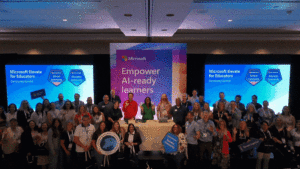


Microsoft Corporation has officially unveiled Microsoft Elevate Washington, a comprehensive strategic initiative designed to democratize access to artificial intelligence technology and training for students and educators throughout its home state. The program represents a major local expansion of the company’s global "Elevate" business unit and seeks to address a widening "opportunity gap" identified between the state’s urban technological hubs and its rural regions. By providing free high-end AI tools, professional development, and technical grants to all 295 public school districts and 34 community and technical colleges in Washington, the initiative aims to ensure the state’s workforce remains competitive in an increasingly automated global economy.
The announcement comes at a pivotal moment for Washington, a state that has historically served as a global incubator for industry-defining innovations. From the early 20th-century expansion of the aerospace sector to the late 20th-century boom in software and retail, Washington has maintained a disproportionate influence on global commerce. However, as cloud computing and generative AI begin to redefine the parameters of labor and education, internal data suggests that the benefits of these advancements are not being distributed equally across the state’s geography. Microsoft executives emphasized that the initiative is a proactive measure to prevent a new form of digital divide from hardening along regional and socioeconomic lines.
The Geographic AI Divide: Data-Driven Insights
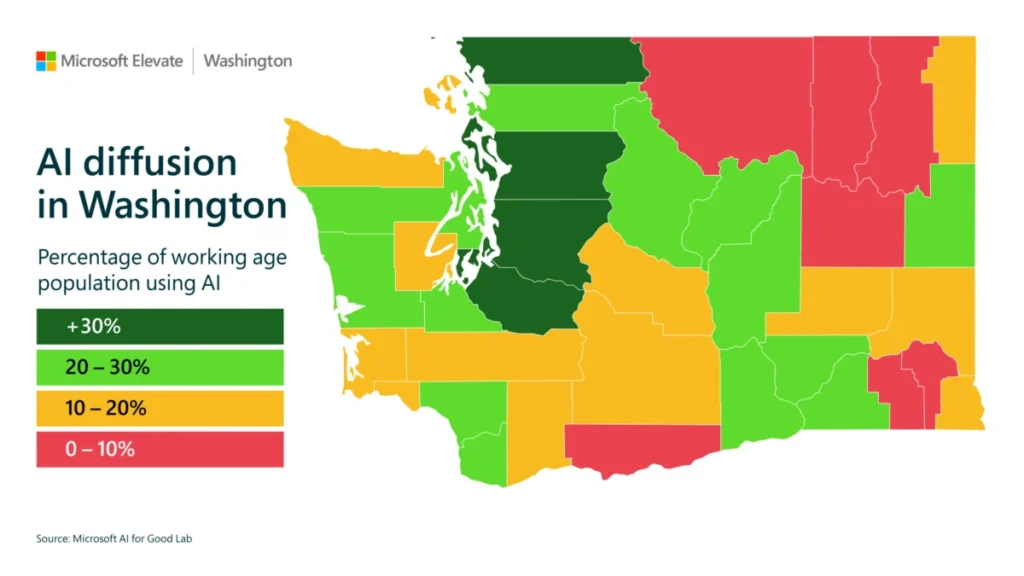
The impetus for Elevate Washington stems from a detailed analysis conducted by Microsoft’s AI for Good Lab. The study tracked the diffusion of AI usage across the state’s 39 counties, revealing a stark contrast in adoption rates. In the tech-heavy corridors of the Puget Sound, AI integration into daily life and work is already well-advanced. Snohomish County leads the state with a 35 percent usage rate among the working-age population, followed closely by King, Pierce, and Whatcom counties, all of which exceed 30 percent adoption.
Conversely, the data highlights a significant lag in the eastern and rural portions of the state. In seven rural counties, AI usage remains below 10 percent. The disparity is most pronounced in Ferry County, where only 2.5 percent of residents utilize AI tools—a tenfold difference compared to Snohomish County. This "diffusion gap" mirrors earlier challenges faced by the state regarding broadband internet access. Microsoft’s leadership noted that while broadband was a matter of connectivity, AI literacy is a matter of economic mobility. In the emerging economy, individuals proficient in AI are expected to see higher productivity and better career prospects than those without such skills.
Implementation Timeline and Institutional Support
The Elevate Washington initiative is structured around a phased rollout designed to give educational institutions time to prepare their infrastructure and staff. The program is tailored for two primary cohorts: K-12 school districts and the community college system.
Beginning in January 2026, Microsoft will provide Copilot Studio to all 295 school districts and 34 community colleges free of charge for a period of three years. Copilot Studio is a low-code platform that allows users to create custom AI agents—automated tools that can handle specific tasks such as scheduling, data analysis, and lesson planning. To facilitate this rollout, Microsoft is offering $25,000 technology consulting grants to 10 selected school districts and 10 community colleges. These "early adopter" institutions will work with consultants to build bespoke AI agents, creating a blueprint that will later be shared with other districts across the state.
For the student body, the rollout is scheduled for mid-2026. Starting in July 2026, high school students (grades 9-12) will gain access to Copilot Chat, Microsoft 365 desktop applications, and specialized "Learning Accelerators." These tools are designed to provide real-time feedback on reading fluency, mathematical problem-solving, and information literacy. By grounding these tools in learning science, the initiative aims to provide personalized tutoring at scale, potentially narrowing the achievement gap for students in under-resourced districts.
Support for Higher Education and Community Colleges
Recognizing the immediate needs of the adult workforce, Microsoft has introduced a time-sensitive offer for community college students. Through November 15, 2025, every community college student in Washington state is eligible for 12 months of free Microsoft 365 Personal. This package includes Copilot integration within Word, Excel, PowerPoint, and Outlook, alongside one terabyte of cloud storage and advanced security features.
This portion of the program is specifically aimed at career readiness. As community colleges often serve non-traditional students and those seeking rapid retraining, providing immediate access to professional-grade AI tools is seen as a way to bolster the state’s talent pipeline. The goal is to ensure that by the time these students enter the job market, they possess the digital fluency required by modern employers.

Empowering the Educator Workforce
A central pillar of Elevate Washington is its focus on the state’s 100,000 educators. Microsoft has entered into a strategic collaboration with the Washington Office of Superintendent of Public Instruction (OSPI), the Washington Education Association (WEA), and the National Education Association (NEA) to provide comprehensive professional development.
The training programs will focus on two primary objectives: administrative efficiency and instructional innovation. By using generative AI to handle repetitive tasks—such as grading rubrics, attendance tracking, and parent communications—educators can reclaim time for direct student engagement. To support this, Microsoft will co-host an AI Innovation Summit, an event intended to bring together over 1,000 educators and administrators to discuss best practices for ethical AI implementation in the classroom.
Furthermore, Microsoft is providing cash grants to help schools integrate AI into their curriculum. These funds are intended to offset the costs of teacher training and the development of new instructional materials that incorporate AI literacy as a core competency.
Strategic Partnerships and Global Context
The launch of Elevate Washington is part of a larger $4 billion global commitment by Microsoft over the next five years to support nonprofits and educational institutions through cash and cloud services. While the global initiative provides the framework, the Washington-specific program leverages the company’s deep local roots and its workforce of over 50,000 employees based in the state.
Microsoft is also partnering with Code.org to implement the "Hour of AI" in schools across the state. This partnership aims to demystify AI for younger students through hands-on workshops led by Microsoft volunteers. Additionally, the company is extending its training programs to youth development workers and career navigators in community organizations, ensuring that the support system surrounding students is equally equipped to navigate the AI era.
Analysis of Economic and Social Implications
The Elevate Washington initiative represents a significant shift in how private technology firms interact with public education systems. By offering high-value software and consulting for free, Microsoft is effectively setting a new standard for corporate social responsibility in the tech sector. However, the move also carries long-term strategic implications for the regional economy.
Economists note that "first-mover advantage" in technology adoption often determines which regions thrive during industrial transitions. By targeting rural Washington, Microsoft is attempting to prevent the economic stagnation that often occurs when technological revolutions bypass non-urban areas. If successful, the program could transform Washington into a "living lab" for AI-integrated education, providing a model for other states and nations.
There are also pedagogical implications to consider. The introduction of AI agents and personalized learning tools into high schools marks a departure from traditional "one-size-fits-all" instruction. While proponents argue that AI will allow for more differentiated learning, critics in the broader educational field have raised concerns regarding data privacy and the potential for over-reliance on automated systems. Microsoft has addressed these concerns by emphasizing that its tools are designed to "augment" rather than replace the teacher-student relationship, focusing on "learning science" and critical thinking.
Conclusion and Future Outlook
As the 2026 implementation dates approach, the success of Elevate Washington will likely depend on the degree of grassroots participation from local school boards and community leaders. Microsoft has issued an "open call" for innovators and educators to partner with the company to build scalable solutions.
The initiative underscores a fundamental belief that the future of AI is intrinsically linked to human creativity and problem-solving. By investing in the human capital of its home state, Microsoft is attempting to ensure that the next century of Washington’s history is as innovative as the last. For the 500,000 students and 100,000 educators targeted by the program, the coming years will represent a transformative period of learning, as the state attempts to bridge the gap between the technology of today and the opportunities of tomorrow.