
The Greek language, with a history spanning over three millennia, possesses a sophisticated lexicon for expressing human emotion, particularly within the realms of love, family, and social cohesion. Central to this linguistic tradition is the phrase S’agapo (Σ’ αγαπώ), meaning "I love you," which serves as the foundational pillar for a vast array of endearment terms. In Greek culture, the use of affectionate language is not merely a romantic gesture but a fundamental social lubricant used to reinforce bonds between partners, family members, and close friends. By integrating specific nouns such as agapi mou (my love) or kardia mou (my heart), speakers can navigate a complex hierarchy of intimacy that characterizes both mainland Greece and the broader Greek-speaking diaspora, including Cyprus.
The Historical and Philosophical Foundations of Greek Affection
To understand modern Greek endearments, one must look to the philosophical roots of the language. Ancient Greek distinguished between at least eight different types of love, a categorization that continues to influence modern usage. These include Eros (romantic, passionate love), Philia (deep friendship), Storge (familial love), Agape (unconditional, selfless love), Ludus (playful love), Pragma (long-standing, committed love), Philautia (self-love), and Mania (obsessive love).
Modern endearments are often linguistic descendants of these concepts. For instance, the common term agapi mou is derived from Agape, suggesting a love that is profound and often selfless. This historical context provides the Greek language with an emotional depth that allows for a high degree of specificity when addressing loved ones. Linguists note that the prevalence of these terms in daily conversation reflects a cultural emphasis on "Philotimo"—a complex Greek concept representing honor, virtue, and the way one interacts with their community and family.
Structural Mechanics: The Role of the Possessive and Diminutives
A defining characteristic of Greek endearments is the consistent use of the post-nominal possessive pronoun mou (μου), meaning "my." In Greek grammar, the placement of mou after the noun—such as in zoi mou (my life)—is essential for creating a sense of personal connection and belonging. This structure differs significantly from English, where the possessive precedes the noun.
Furthermore, the Greek language utilizes a systematic approach to creating nicknames through diminutive suffixes. By adding endings such as -aki, -itsa, -oulis, or -oula to a proper name or a standard noun, the speaker conveys a sense of smallness, cuteness, or heightened affection. For example, the name Maria may become Marioula, or the word for child, paidi, becomes paidaki. This "diminutive culture" is a cornerstone of Greek domestic life, used by parents to address children and by adults to signal a close, informal relationship.
A Categorical Analysis of Common Endearment Terms
The application of affectionate terms in Greek is highly contextual, with specific words reserved for different social tiers. Below is an analysis of the most frequently utilized terms and their cultural implications.
Universal Terms of Endearment
These terms are widely applicable across romantic, familial, and sometimes close platonic relationships:
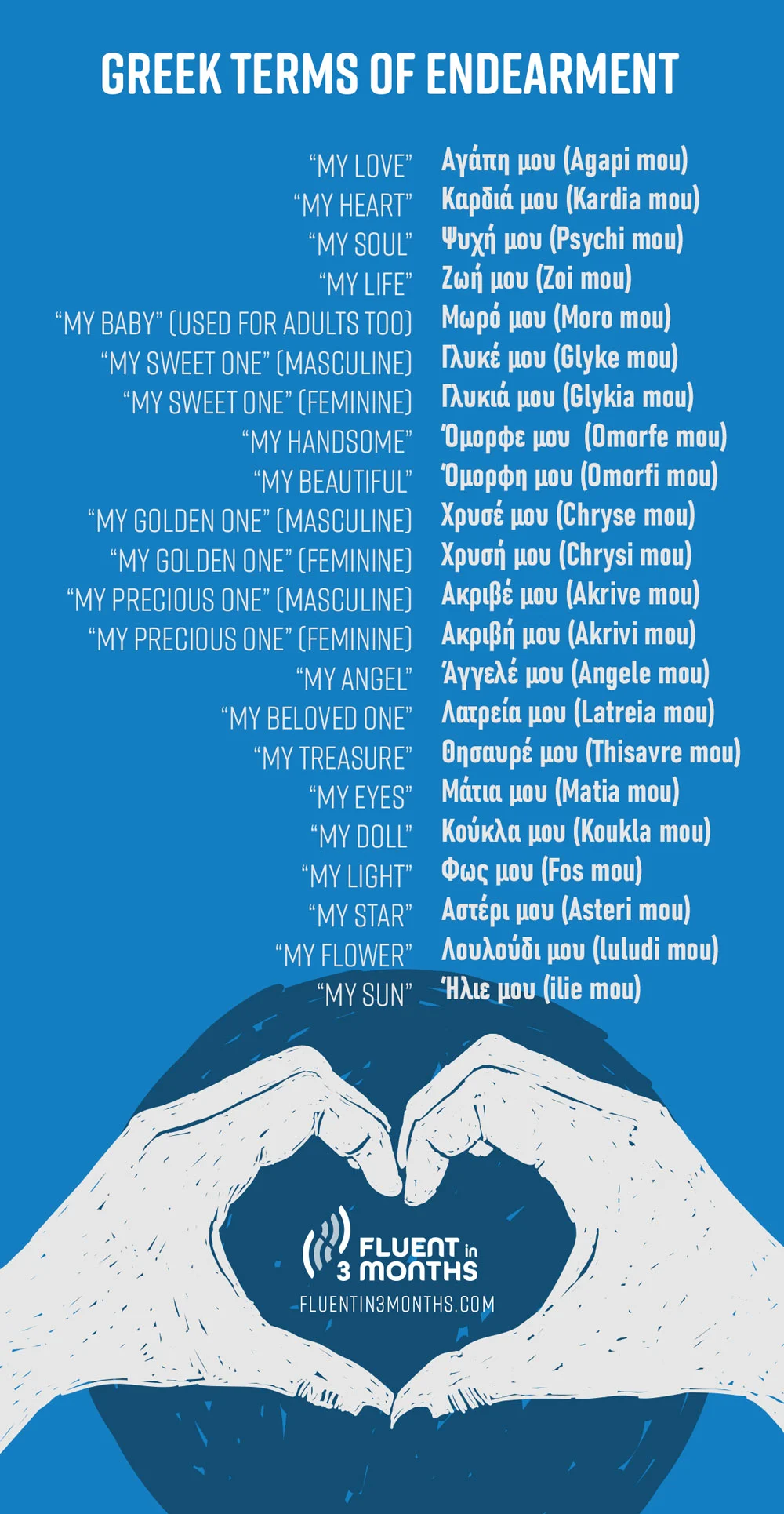
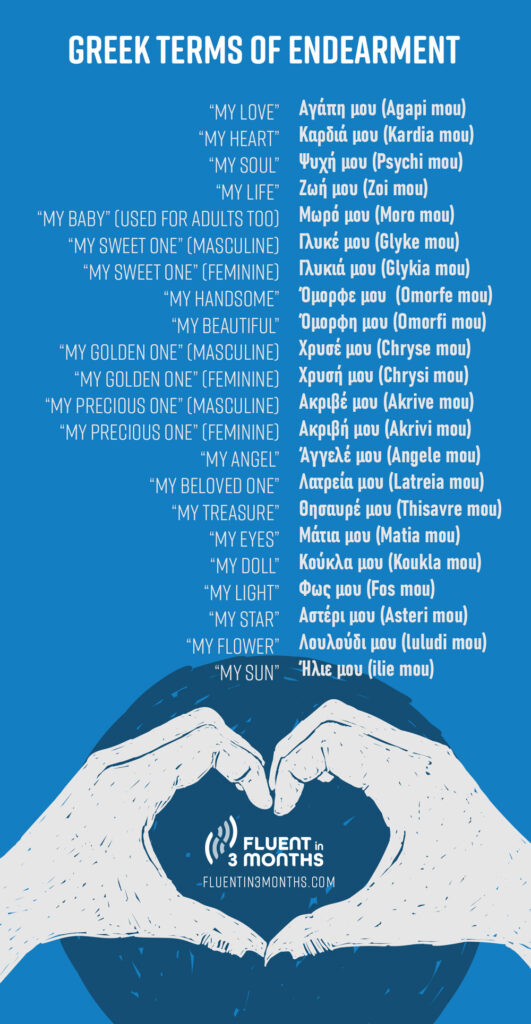
- Agapi mou (Αγάπη μου): "My love." The most versatile and common term.
- Kardia mou (Καρδιά μου): "My heart." Implies that the person is vital to the speaker’s existence.
- Psychi mou (Ψυχή μου): "My soul." Represents a deep, spiritual connection.
- Zoi mou (Ζωή μου): "My life." Used to signify the utmost importance of the individual.
- Moro mou (Μωρό μου): "My baby." Commonly used for infants, but also ubiquitous among romantic partners of all ages.
- Matia mou (Μάτια μου): "My eyes." This term suggests that the person is as precious as the speaker’s own sight.
Gender-Specific and Descriptive Terms
Greek is a gendered language, requiring adjectives and nouns to match the gender of the person being addressed:
- Glyke mou / Glykia mou (Γλυκέ μου / Γλυκιά μου): "My sweet one" (masculine/feminine).
- Omorfe mou / Omorfi mou (Όμορφε μου / Όμορφη μου): "My handsome / My beautiful."
- Chryse mou / Chrysi mou (Χρυσέ μου / Χρυσή μου): "My golden one."
- Akrive mou / Akrivi mou (Ακριβέ μου / Ακριβή μου): "My precious/dear one."
Romantic Specificity
While agapi mou is standard, romantic partners often employ more targeted terms:
- Agori mou (Αγόρι μου): "My boy" (used for a boyfriend).
- Andra mou (Άντρα μου): "My man" (often used for a husband).
- Koritsi mou (Κορίτσι μου): "My girl" (used for a girlfriend).
- Gynaika mou (Γυναίκα μου): "My woman/wife."
Familial Bonds and the Centrality of the Domestic Unit
In Greek society, the family is the primary social unit, and the language reflects this through specialized "cute" versions of familial titles. This practice, often referred to as "manoula" culture, emphasizes the warmth and protection of the home.
Data from sociological studies on Mediterranean cultures suggest that the use of diminutive familial terms correlates with higher levels of multi-generational household interaction. Common examples include:
- Manoula mou (Μανούλα μου): "My mommy/momma" (from mitera).
- Bambaka mou (Μπαμπάκα μου): "My daddy" (from bambas).
- Yiayioula mou (Γιαγιούλα μου): "My sweet grandma" (from yiayia).
- Pappouli mou (Παππούλη μου): "My sweet grandpa" (from pappous).
- Adelfaki mou (Αδελφάκι μου): "My little brother/sister" (from adelfos/adelfi).
These terms are frequently used even by adults when speaking to their elderly parents, reinforcing a lifelong bond that transcends the typical markers of maturity found in Western European or North American cultures.
Social and Platonic Dynamics: The Language of Friendship
Among friends, Greek endearments serve to establish "parea"—a group of friends who gather to share life experiences. Terms such as file mou (my friend) are standard, but the use of koukla mou (my doll) or glike mou (my sweet) among female friends is common to denote a high level of comfort and sisterhood.
In male friendships, the use of re (a colloquial particle) combined with names or terms like file creates a casual, fraternal atmosphere. The evolution of these terms shows a move toward more informal, yet still deeply affectionate, social interactions in urban centers like Athens and Thessaloniki.
Phonetic Considerations and Cultural Integration
For non-native speakers, the correct pronunciation of these terms is vital for achieving the intended emotional effect. Greek contains several phonemes that do not have direct equivalents in English:
- The Gamma (γ): A soft, breathy "g" sound, as in agapi.
- The Delta (δ): A voiced "th" sound, as in kardia.
- The Theta (θ): An unvoiced "th" sound, as in thisavre (my treasure).
Linguistic experts suggest that when learners master these sounds, they are perceived as more culturally integrated and "fluent" in the emotional nuances of the language. This integration is particularly important in the context of "Xenia," the ancient Greek concept of hospitality and ritualized friendship. Using the correct endearment term can transform a formal interaction into a warm, welcoming exchange.
Chronology of Linguistic Evolution
The timeline of Greek endearments shows a transition from the formal and often poetic language of the Byzantine and Ottoman periods to the more direct and "Demotic" (popular) language of today.
- 19th Century: Use of more formal, often French-influenced terms among the aristocracy.
- Mid-20th Century: The rise of Demotic Greek leads to the standardization of terms like moro mou and agapi mou in popular music and cinema.
- 21st Century: Digital communication and social media have further popularized shortened versions and the widespread use of diminutives in text-based interactions.
Broader Impact and Implications
The persistent use of endearment terms in Greece has significant implications for mental health and social stability. Psychologists have noted that the frequent verbalization of affection contributes to a strong sense of security and belonging within the family unit. Furthermore, for the Greek diaspora, these words serve as a "linguistic umbilical cord," connecting younger generations to their ancestral heritage even if their functional command of the Greek language is limited.
In a globalized world where many languages are becoming more utilitarian, the Greek language maintains a rich emotional vocabulary that prioritizes human connection. Whether through the romantic whisper of psychi mou or the playful call of a grandmother to her Yiorgaki, these terms of endearment remain a vital expression of the enduring Greek spirit. As the language continues to evolve, its architecture of affection remains a testament to the cultural value placed on love, family, and the bonds that define the human experience.