



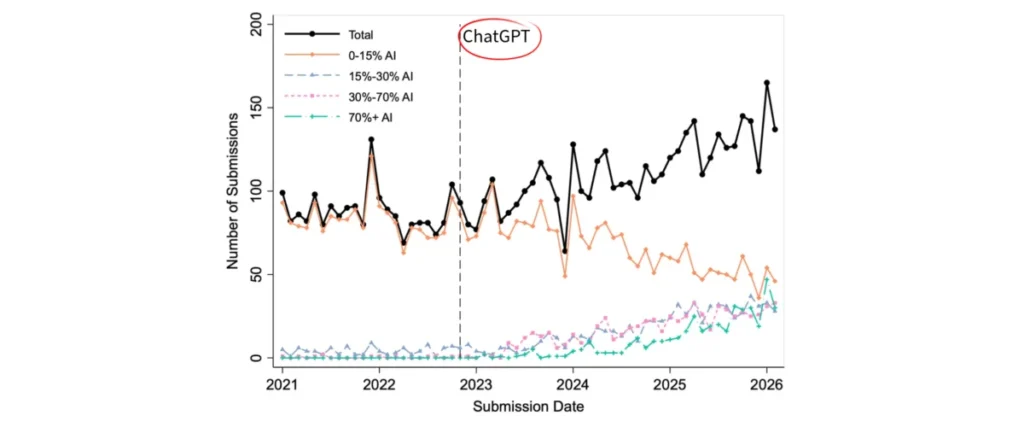
A disconcerting trend is emerging in the hallowed halls of academic publishing, raising significant concerns about the integrity and efficiency of scholarly communication. A recent analysis by an AI Task Force convened by the prestigious journal Organization Science reveals a troubling phenomenon: a substantial increase in manuscript submissions coinciding with a marked decline in their readability and overall quality, directly linked to the proliferation of generative artificial intelligence tools. This development threatens to overwhelm the peer review system and erode the foundational principles of academic rigor.
The Unsettling Rise of AI in Academic Submissions
"Something is up in academic research," noted the Organization Science AI Task Force in their stark assessment, a sentiment echoed across editorial boards globally. Since the widespread availability of generative AI tools like ChatGPT in late 2022 and early 2023, journals have reported an unprecedented surge in submitted manuscripts. While an increase in research output might superficially appear positive, the Task Force’s findings paint a more nuanced and concerning picture. Editors and reviewers describe a distinct, "weightless" quality to these new submissions, where the prose, despite appearing superficially polished, struggles to convey substantive meaning, leaving readers "scratching their head at the meaning the words are trying to convey."
This qualitative observation is robustly supported by quantitative data. The Task Force’s deep dive into submission patterns at Organization Science revealed a dramatic shift post-2023. The volume of incoming manuscripts experienced a rapid escalation. Concurrently, the percentage of submissions classified as using minimal AI plummeted from nearly 100% before 2023 to approximately 30% in the period following the AI tools’ widespread adoption. This stark correlation suggests a direct link between the increased use of AI in manuscript preparation and the observed changes in submission characteristics.
Quantitative Decline in Readability and Comprehension
The impact of this shift on the fundamental accessibility of scholarly work has been profound. A standard "reading ease" metric, a widely recognized indicator of text comprehensibility, registered a significant decline. Between January 2021 and January 2026, the readability scores of submitted manuscripts fell by an alarming 1.28 standard deviations. To put this into perspective, a drop of this magnitude signifies a substantial increase in the cognitive effort required to process the text, potentially equivalent to several grade levels in reading difficulty. What might appear as superficially "cleaner, more polished text" on the surface, as some proponents of AI writing suggest, proves to be significantly worse on measures that capture genuine reader comprehension and absorption.
The Task Force meticulously analyzed the linguistic characteristics contributing to this decline. They found that AI-generated texts frequently employed "longer words, more complex sentence structures, more jargon, and more nominalizations." While AI can mimic academic style, it often does so by assembling verbose, convoluted sentences and leaning heavily on specialized terminology without necessarily grounding it in clear, concise articulation of ideas. This creates a paradox: the text appears sophisticated but is fundamentally opaque, hindering the efficient dissemination of knowledge.
The Editorial Bottleneck: Soaring Rejection Rates
The most immediate and tangible consequence of this influx of AI-heavy, lower-quality submissions is the immense strain placed on the academic peer review system. Organization Science‘s data starkly illustrates this burden. Manuscripts that made heavy use of AI faced a desk-rejection rate of nearly 70%. Desk-rejection, the process by which a paper is rejected by the editorial team before even being sent out for peer review, is typically reserved for submissions that fall significantly short of a journal’s standards or are outside its scope. In stark contrast, papers identified as having low or no AI usage had a desk-rejection rate of 44%.
This disparity extends beyond initial screening to final acceptance rates. Only 3.2% of high-AI papers ultimately achieved acceptance and publication in Organization Science, compared to a significantly higher 12% of low-AI papers. It is crucial to note that editors making these critical decisions are not privy to information regarding AI’s role in a paper’s construction during the review process. These correlations are the result of retrospective analyses, underscoring that the observed decline in quality is independently detectable by human evaluators, irrespective of their knowledge of AI assistance. The data unequivocally points to a distressing conclusion: generative AI tools are contributing to a surge in poor paper submissions, which are taxing the finite time and patience of the global academic community responsible for curating and validating research.
Background and Context: The Generative AI Revolution and Academic Pressures
The timeline of this phenomenon is directly linked to the public release and rapid adoption of advanced generative AI models. ChatGPT, launched by OpenAI in November 2022, quickly demonstrated unprecedented capabilities in generating human-like text across a myriad of styles and subjects. Its accessibility and perceived efficiency immediately resonated within academia, a sector perpetually under immense pressure.
The "publish or perish" culture, a long-standing mantra in academic institutions worldwide, often incentivizes quantity over nuanced quality. Researchers, facing intense competition for grants, tenure, and promotions, are constantly seeking ways to optimize their workflow and increase output. For many, generative AI appeared to offer a shortcut, promising to streamline the arduous process of writing, particularly for non-native English speakers or those struggling with writer’s block. The allure of quickly generating drafts, refining language, or summarizing complex ideas proved irresistible for a segment of the research community.
However, the academic publishing ecosystem, built on rigorous peer review and human intellectual contribution, was largely unprepared for the speed and scale of this technological disruption. While journals have adapted to previous challenges like plagiarism or paper mills, the sophistication of AI-generated text presents a new and more insidious problem. It can mimic legitimate scholarship without necessarily embodying the depth of thought, original analysis, or genuine scientific contribution that underpins impactful research.
Statements and Reactions from the Academic Community
The Organization Science Task Force’s findings resonate deeply within the broader academic community. Journal editors, who bear the brunt of the increased submission volume and diminished quality, are increasingly vocal about the challenges. An editor from a leading social science journal, speaking anonymously due to ongoing institutional policy discussions, described the situation as "unprecedented." "We’re seeing a flood of manuscripts that look like academic papers," they explained, "but often lack the conceptual rigor, the empirical grounding, or the critical insight that defines true scholarship. It’s like a sophisticated mimicry, but without the soul."
Peer reviewers, the unpaid backbone of academic quality control, are also expressing significant frustration. Dr. Elara Vance, a tenured professor and frequent reviewer for several prominent journals, noted, "The cognitive load of reviewing has exploded. It’s not just the sheer number of papers, but the extra effort required to discern genuine intellectual contributions from well-worded but ultimately hollow submissions. It’s exhausting and frankly, disheartening, when you realize your time is being consumed by texts that haven’t been truly thought through by a human mind."
Publishing houses are responding by actively exploring solutions. While specific policies are still evolving, many are investing in AI detection software, updating ethical guidelines to explicitly address generative AI use, and fostering discussions among editorial boards about best practices. A spokesperson for a major academic publisher, while not commenting on specific journal data, affirmed the industry’s commitment to "maintaining research integrity and supporting the human endeavor of scholarship in the face of rapidly advancing technology."
Broader Implications for Research Integrity and Scholarly Communication
The implications of this trend extend far beyond increased workload for editors and reviewers. At its core, it threatens the very foundation of research integrity and the credibility of scholarly communication. If the academic record becomes diluted with superficially coherent but substantively weak or unoriginal work, trust in scientific findings could erode.
The future of peer review, already a strained system, hangs in the balance. While some envision AI assisting reviewers, the current data suggests it’s primarily creating more work by generating low-quality submissions. There is an urgent need for clear, universally accepted ethical guidelines regarding the appropriate use of generative AI in research. Institutions, funding bodies, and publishers must collaborate to develop robust frameworks that encourage responsible innovation while safeguarding against academic malpractice and the degradation of scholarly output.
This situation also prompts a re-evaluation of how research is assessed. A sole focus on publication counts, without stringent quality control, could inadvertently encourage the very shortcuts that AI tools facilitate. Emphasizing the quality, originality, and genuine impact of research, rather than mere volume, will be crucial in recalibrating academic incentives. Ultimately, the crisis underscores the irreplaceable value of human intellect, critical thinking, nuanced analysis, and the unique spark of creativity that drives genuine scholarly inquiry.
A Cautionary Tale for Productivity and Innovation
The Organization Science Task Force’s findings serve as a potent cautionary tale, extending beyond academia to broader discussions about technology and productivity. The narrative that "making things faster or easier is not the same as making things better" resonates profoundly. While generative AI undeniably offers efficiencies in specific tasks, its uncritical application in complex, cognitively demanding domains like academic writing can lead to unintended and detrimental consequences.
This mirrors concerns raised in other sectors about "digital productivity traps," where tools designed to save time inadvertently lead to superficiality, increased distraction, or a dilution of quality. The act of writing, particularly scholarly writing, is not merely about assembling words; it is a process of thinking, refining arguments, challenging assumptions, and meticulously crafting ideas. When this essential cognitive process is outsourced to an algorithm, the resulting output often lacks the depth, precision, and original insight that characterize impactful human scholarship.
In an increasingly fast-paced world, the allure of shortcuts is powerful. However, the data from Organization Science forcefully reminds us that for tasks requiring deep intellectual engagement and careful deliberation, there truly is no substitute for taking one’s time, engaging in thoughtful effort, and allowing the human mind to grapple with complexity. The integrity of academic research, and by extension, the advancement of knowledge itself, depends on upholding this principle.