



Microsoft has officially launched its Discovery platform into general availability, marking a significant milestone in the application of artificial intelligence to scientific research and industrial innovation. Announced at the recent Build 2026 conference, this service is positioned as a production-ready environment empowering scientists and researchers to leverage advanced AI agents for accelerating complex discovery processes. The platform is meticulously designed to streamline and coordinate critical research phases, including data analysis, hypothesis generation, sophisticated experimentation, and comprehensive knowledge management, all orchestrated through a sophisticated collection of specialized AI agents. This move underscores Microsoft’s deepening commitment to embedding agentic AI capabilities across its diverse portfolio, reflecting a burgeoning global interest in harnessing intelligent systems to propel scientific and industrial breakthroughs at an unprecedented pace.
The Dawn of Agentic AI in Scientific Discovery
The release of Microsoft Discovery into general availability signifies a pivotal moment in the evolution of scientific computing, moving beyond mere analytical tools to truly autonomous, reasoning AI systems. Agentic AI refers to a paradigm where AI models are not just reactive but are capable of planning, reasoning, utilizing tools, and executing multi-step processes to achieve complex goals. In the context of scientific research, this translates into AI agents that can actively engage in the scientific method: sifting through vast datasets, formulating plausible hypotheses, designing and even simulating experiments, analyzing results, and iteratively refining their understanding. This approach is a stark contrast to earlier AI applications that primarily focused on pattern recognition or predictive analytics, offering a transformative shift towards intelligent automation in the often-arduous cycles of research and development.
Microsoft’s broader strategy, evident across Azure, Microsoft Foundry, GitHub, and Microsoft 365, has been consistently building towards this agent-centric future. The Discovery platform is a direct manifestation of this vision, specifically targeting the high-value, data-intensive, and often expensive domain of scientific R&D. Traditional research cycles are notoriously time-consuming and resource-intensive, with drug discovery, for example, often taking over a decade and billions of dollars for a single successful compound. The sheer volume of scientific literature and experimental data generated daily far exceeds human capacity for comprehensive review and synthesis. It is within this challenging landscape that agentic AI, as embodied by Microsoft Discovery, promises to unlock new efficiencies and accelerate the pace of innovation.
Core Architecture and Functionality of Microsoft Discovery

At the heart of the Microsoft Discovery platform lies a sophisticated, graph-based knowledge engine. This engine is engineered to seamlessly integrate and connect disparate data sources, ranging from an organization’s proprietary research data—such as internal experimental results, clinical trial data, or material properties—to a vast repository of external scientific information, including published papers, public databases, and chemical libraries. By constructing a unified, interconnected knowledge graph, the platform enables AI agents to reason across complex relationships that might otherwise remain obscured. These agents are designed to evaluate competing findings, identify novel connections, and support iterative research processes with a level of depth and speed unattainable by conventional methods.
The Microsoft Discovery Engine is the operational core, supporting the fundamental loop of scientific inquiry: moving from initial evidence to the generation of testable hypotheses, then through the execution of experiments (or simulations), rigorous analysis of the outcomes, and subsequent iterations based on new insights. This continuous feedback loop is critical for scientific progress, and the platform aims to significantly compress the time required for each cycle. For instance, in materials science, an agent could analyze existing data on compounds, hypothesize new structures with desired properties, simulate their behavior, and suggest optimal synthesis pathways, all before a single physical experiment is conducted.
Ensuring Governance, Reproducibility, and Human Oversight
A critical consideration for any AI system deployed in sensitive research environments is governance, transparency, and the maintenance of human oversight. Microsoft has proactively addressed these concerns, positioning Discovery as a system that not only connects to institutional knowledge, domain-specific data, and advanced simulation tools but also ensures that all AI-generated outputs are reviewable and workflows are reproducible. The company explicitly states that the platform is designed to keep "human judgment" firmly at the center of all research decisions. This commitment is paramount in fields like drug development or advanced materials research, where accuracy, ethical considerations, and regulatory compliance are non-negotiable.
For enterprise IT and research organizations, the platform offers features designed to facilitate audit trails, version control for AI-generated insights, and clear attribution for data sources. This ensures that while AI agents perform the heavy lifting of data synthesis and hypothesis generation, human experts retain the ultimate authority to validate findings, interpret nuanced results, and make strategic research decisions. The emphasis on reproducibility is particularly vital in scientific research, where the ability to verify and replicate experimental outcomes is a cornerstone of scientific integrity. By providing a structured, traceable environment for agent-driven research, Microsoft aims to build trust and accelerate the adoption of these powerful tools within regulated and rigorous scientific domains.
Democratizing Access: The Microsoft Discovery App Preview
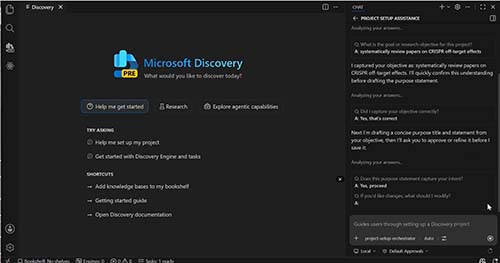
Recognizing that not all research teams or institutions are immediately prepared for a full enterprise deployment of a comprehensive platform, Microsoft also launched a preview of the Microsoft Discovery app. This local desktop experience is specifically aimed at individual researchers, students, academic labs, and smaller scientific teams seeking to explore the capabilities of agentic AI without the immediate need for extensive infrastructure integration.
The app, which can be easily downloaded from GitHub and integrated with a GitHub Copilot account, serves as an accessible entry point. It allows users to begin experimenting with agent-powered literature review, sophisticated hypothesis generation, advanced scientific reasoning, and iterative experimentation on a smaller, more manageable scale. This approach lowers the barrier to entry, enabling a broader community of scientists to familiarize themselves with agentic AI workflows. The preview phase provides invaluable feedback to Microsoft while simultaneously empowering a new generation of researchers to integrate AI into their daily work, paving the way for eventual migration to the broader Microsoft Discovery platform as their needs and capabilities grow. This strategy mirrors Microsoft’s successful rollout of other AI tools, gradually introducing powerful capabilities to a wider audience.
Transformative Early Use Cases Across Academia and Industry
The real-world applicability and transformative potential of Microsoft Discovery are already being demonstrated through several pioneering early adopters across diverse sectors:

-
Yale Engineering: Researchers at Yale Engineering have leveraged the Discovery Engine in their work related to small molecule design for grid-scale aqueous organic redox flow batteries. Professor David Kwabi highlighted the synergy between human-led experimentation and the AI’s unparalleled ability to explore vast chemical design spaces. This combination allows for the rapid identification of promising candidates for energy storage solutions, significantly compressing the development timeline for next-generation battery technologies crucial for renewable energy integration.
-
Pacific Northwest National Laboratory (PNNL): PNNL is actively collaborating with Microsoft Discovery in critical areas such as energy storage and biosystems engineering. Their work includes developing "self-driving scientific workflows" that seamlessly connect AI agents with advanced laboratory automation systems. This integration creates intelligent experimental pipelines where AI can not only design experiments but also directly control robotic lab equipment, execute procedures, and analyze results in real-time, leading to unprecedented levels of experimental throughput and discovery acceleration.
-
Ginkgo Bioworks: A leader in biological discovery, Ginkgo Bioworks is partnering with Microsoft to deploy specialized agents capable of analyzing complex biological datasets, generating novel hypotheses about gene function or metabolic pathways, and designing intricate experiments to test these theories. This collaboration aims to unlock new insights into synthetic biology, accelerate biomanufacturing processes, and potentially revolutionize drug and chemical production.
-
BHP: In the commercial and industrial sector, global mining giant BHP is utilizing Discovery to study advanced copper leaching methods. By applying agentic AI to optimize mineral extraction processes, BHP aims to enhance efficiency, reduce environmental impact, and uncover more sustainable mining techniques, addressing critical challenges in resource management.
-
Syensqo: A materials science company, Syensqo is employing agentic AI in its research tied to developing next-generation heat transfer fluids for semiconductor manufacturing. As semiconductor technology pushes the boundaries of miniaturization and power density, efficient heat dissipation becomes paramount. Discovery helps Syensqo explore vast material compositions and designs to identify optimal fluid formulations, accelerating innovation in a highly competitive industry.

-
GSK: The pharmaceutical giant GSK is actively exploring Microsoft Discovery for various drug development workflows. From identifying potential drug targets to optimizing lead compounds and predicting efficacy or toxicity, agentic AI has the potential to drastically reduce the time and cost associated with bringing new medicines to market, offering hope for faster treatments for complex diseases.
Broader Market Context and Strategic Implications
The launch of Microsoft Discovery arrives amidst a booming market for AI in scientific research and development. Analysts project the global AI in drug discovery market alone to reach tens of billions of dollars within the next few years, with similar growth expected across materials science, biotechnology, and industrial R&D. The increasing complexity of scientific challenges, coupled with the exponential growth of data, makes AI an indispensable tool.
Microsoft’s entry into this specialized domain with a production-ready platform is a strategic move, positioning the company as a key enabler for scientific advancement. It leverages their existing strengths in cloud computing (Azure), development tools (GitHub), and enterprise solutions (Microsoft 365) to offer a comprehensive ecosystem. While numerous startups and academic groups are developing AI tools for specific scientific tasks, Microsoft’s offering aims for a more integrated, agent-orchestrated platform that can handle end-to-end research workflows. This integrated approach, backed by Microsoft’s robust infrastructure and security protocols, offers a compelling proposition for large enterprises and research institutions.
However, the adoption of agentic AI in science is not without its challenges. Issues such as data privacy, the potential for algorithmic bias in hypothesis generation, and the ongoing need for human interpretation of complex AI outputs remain crucial considerations. Microsoft’s emphasis on human judgment and reproducibility is a direct response to these concerns, aiming to build a responsible AI framework for scientific discovery. The platform’s success will ultimately depend on its ability to consistently deliver verifiable results, seamlessly integrate with existing research infrastructures, and empower scientists to ask and answer questions that were previously intractable.

Availability and Future Outlook
Microsoft Discovery is generally available now, marking its readiness for broad enterprise and institutional deployment. The Microsoft Discovery app, designed for individual and smaller team use, remains in preview. Microsoft has indicated that features within the preview app may evolve and change based on user feedback before its final release, demonstrating an iterative development approach common in software development.
For detailed information and to explore the platform’s capabilities, interested parties are encouraged to visit the official Microsoft blog. The future of scientific research stands poised for a dramatic transformation, and with platforms like Microsoft Discovery, the journey towards accelerated discovery, enhanced efficiency, and unprecedented innovation is gaining significant momentum. This marks not just a technological advancement but a fundamental shift in how humanity approaches the grand challenges of science and engineering.