


The Ottawa Art Gallery buzzed with intellectual energy on June 23, 2024, as Universities Canada hosted "Scholars to Scholars: Advancing Knowledge, Impact and Community." This pivotal event brought together a dozen distinguished scholarship recipients, celebrating their groundbreaking research and fostering a shared commitment to community engagement, knowledge mobilization, and societal transformation. The day served as a powerful testament to the evolving landscape of academic inquiry, emphasizing that true research impact extends far beyond theoretical discovery and publication, reaching into the very fabric of communities it aims to serve.
The event was meticulously organized by Universities Canada, the publisher of University Affairs, to highlight the significant contributions of six key scholarship programs: the Canadian Federation of University Women, the Flight 302 Legacy Award, International Development Research Awards (IDRA), Queen Elizabeth Scholars, Canadian International Development Scholarships 2030 (BCDI 2030), and the Molloy Medicine Award. These programs collectively support a diverse cohort of emerging scholars dedicated to addressing pressing global and national challenges.
At the heart of the discussions was the philosophy that research gains its greatest value when it is co-created with and directly benefits the communities it studies. This sentiment was echoed by Ugochukwu Okoye, a PhD candidate in anthropology at Carleton University and a 2024 SSHRC doctoral fellow, who also received the inaugural Flight 302 Legacy Award. Mr. Okoye’s research delves into the resilience of African societies, particularly examining how community-led organizations bridge gaps in state support by leveraging diaspora networks for grassroots development and acting as alternative governance structures. For Okoye, his academic pursuits are intrinsically linked to fostering "meaningful, respectful, and sustained relationships" with the people and communities central to his work.
The Centrality of Community Engagement
The first panel, aptly titled "Building Meaningful Community Connections," set a precedent for the day’s discourse. Scholars shared deeply personal accounts of their journeys, underscoring the ethical imperative of involving communities as active participants, not passive subjects, in the research process. The dialogue illuminated how collaborative research methodologies can not only yield more accurate and relevant findings but also empower communities and foster mutual understanding.
Dr. Mona Ghadirian, an independent researcher associated with Participatory Research at McGill University and a former Queen Elizabeth Scholar, articulated a profound perspective: "Community engagement isn’t just one research tool, but I think it’s the purpose of research in general; I think it gives you an opportunity to reflect on your assumptions that you have within the research." This statement resonated deeply, highlighting the self-reflective and transformative potential inherent in community-based research. Dr. Atul Jaiswal, research lead at the Perley Health Centre of Excellence in Frailty-Informed Care and an adjunct professor at the University of Ottawa, further emphasized the practical implications of this approach. He posited, "Research should be a tool for change. If that’s not happening, then what’s the point of doing this research?" This question serves as a powerful reminder of the ultimate goal of academic inquiry: tangible, positive societal change.
The panel also featured Mr. Okoye, who provided insights into his fieldwork, demonstrating how his anthropological approach prioritizes reciprocal learning and shared decision-making. The emphasis on building trust and long-term partnerships was a recurring theme, suggesting a paradigm shift in how academic institutions view and evaluate community-engaged scholarship. This approach moves beyond transactional relationships, advocating for genuine partnerships that respect local knowledge and priorities.
Mobilizing Knowledge for Real-World Impact
The second panel, "Knowledge Travels Through People," shifted the focus to the critical process of knowledge mobilization – translating research findings into actionable insights and widespread understanding. Nadia Firoz, a PhD candidate in sociology at Carleton University and a 2024 IDRA recipient, offered three indispensable pieces of advice for scholars embarking on their research journeys. Her work, which investigates the resilience and agency of Rohingya refugee women in Bangladesh amidst persecution and displacement, provides a poignant backdrop for her recommendations.
Ms. Firoz’s first piece of advice was to "start thinking about knowledge mobilization from day one – don’t leave it for later. Don’t wait until your data is analyzed and your report is written and only then ask who should read this." This proactive approach underscores the need to integrate dissemination strategies from the outset, considering diverse audiences and platforms beyond traditional academic publications.
Her second, and perhaps most impactful, counsel was to "invest in relationships rather than products. Sometimes what happens is we become so focused on outputs – that we often forget that knowledge does not really travel through documents. It travels through people." This statement powerfully challenges the overemphasis on quantifiable outputs in academia, highlighting the profound influence of personal connections and networks in sharing and enacting knowledge. It suggests that building strong relationships with stakeholders, policymakers, and community leaders is paramount for ensuring research findings have a lasting impact.
Finally, Ms. Firoz urged scholars to "step outside your own discipline whenever you can. Speak to practitioners or policy makers, community organizations, and also researchers from completely different academic fields and disciplines. Because I have found that those conversations will often challenge you to rethink your work, but it will also help you communicate it more clearly and more meaningfully." This call for interdisciplinary dialogue and engagement with non-academic actors is crucial for fostering innovation and ensuring that research remains relevant and responsive to the complexities of the real world.
The panel also included Joy Karinge, a PhD student in anthropology and African studies at Carleton University and a 2025 Flight 302 Legacy Award recipient, and Dr. Kenneth Gyamerah, an assistant professor at Ontario Tech University and a 2022 IDRA recipient. Their contributions further enriched the discussion on how to effectively bridge the gap between academic research and its practical application, emphasizing the importance of clear communication and accessible knowledge sharing.
Research as a Catalyst for Societal Change
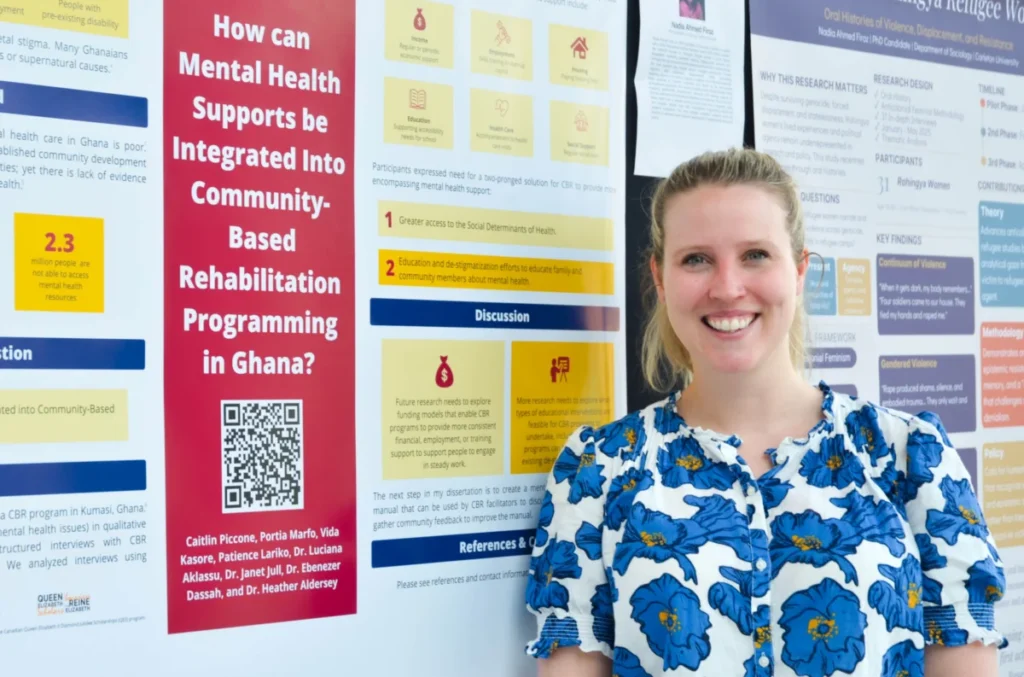
Following a networking lunch, the afternoon sessions delved deeper into the transformative potential of research. A panel dedicated to "Research for Societal Change" featured scholars whose work directly addresses critical societal issues. Nodir Ataev, a PhD candidate in global development at Queen’s University and a Flight 302 Legacy Award recipient, and Caitlin Piccone, a PhD candidate in rehabilitation science at Queen’s University and a Queen Elizabeth Scholar, shared their experiences. They were joined by Claudia Gonzales, a PhD candidate in public health at Université de Montréal and an International Doctoral Research Award recipient.
Ms. Piccone articulated a fundamental principle of impactful research: "Research isn’t just about what issues we study, [but] it is also about how we study them. Shifting the power dynamic between the researcher and the community is a really important first step towards creating real societal impact." This statement underscores the ethical imperative to dismantle hierarchical structures in research and to empower communities to have a greater say in the research agenda and its outcomes. This approach is vital for ensuring that research is not extractive but rather a collaborative endeavor that benefits all involved.
The discussions highlighted how these scholars are actively working to address complex challenges, from global development to public health, with a clear focus on creating measurable and sustainable improvements in people’s lives. Their personal narratives revealed the immense dedication, perseverance, and ethical considerations that underpin their pursuit of research that matters. The commitment to not only identify problems but to actively contribute to their solutions was a powerful takeaway.
Leadership Through Inclusion and Collective Success
The final panel, "Leadership Means Inclusion," explored the development of leadership skills among scholars and the impact of diverse perspectives on their academic and personal growth. Yvonne Ndelle, a Queen Elizabeth Scholarship recipient from the University of Ottawa, offered a compelling definition of leadership: "The aim is to achieve collective success. You’re working to achieve something, you’re working to achieve success, you’re working to empower people, and at the same time, you’re learning and becoming a better version of yourself." This perspective emphasizes a collaborative and empowering model of leadership, one that prioritizes mutual growth and shared achievement.
This vision of leadership aligns with the broader themes of the event, suggesting that effective leadership in research is not about individual brilliance but about fostering an environment where diverse voices are heard and valued, leading to collective progress. The inclusion of Kouessi Agbodande, a BCDI 2030 recipient from the University of Ottawa, and Racheal Wallace, a Flight 302 Legacy Award recipient from Carleton University, further enriched this discussion, showcasing how varied experiences and backgrounds contribute to a more robust and innovative approach to research and leadership.
A Vision for the Future of Research
The "Scholars to Scholars" event concluded with a strong consensus on the future direction of academic research. With over eighty scholars and academics in attendance, the day served as a vibrant platform for celebrating the achievements of the twelve featured scholars and for collectively envisioning a research landscape that is more engaged, impactful, and inclusive. The overarching message was clear: research has an inherent responsibility to contribute positively to the world, whether at a local or global scale.
Dr. Kenneth Gyamerah’s concluding remarks encapsulated this sentiment powerfully: "Your research has something to give the world, and never underestimate the impacts that your weight can drive." This statement serves as an enduring call to action for all scholars, encouraging them to recognize the profound potential of their work and to embrace their role as agents of positive change. The event underscored the critical role of organizations like Universities Canada and the supporting scholarship programs in nurturing a generation of researchers committed to making a tangible difference in society. The discussions and shared insights from this gathering are expected to resonate within academic circles and beyond, inspiring a continued commitment to research that is not only intellectually rigorous but also deeply rooted in community and dedicated to societal betterment. The legacy of this event lies in its affirmation of a research paradigm that prioritizes human connection, collaborative inquiry, and transformative impact.