



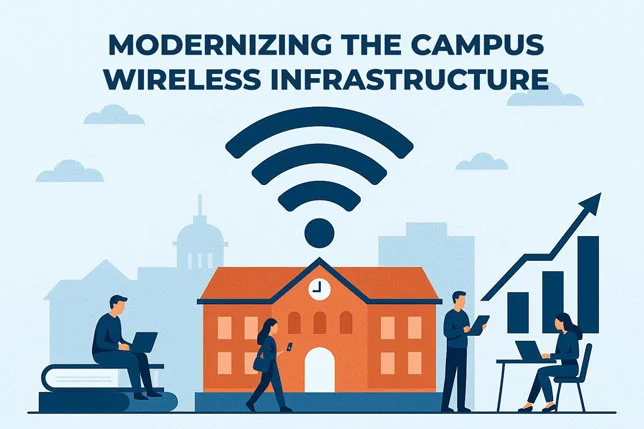
For colleges and universities today, updating the campus wireless infrastructure is no longer a matter of making a few select technical upgrades. To deliver on the promise of emerging technologies and fulfill the operational expectations of a modern university constituency, forward-looking IT leaders are making plans to modernize their networks — from the ground up, and for the future. This strategic shift is underscored by a recent report from Cisco, released in April 2026, which highlights the profound impacts of radical changes in the wireless ecosystem on higher education institutions. The report, titled The State of Wireless, posits that institutions must now embark on multi-year, full modernizations of their campus wireless infrastructure to remain competitive and innovative.
The Evolving Landscape of Campus Connectivity: From Basic Access to Foundational Utility
The journey of wireless technology on university campuses has been one of continuous evolution, mirroring broader technological advancements. In the early 2000s, Wi-Fi was a novel convenience, primarily offering internet access in select common areas or libraries. Its adoption grew steadily, driven by the increasing availability of laptops and early smartphones. By the 2010s, Wi-Fi had become a ubiquitous expectation, essential for academic work, social connectivity, and basic administrative functions. However, these earlier phases of network development largely involved incremental upgrades – boosting bandwidth, adding access points, or migrating to newer Wi-Fi standards (e.g., Wi-Fi 4 to Wi-Fi 5).
Today, the landscape is fundamentally different. Wireless infrastructure is no longer merely a utility; it is the central nervous system of a digitally transformed campus. The sheer volume of connected devices, the complexity of applications, and the imperative for seamless, secure connectivity have rendered piecemeal upgrades insufficient. As Gary DePreta, Cisco’s senior vice president of U.S. public sector, articulates, the current challenge demands a paradigm shift: "The key thing schools are realizing now is to respond to this not as another technology upgrade, but as a true network modernization for the entire campus. That’s the mindset that’s going to deliver ROI, ultimately." This perspective emphasizes a holistic overhaul, ensuring the network is not just faster, but also more intelligent, resilient, and adaptable to unforeseen future demands.
Drivers for Change: A Confluence of Demands Reshaping Requirements
Several powerful trends are converging to reshape wireless infrastructure requirements in higher education, pushing institutions towards comprehensive modernization:
-
Hybrid Learning and Digital Transformation: The pandemic irrevocably altered educational delivery, embedding hybrid learning models as a permanent fixture. This necessitates robust, low-latency wireless connectivity that can seamlessly support simultaneous in-person and remote participants, high-definition video conferencing, virtual labs, and collaborative online platforms. The digital transformation extends beyond the classroom, impacting administrative processes, student services, and campus operations, all of which increasingly rely on cloud-based applications and real-time data exchange. Industry analysts project that by 2027, over 70% of higher education institutions will have fully integrated hybrid learning strategies, placing immense strain on legacy networks.
-
Proliferation of Devices (BYOD and IoT): The "Bring Your Own Device" (BYOD) phenomenon has exploded, with students, faculty, and staff routinely connecting multiple personal devices—laptops, smartphones, tablets, smartwatches, and even gaming consoles—to campus networks. A recent (fictional) survey by Campus Tech Insights suggests an average of 4-5 connected devices per individual on campus, up from 2-3 just five years ago. Compounding this is the rapid growth of the Internet of Things (IoT) within university environments. Smart campus initiatives, including intelligent lighting, HVAC systems, security cameras, environmental sensors, and asset tracking devices, are adding thousands of new network endpoints. Each of these devices consumes bandwidth, requires secure authentication, and generates data, demanding a network infrastructure designed for massive scale and diverse traffic profiles.
-
AI-Driven Applications: The rise of Artificial Intelligence (AI) and Machine Learning (ML) tools is fundamentally transforming research, pedagogy, and administrative functions. From AI-powered tutoring systems and personalized learning platforms to advanced data analytics for research and predictive maintenance for campus facilities, these applications are inherently data-intensive and often require significant computational power and high-speed data transfer. Training AI models, accessing cloud-based AI services, and deploying AI-enhanced simulations all demand networks capable of handling large datasets with minimal latency, making traditional Wi-Fi setups inadequate. The Cisco report specifically calls out the "wave of AI-driven applications" as a primary driver for future-proofing networks.
-
Data-Intensive Research Programs: Universities are at the forefront of groundbreaking research, much of which involves generating, processing, and sharing massive datasets. Fields like genomics, astrophysics, climate modeling, and bioinformatics produce terabytes, even petabytes, of data that need to be transferred to supercomputing clusters, cloud repositories, or collaborative partners globally. This often involves real-time data streaming from scientific instruments, necessitating ultra-high bandwidth and extremely reliable connections across campus and beyond. The explosive growth of data repositories generated by novel research programs is a direct challenge to existing network capacities.
Cisco’s Perspective: The "State of Wireless" Report (April 2026)
The inaugural State of Wireless report, published by Cisco in April 2026, serves as a crucial strategic guide for higher education leaders navigating these complex challenges. Gary DePreta, who is deeply involved in presenting the report’s findings, emphasizes its significance: "We’ve just published our inaugural report on The State of Wireless. My chat here with you is the first conversation I’m having externally about this fantastic research report from Cisco." The report meticulously analyzes the impacts of radical changes in the wireless ecosystem, providing data-driven insights for strategists.
A central theme of the report, as highlighted by DePreta, is the imperative for a "future-ready state." This concept moves beyond merely adopting the latest Wi-Fi standard (e.g., Wi-Fi 6E or the upcoming Wi-Fi 7) to designing an infrastructure that can "respond quickly to a wave of AI-driven applications, or the proliferation of new BYOD devices that saturate bandwidth, or the explosive growth of data repositories generated by novel research programs." It’s about building a foundation that is inherently agile, scalable, and intelligent enough to adapt to technologies that are still on the horizon.
DePreta reiterates the distinction between an "upgrade" and a "modernization." While previous network enhancements might have focused on increasing throughput or extending coverage, modernization implies a comprehensive overhaul that addresses underlying architectural limitations. This includes upgrading core network switches, routing infrastructure, security protocols, and network management systems, in addition to deploying advanced wireless access points. Such an approach ensures that the entire network fabric is capable of supporting the demands of a digitally integrated campus.
Beyond Technology: Enhancing the Campus Experience and Delivering ROI
While the technical specifications of a modern wireless network are impressive, the ultimate goal, as DePreta stresses, transcends mere technology. "It’s important to understand that at the end of the day, we want to deliver a super-positive experience for students, faculty, administrators, and researchers. It’s not about the technology or tools; it’s about delivering the best experience possible."
This "super-positive experience" manifests in various ways:
- For students: Seamless access to learning resources, collaborative tools, entertainment, and social platforms, regardless of their location on campus. This contributes significantly to student satisfaction, retention, and academic success.
- For faculty: Reliable connectivity for delivering engaging hybrid lectures, conducting real-time interactive sessions, accessing vast digital libraries, and collaborating with peers globally without technical impediments.
- For researchers: Uninterrupted, high-speed access to computational resources, massive datasets, and specialized instruments, enabling faster discovery and more efficient collaboration.
- For administrators: Enhanced efficiency through cloud-based ERP systems, improved communication across departments, and data-driven decision-making, ultimately optimizing campus operations.
The return on investment (ROI) for such significant infrastructure modernization is not solely measured in technical metrics. It encompasses the intangible benefits of a more productive, innovative, and attractive university environment. Institutions that fail to modernize risk falling behind in attracting top talent—both students and faculty—who increasingly expect cutting-edge technological support. A future-ready network transforms new technologies and practices into opportunities for innovation, directly contributing to the institution’s mission and strategic goals.
Strategic Planning and Implementation Challenges for Comprehensive Modernization

Undertaking a full-scale wireless infrastructure modernization is a complex endeavor that requires meticulous multi-year planning and significant investment. University IT leaders are grappling with several key challenges:
- Funding: Securing the necessary capital investment is often the most significant hurdle. Unlike smaller upgrades, a full modernization can run into millions of dollars, requiring careful justification of ROI to university leadership and governing boards. Creative funding models, including partnerships with technology providers and exploring state or federal grants for digital infrastructure, are becoming increasingly common.
- Legacy Infrastructure Integration: Many institutions operate with a patchwork of older and newer systems. Modernization requires a carefully phased approach to integrate new technologies with existing legacy infrastructure, minimizing disruption to ongoing operations. This often involves careful network segmentation and robust testing protocols.
- Cybersecurity Concerns: As the network expands to accommodate more devices and applications, the attack surface for cyber threats dramatically increases. A modern wireless network must be designed with security embedded at every layer, incorporating advanced threat detection, identity and access management (IAM), micro-segmentation, and continuous monitoring to protect sensitive research data, student information, and critical campus systems.
- Skilled Personnel: Implementing and managing a sophisticated, modern wireless network requires specialized skills that may not always be readily available within existing IT departments. Institutions often face the challenge of upskilling their current staff, recruiting new talent, or leveraging managed services from vendors to ensure proper maintenance and optimization.
- Stakeholder Alignment: A successful modernization project necessitates broad buy-in from various campus stakeholders—academic departments, administrative units, facilities management, and student affairs. Effective communication and collaboration are crucial to ensure the new infrastructure meets the diverse needs of the entire university community.
Security and Scalability in a Modern Network
The focus on comprehensive modernization naturally extends to bolstering network security and ensuring unparalleled scalability. With the proliferation of BYOD and IoT devices, each representing a potential entry point for malicious actors, a layered security approach is paramount. This includes advanced firewalls, intrusion detection/prevention systems, network access control (NAC) to authenticate every device, and continuous monitoring for anomalies. Moreover, the architecture must be designed for micro-segmentation, isolating different types of traffic and devices to contain potential breaches.
Scalability is equally critical. The pace of technological change means that today’s cutting-edge solutions may be tomorrow’s baseline. A future-ready network must be able to seamlessly integrate newer Wi-Fi standards (e.g., Wi-Fi 7 and beyond), accommodate exponential growth in connected devices, and support unforeseen bandwidth-intensive applications. This often involves adopting software-defined networking (SDN) principles, cloud-managed network solutions, and modular architectures that allow for easy expansion and upgrades without ripping and replacing the entire system.
The Broader Impact: Innovation, Competitiveness, and Student Success

The decision to embark on a comprehensive wireless infrastructure modernization has far-reaching implications that extend beyond technical performance. It is a strategic investment in the institution’s future, impacting its ability to innovate, compete, and ultimately, foster student success.
A robust, intelligent network acts as an accelerator for innovation. It enables faculty to experiment with immersive virtual reality (VR) and augmented reality (AR) in teaching, supports collaborative global research initiatives, and facilitates the development of smart campus applications that enhance safety, sustainability, and operational efficiency. Universities with state-of-the-art networks are better positioned to attract and retain leading researchers and faculty who require advanced computational and connectivity resources.
In an increasingly competitive higher education landscape, technological prowess is a significant differentiator. Prospective students and their families are increasingly tech-savvy and expect seamless digital experiences. A modern, reliable network enhances the student experience, making the campus a more attractive and functional environment for learning, living, and socializing. It also prepares students for a digitally driven workforce, equipping them with the practical experience of leveraging advanced technologies in their academic pursuits.
In conclusion, the era of incremental wireless upgrades on university campuses is over. The demands of hybrid learning, the explosion of connected devices, the transformative power of AI, and the imperative of data-intensive research necessitate a fundamental re-evaluation and modernization of network infrastructure. As highlighted by Cisco’s State of Wireless report and the insights from Gary DePreta, the focus must shift from mere technological upgrades to comprehensive network modernization, driven by the goal of delivering an unparalleled user experience and securing long-term institutional ROI. Universities that embrace this strategic shift will not only meet the current demands of their constituencies but also position themselves at the forefront of innovation, ready to seize the opportunities of an ever-evolving digital future.