


A recent investigation by an AI Task Force convened by the prestigious journal Organization Science has unveiled a concerning trend within academic research: a dramatic surge in manuscript submissions since the widespread availability of generative artificial intelligence tools like ChatGPT, coupled with a marked decline in readability and a significantly lower acceptance rate for papers heavily relying on AI. This phenomenon is raising serious questions about the integrity of the peer-review process, the quality of scholarly output, and the broader implications for academic productivity and the advancement of knowledge.
The Emergence of a "Weightless" Era in Academic Writing
"Something is up in academic research," reported the AI Task Force members in a recent communication, encapsulating the growing unease among editors and reviewers. The qualitative shift in submissions, which began to manifest distinctly in early 2023, has been described as a "particular feel that is hard to pin down." While superficially resembling traditional academic papers, the writing often conveys a "weightless" quality, leaving experienced readers scratching their heads at the intended meaning. This observation from Organization Science, a leading journal in management and organizational studies, mirrors anecdotal evidence from various other disciplines, suggesting a systemic shift rather than an isolated incident.
The public release of ChatGPT by OpenAI in November 2022 marked a pivotal moment, democratizing access to sophisticated generative AI capabilities. Initially hailed for its potential to streamline various writing tasks, from drafting emails to summarizing complex texts, the academic community quickly recognized its potential application in research manuscript preparation. The promise of faster drafting, improved grammar, and enhanced clarity appealed to researchers facing ever-increasing pressure to publish. However, the Organization Science task force’s data presents a stark counter-narrative to these optimistic projections.
Quantifying the AI Impact: A Data-Driven Revelation
The task force undertook a rigorous quantitative analysis to move beyond subjective observations. Their findings present a clear timeline and correlation between the advent of AI and changes in submission patterns and quality.
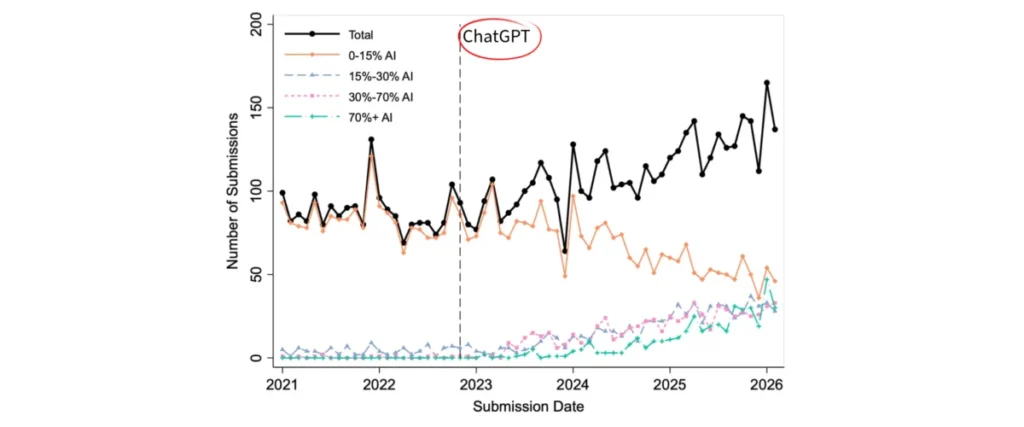
- Surge in Submissions: Starting in 2023, immediately following ChatGPT’s public release, Organization Science experienced a rapid and unprecedented increase in the volume of manuscript submissions. This influx placed immediate strain on the journal’s editorial and peer-review infrastructure, which is typically designed for more predictable submission rates.
- Dramatic Shift in AI Usage: Concurrently, the percentage of submissions classified as using "minimal AI" plummeted from nearly 100% to approximately 30%. This indicates a pervasive and rapid adoption of AI tools by authors in the manuscript preparation process across a significant portion of the submitting pool. The methodology for classifying AI usage, while not explicitly detailed in the initial report, likely involved a combination of sophisticated detection tools and expert editorial assessment, conducted retrospectively to avoid bias in initial editorial decisions.
- Decline in Reading Ease: Perhaps the most striking quantitative finding relates to readability. Between January 2021 and January 2026, scores on a standard "reading ease" metric—commonly Flesch-Kincaid or similar indices designed to quantify text comprehensibility—fell by a staggering 1.28 standard deviations. This is a substantial decline, indicating that the average manuscript has become significantly harder for human readers to parse and absorb.
The task force emphasized that this decline is counterintuitive to common assumptions. "Most people assume that AI produces cleaner, more polished text," they noted. While AI might indeed excel in narrow dimensions like correcting grammatical errors or ensuring syntactical correctness, its current generative capabilities appear to hinder overall comprehensibility. The analysis revealed that AI-assisted writing tends to employ "longer words, more complex sentence structures, more jargon, and more nominalizations." These characteristics, while sometimes mistakenly equated with academic sophistication, actively impede clarity and cognitive processing, making the text denser and less accessible to even expert readers.
The Alarming Decline in Acceptance Rates
The ultimate measure of a submission’s quality in academia is its progression through the peer-review process and eventual acceptance for publication. Here, the Organization Science data reveals a deeply concerning disparity:
- Higher Desk-Rejection Rates: Manuscripts identified as making "heavy use of AI" faced a nearly 70% desk-rejection rate. Desk-rejection occurs when editors decide a paper does not meet the journal’s standards or scope without sending it for external peer review, saving valuable reviewer time. In stark contrast, papers written without AI were desk-rejected at a rate of 44%. This substantial difference suggests that a significant proportion of AI-generated content fails to meet even the initial editorial bar for quality and relevance.
- Drastically Lower Acceptance Rates: For papers that did proceed past the initial editorial screening, the disparity in final acceptance rates was even more pronounced. Only 3.2% of high-AI papers were ultimately accepted for publication, compared to 12% of low-AI papers. This nearly four-fold difference underscores a fundamental issue with the quality and intellectual contribution of AI-assisted submissions.
Crucially, these analyses were conducted retrospectively. The editors making the initial desk-rejection decisions and overseeing the peer-review process were unaware of the extent of AI involvement in the papers at the time of their decisions. This blind assessment strengthens the validity of the findings, indicating that the issues are inherent to the AI-generated content itself rather than a bias against AI tools.
The Burden on the Peer-Review System and Academic Community
The confluence of increased submission volume and a decline in quality places an immense and unsustainable burden on the academic peer-review system. Editors and reviewers, typically active researchers themselves, volunteer their time to rigorously evaluate submissions. The current trend means they are spending more time sifting through a larger volume of papers, a higher percentage of which are deemed unpublishable. This increases workload, contributes to reviewer fatigue, and risks diverting attention and resources from genuinely novel and high-quality research.
The Organization Science findings resonate with broader discussions within the academic community about the sustainability of the peer-review model. Journals worldwide already struggle to recruit and retain sufficient numbers of qualified reviewers. The influx of AI-generated content, characterized by its "weightless" prose and often superficial adherence to academic conventions, exacerbates this challenge, potentially leading to burnout among dedicated gatekeepers of scientific quality.
Ethical Dimensions and the Future of Authorship
Beyond the immediate practical challenges, the proliferation of AI-assisted writing raises profound ethical questions. The concept of authorship in academic research traditionally implies intellectual contribution, critical thinking, and the original synthesis of ideas. When AI tools generate significant portions of text, the line between human intellectual labor and machine-generated content becomes blurred. Questions arise about:
- Originality and Plagiarism: While AI might not "plagiarize" in the traditional sense of copying existing text, it can generate content that lacks genuine original thought or merely rephrases existing knowledge without new insights.
- Transparency: Should authors be required to disclose their use of AI tools in manuscript preparation? If so, what level of disclosure is appropriate?
- Skill Degradation: The ease of generating text through AI might lead to a degradation of essential academic writing skills among researchers, potentially impacting their ability to articulate complex ideas independently in the long run.
Academic institutions, funding bodies, and publishers are beginning to grapple with these issues. Many journals are revising their author guidelines to address AI usage, often requiring disclosure and asserting that ultimate responsibility for the content, including its accuracy and originality, rests solely with the human authors. However, detection remains a significant challenge, and the rapidly evolving capabilities of AI tools mean that policies must be agile and adaptive.
Broader Implications for Research Integrity and Progress
The Organization Science cautionary tale extends beyond the confines of a single journal or discipline. It highlights a critical distinction: making things faster or easier is not synonymous with making them better. The immediate individual benefit of using AI to accelerate writing processes appears to be leading to a collective detriment for the academic field as a whole.
If the trend of increased, lower-quality AI-assisted submissions continues unchecked, it could have several long-term implications:
- Erosion of Trust: A decline in the overall quality of published research, even if mitigated by rigorous peer review, could erode public and scholarly trust in academic outputs.
- Hindrance to Scientific Progress: If the signal-to-noise ratio in academic publishing worsens, genuinely groundbreaking research might be harder to identify and disseminate, slowing scientific advancement.
- Redefinition of Research Skills: The academic community may need to re-evaluate the core skills required for researchers, placing renewed emphasis on critical thinking, original conceptualization, and robust analytical skills that transcend mere text generation.
The findings from Organization Science serve as a powerful reminder that there is often no shortcut to quality in intellectual endeavors. The laborious process of crafting clear, concise, and impactful academic prose, infused with genuine insight and critical thought, remains a cornerstone of effective scholarly communication. As AI tools continue to evolve, the challenge for academia will be to harness their potential responsibly, ensuring they augment, rather than undermine, the fundamental principles of research integrity and scholarly excellence. This will likely involve a combination of new ethical guidelines, enhanced educational practices for researchers, and continuous adaptation of the peer-review system to maintain its vital role in quality assurance.