

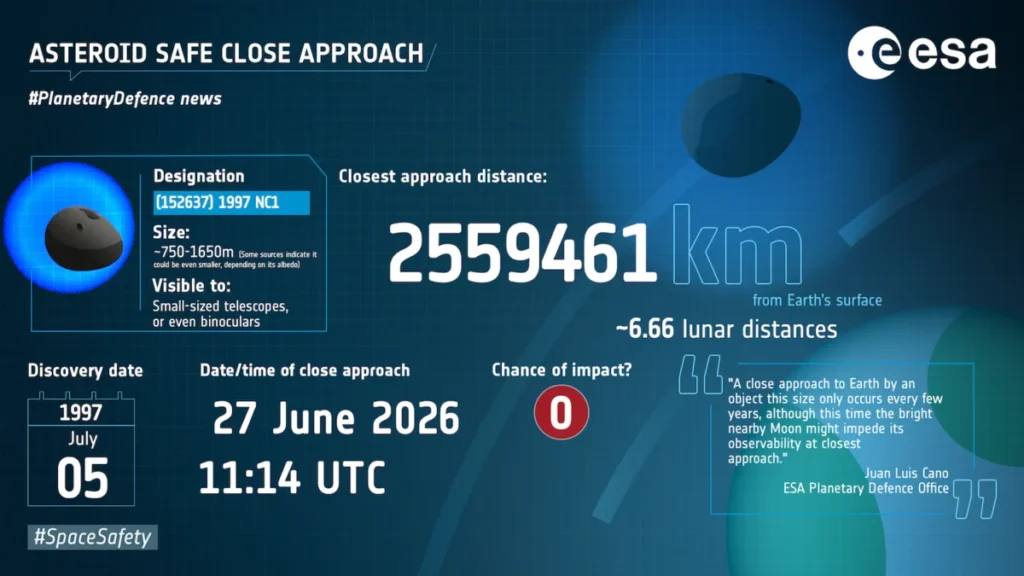
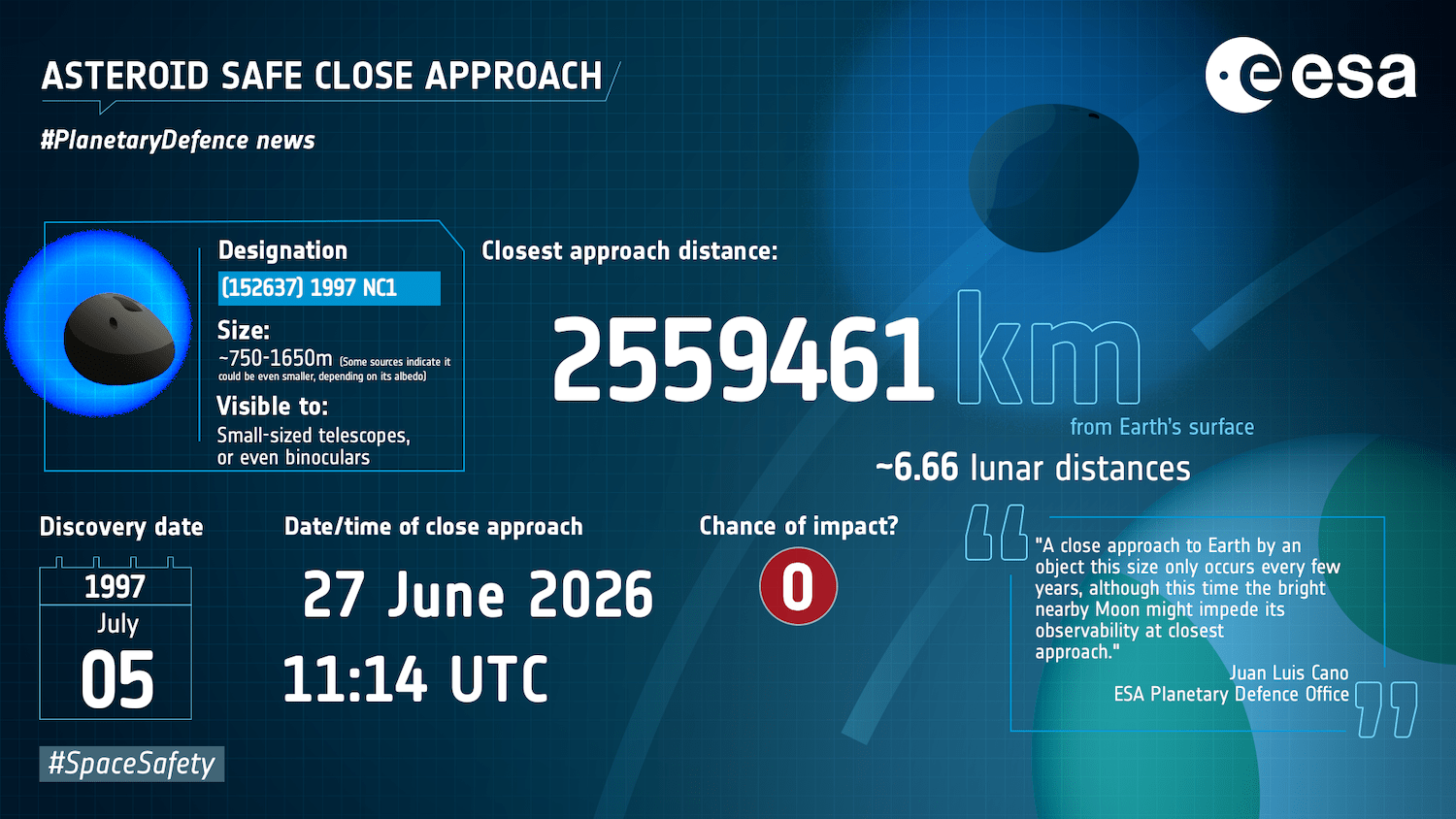
The celestial landscape is set for a significant event this week as a massive near-Earth object (NEO), designated as asteroid (152637) 1997 NC1, prepares for a relatively close encounter with our planet. Measuring approximately the length of five modern cruise ships, this cosmic traveler is currently hurtling through the vacuum of space at a velocity of 5.6 miles per second, or roughly 20,160 miles per hour. While the sheer scale and speed of the object are staggering, astronomers and planetary defense experts have confirmed that the asteroid poses no threat of impact to Earth during this pass. Instead, the event offers a rare opportunity for both professional scientists and amateur stargazers to observe a large-scale remnant of the early solar system as it glides past at a distance of approximately 1.59 million miles.
Understanding Asteroid (152637) 1997 NC1: Dimensions and Characteristics
Asteroid 1997 NC1 was first identified by astronomers nearly thirty years ago, providing researchers with decades of orbital data to precisely calculate its trajectory. Based on the amount of sunlight the object reflects—a metric known as albedo—scientists estimate its diameter to be between 820 and 1,800 yards (approximately 750 to 1,650 meters). To put this size into perspective, the upper estimate of 1,800 yards is nearly four times the height of the Empire State Building and significantly larger than the world’s largest aircraft carriers.
Because the asteroid’s exact composition remains a subject of ongoing study, its precise dimensions can be difficult to pin down. If the asteroid is composed of darker, carbon-rich material, it would need to be larger to reflect the amount of light observed by telescopes. Conversely, if it is composed of highly reflective silicate rock or metal, it could be on the smaller end of the estimated range. Regardless of the specific measurement, 1997 NC1 is classified as a "Potentially Hazardous Asteroid" (PHA). This designation is applied by the International Astronomical Union’s Minor Planet Center to any asteroid larger than 140 meters that comes within 4.6 million miles (0.05 astronomical units) of Earth’s orbit. While the term sounds alarming, it is primarily a tool for prioritizing objects that require long-term monitoring rather than an indicator of an imminent collision.
Chronology of the June 27 Flyby
The upcoming encounter is the result of a long-predicted orbital alignment. Asteroid 1997 NC1 follows an elliptical path around the sun that occasionally brings it into the neighborhood of Earth’s orbit. The 2024 approach is one of its closest in recent history.
According to data from the European Space Agency (ESA) and NASA’s Center for Near-Earth Object Studies (CNEOS), the asteroid will reach its perigee—the point in its orbit closest to Earth—at approximately 7:15 a.m. EDT on Thursday, June 27. At that moment, it will be situated roughly 1.59 million miles away. In astronomical terms, this is a "near miss," but in practical terms, it is a vast distance, representing more than six times the average gap between the Earth and the moon.
The timeline for observation begins several days prior to the closest approach as the asteroid’s brightness increases. For observers in the Northern Hemisphere, the asteroid will be most visible during its approach phase in the nights leading up to June 27. Following the closest approach, the rock will begin its departure from the inner solar system, at which point it will become more visible to observers in the Southern Hemisphere.
Technical Challenges for Observers
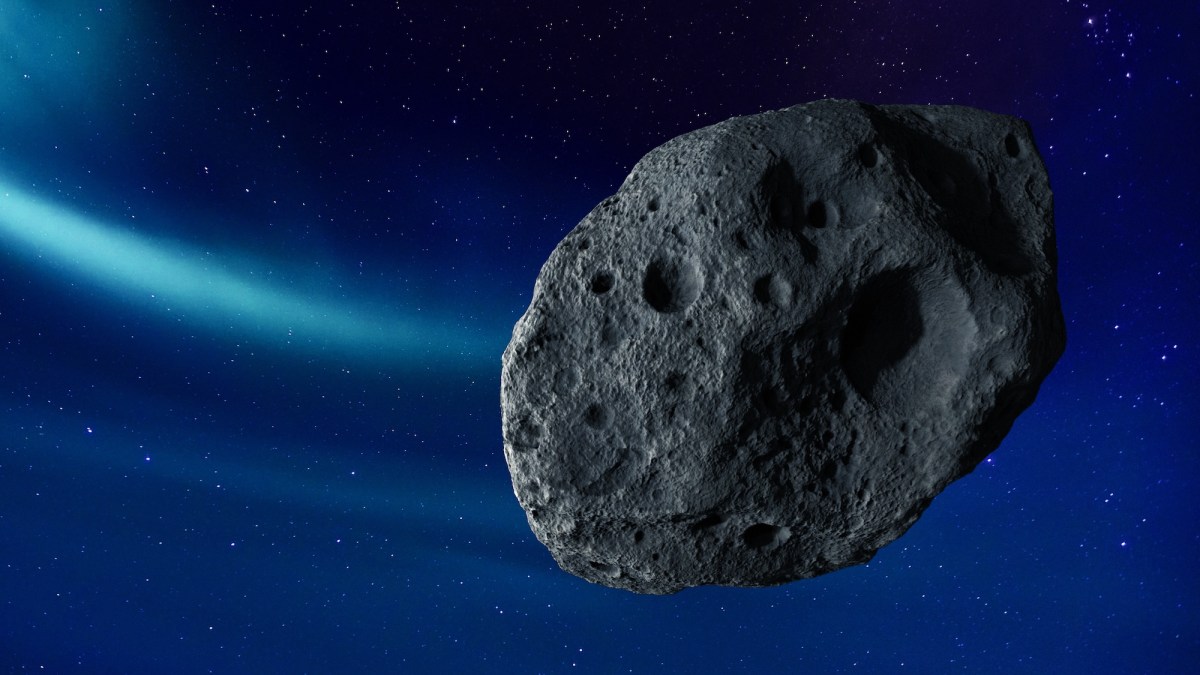
While 1997 NC1 is large enough to be seen with high-quality consumer optics, several factors may complicate the viewing experience for amateur astronomers. The asteroid’s apparent magnitude—a measure of its brightness as seen from Earth—will be high enough for detection with strong binoculars or a small telescope under ideal conditions. However, the timing of the flyby coincides with a challenging phase of the lunar cycle.
Juan Luis Cano, an information specialist at the European Space Agency’s Planetary Defense Office, noted that the presence of the moon could hinder visibility. "A close approach to Earth by an object this size only occurs every few years, although this time the bright nearby moon might impede its observability at closest approach," Cano stated. The moonlight scatters in the atmosphere, creating a "washout" effect that can make it difficult to distinguish the faint, moving point of light that represents the asteroid against the backdrop of distant stars.
To successfully spot the asteroid, enthusiasts are encouraged to seek out "dark sky" locations far from urban light pollution and use star-charting software or mobile apps to pinpoint the asteroid’s exact coordinates in the sky. Unlike a shooting star, which streaks across the sky in a fraction of a second, 1997 NC1 will appear to move very slowly, requiring several minutes of observation to notice its shift in position relative to the stars.
The Role of Planetary Defense and Monitoring
The tracking of 1997 NC1 is part of a broader, global effort to catalog every significant Near-Earth Object. Organizations like NASA’s Planetary Defense Coordination Office (PDCO) and ESA’s Space Safety program work in tandem to monitor the skies using a network of ground-based telescopes and space-based infrared sensors.
The primary goal of these programs is to identify potential threats decades in advance. The discovery of 1997 NC1 nearly 30 years ago is a testament to the success of these early detection systems. By calculating the asteroid’s "orbital elements"—the mathematical parameters that define its path—scientists can run computer simulations to predict its position for centuries into the future. Currently, there are no known asteroids larger than 140 meters that have a significant probability of hitting Earth in the next 100 years.
However, the scientific community remains vigilant. The 2022 DART (Double Asteroid Redirection Test) mission, in which NASA successfully crashed a spacecraft into the moonlet of a larger asteroid to change its orbit, proved that humanity now possesses the technology to potentially deflect a threatening object. Monitoring flybys like that of 1997 NC1 provides essential data on how these bodies behave, their rotation speeds, and how they are affected by "Yarkovsky effects"—the slight push an asteroid receives when it absorbs sunlight and re-emits it as heat.
Historical Context: From Chicxulub to Tunguska
The interest in 1997 NC1 is rooted in the long and violent history of cosmic impacts on Earth. Our planet bears the scars of millions of years of bombardment, though most are hidden by erosion and tectonic activity. The oldest evidence of a major impact dates back roughly 3 billion years, to a time when Earth’s crust was still relatively young.
The most famous of these events occurred approximately 66 million years ago when an asteroid roughly 6 to 9 miles wide struck the Yucatan Peninsula in present-day Mexico. That event, known as the Chicxulub impact, triggered a global mass extinction that ended the reign of the dinosaurs. While 1997 NC1 is significantly smaller than the Chicxulub impacter, it is much larger than the object responsible for the most recent major atmospheric explosion.
In 1908, an object estimated to be about 180 feet wide exploded over the Podkamennaya Tunguska River in a remote region of Siberia. Known as the Tunguska Event, the blast did not leave a crater but instead flattened an estimated 830 square miles of forest—roughly 80 million trees. The energy released was equivalent to 3 to 50 megatons of TNT. If an object the size of 1997 NC1 were to impact Earth, the results would be catastrophic on a continental scale, reinforcing why the work of the Planetary Defense Office is considered vital for the long-term survival of civilization.
Scientific Analysis and Future Implications
Beyond the concerns of planetary defense, asteroids like 1997 NC1 are considered "time capsules" from the birth of the solar system. They are composed of the original material that formed the planets 4.6 billion years ago, largely unchanged by the heat and pressure that transformed the larger planetary bodies.
By studying the light reflected off 1997 NC1 during this close approach, astronomers can perform spectroscopy to determine its mineralogical makeup. This data helps scientists understand the distribution of materials in the early solar nebula. Furthermore, observing the asteroid’s "light curve"—the way its brightness fluctuates over time—allows researchers to determine its shape and rotation period. Many asteroids are not solid rocks but "rubble piles," held together by weak gravitational forces. Understanding the structure of 1997 NC1 could provide clues about how it might respond to a future deflection mission if one were ever required.
As 1997 NC1 continues its journey past Earth and back toward the outer reaches of its orbit, it will remain under the watchful eyes of the global astronomical community. This flyby serves as a reminder of our place in a dynamic and busy solar system. While the vast distances of space generally keep us safe, the continued monitoring of these "cruise-ship-sized" rocks ensures that humanity will not be caught off guard by the clockwork motions of the heavens. For now, the June 27 event remains a spectacular, safe, and scientifically rich moment for the world to look upward.