



For over a century, corporate leadership training has remained a cornerstone of organizational strategy, yet the fundamental challenge persists: how to architect these programs to ensure measurable shifts in performance indicators. Despite decades of investment, many organizations continue to struggle with the "transfer of training" problem—the gap between classroom learning and on-the-job application. As global market volatility increases, the necessity for a rigorous, data-driven approach to management development has never been more critical.
The Evolution and Current State of Leadership Training
The history of corporate training began in the early 20th century, mirroring the industrial expansion of the era. Early models were largely task-oriented, focusing on operational efficiency. By the 1970s and 1980s, the focus shifted toward "soft skills" and behavioral psychology. Today, the landscape is defined by digital integration and the rise of the "learning organization." However, data from the Association for Talent Development (ATD) suggests that despite global spending on corporate training exceeding $370 billion annually, less than 20% of participants report that the training significantly improves their job performance.
This disparity stems from a common, albeit flawed, practice: the "copy-paste" method. Organizations frequently adopt generic competency models or external training curricula without auditing their specific cultural or operational requirements. This practice ignores the reality that leadership is not an innate trait but a cumulative process of systematic skill acquisition.
A Systemic Framework for Organizational Performance
Analysis of over 1,200 leaders across 15 large and medium-sized enterprises reveals that training yields a measurable return on investment (ROI) only when it operates as a cohesive system. Fragmented initiatives—where disparate topics are taught in isolation—consistently fail to produce long-term business impact. An effective program must be built upon a foundation of alignment: the content must mirror the organization’s current business environment, management expectations, and available resources.
The architecture of a high-impact program begins with defining clear business objectives. Designers must identify the specific management actions required to achieve these goals and the target cohorts who will execute them. When programs are instead assembled as an "eclectic mix" of popular management topics, they lack the logical progression required to build foundational skills. Each instructional block should build upon the last, moving from fundamental principles to complex strategic execution, ensuring that every session answers a critical question: "How does this behavior change benefit the bottom line?"
Integrating Performance Metrics via the Kirkpatrick Model
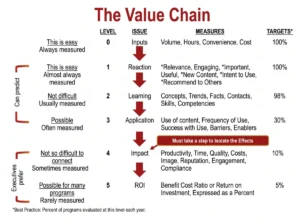
To ensure accountability, metrics must be established during the design phase, prior to the program’s launch. The industry-standard Kirkpatrick Evaluation Model provides the necessary framework for this:
- Reaction: Measuring participant engagement and satisfaction immediately following a training module.
- Learning: Assessing the acquisition of knowledge through pre- and post-tests.
- Behavior: Evaluating the transfer of skills to the workplace through 360-degree feedback or direct observation.
- Results: Quantifying the impact on business KPIs, such as increased revenue, reduced turnover, or improved project delivery timelines.
The Role of Internal Expertise and Senior Leadership
A significant shift in modern L&D (Learning and Development) strategy is the pivot toward utilizing internal business coaches for line and middle management. Unlike external trainers, internal coaches possess a granular understanding of the company’s cultural nuances. They can translate abstract leadership theories into real-world business cases, effectively neutralizing the common employee refrain: "Our industry is different; this theory doesn’t apply to us."
Furthermore, the participation of senior management is a non-negotiable requirement for cultural alignment. When executives attend the same training sessions as their direct reports, they achieve two primary objectives. First, they gain insight into the common management language being adopted, ensuring that feedback and performance reviews are aligned with the new behavioral expectations. Second, they model the behavior they expect to see, fostering an environment where subordinates feel safe experimenting with new tools.
The Mechanics of Skill Consolidation
To move knowledge from short-term to long-term memory, the learning process must be integrated into the daily work rhythm. This is achieved through a sequence of "inter-modular" sessions where participants apply new tools in a safe, peer-reviewed environment. This cycle—learn, test in a group, implement in a work setting, and debrief—is essential.
A controversial but effective practice gaining traction is the requirement for handwritten assignments. In an era dominated by generative AI, the manual creation of mind maps and reflective journals forces a higher level of cognitive engagement. By physically documenting management mistakes and drafting personal commitments, leaders create a deeper neural connection to the concepts, which often results in more deliberate decision-making.
Strategic Cascading: From Leader to Team
The most effective programs incorporate a "train-the-trainer" element, where participants are required to explain the material to their immediate teams. This pedagogical approach serves a dual purpose: it reinforces the leader’s mastery of the subject and democratizes the knowledge throughout the organization. When a manager teaches a concept to their team, they gain instant feedback on its practical applicability, while the team feels empowered by the professional development opportunity. This practice strengthens horizontal professional connections, turning the training program into a network-building exercise that lasts long after the final module is completed.
The Strategic Necessity of Top-Down Advocacy
None of these elements can function in a vacuum. Top-down support is the catalyst that transforms training from a "human resources initiative" into a "strategic business imperative." Executives who act as advocates for these programs ensure that funding is protected, bureaucratic hurdles are removed, and participants are shielded from the pressure of short-term targets while they are in the process of mastering new skills.
Broader Implications and Future Outlook
The current trend toward "integrated development" suggests that the role of the L&D function is evolving. No longer merely a provider of workshops, the L&D department is becoming a strategic partner to the business. Organizations that adopt this systemic approach report a higher degree of agility. When the entire management tier shares a common language and methodology, the company becomes more resilient to market disruptions.
The implications for the broader labor market are clear: as the demand for sophisticated leadership grows, the companies that prioritize systemic, evidence-based development will likely see lower attrition rates and higher internal promotion success. Conversely, firms that rely on ad-hoc training will continue to experience "leadership drift," where the lack of a unified management framework leads to decision-making silos.
In conclusion, the most effective leadership training is not a high-budget event, but a meticulously structured environment. By aligning learning objectives with business KPIs, leveraging internal expertise, and requiring active, manual engagement with the material, companies can create a self-sustaining ecosystem of leadership development. As these practices become embedded in the company culture, the "training" aspect fades into the background, leaving behind a management team that is naturally aligned, strategically focused, and consistently capable of driving the business forward. The shift from seeing training as an "extra" to viewing it as an essential component of business strategy is the definitive step toward long-term organizational success.