



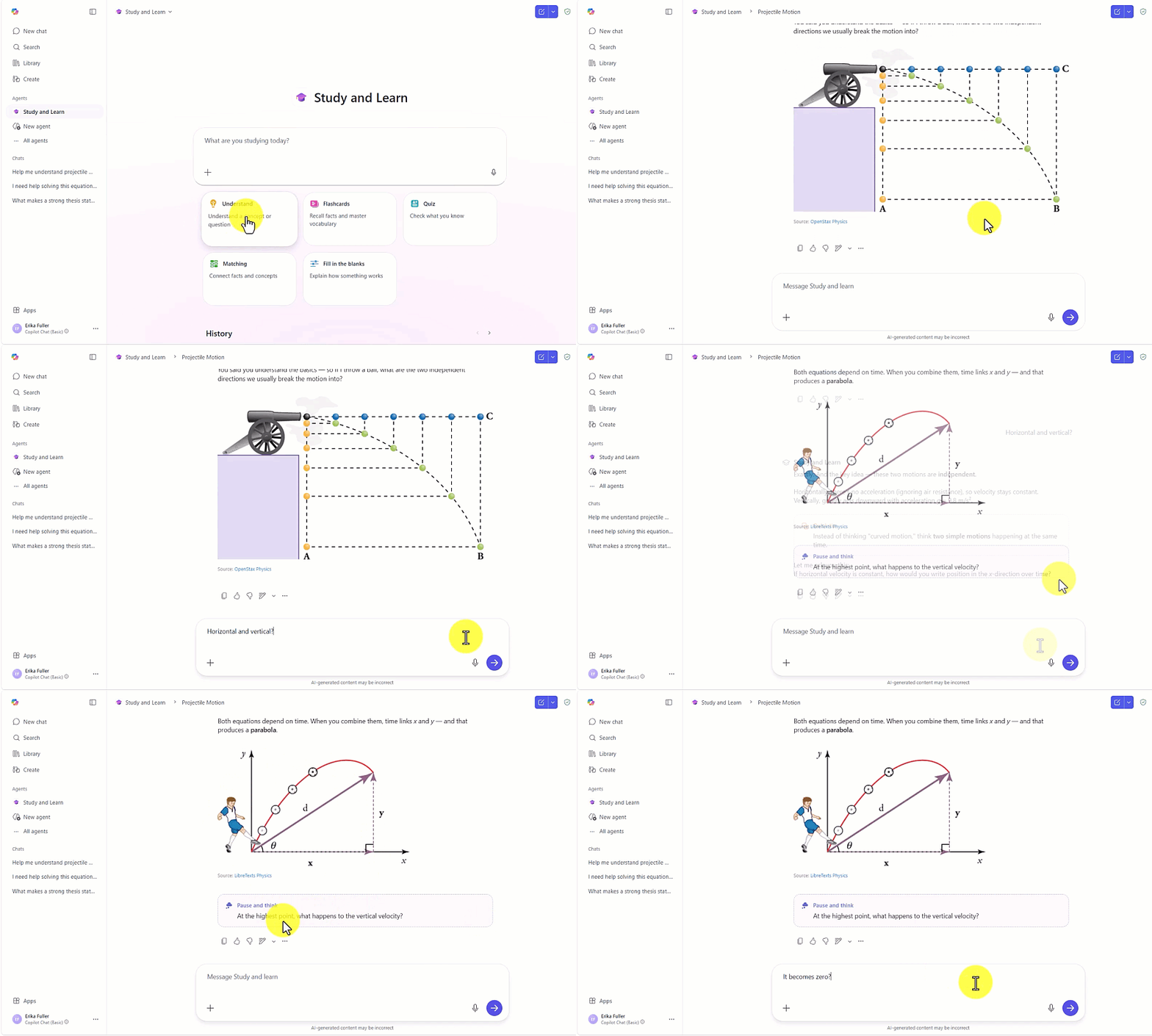
The integration of artificial intelligence within modern classrooms has long presented a fundamental paradox for educators and institutional leaders: while students increasingly rely on digital assistants to navigate complex academic materials, the vast majority of consumer-grade generative AI tools prioritize immediate task completion over genuine comprehension. Rather than fostering critical thinking, standard applications often act as passive "answer bots," delivering shortcuts that bypass the cognitive effort required for true learning. In response to widespread institutional bans, cautious district policies, and a growing trust deficit regarding student data privacy, Microsoft Corporation has officially rolled out a purpose-built solution. The newly launched Study and Learn Agent within Microsoft 365 Copilot is now generally available at no additional cost for all global education customers, offering a pedagogically grounded alternative designed explicitly for students aged 13 and older.
Background Context of the EdTech AI Dilemma
The rapid expansion of generative artificial intelligence following the late 2022 breakout of foundational large language models sent shockwaves through the global educational landscape. Schools, universities, and vocational training centers suddenly found themselves grappling with unprecedented academic integrity challenges, rampant unguided cheating, and profound concerns regarding the displacement of foundational writing and analytical skills. Many early-adopting institutions responded to these disruptions with reactionary measures, implementing blanket network bans on popular consumer chatbots or restricting student access to emerging technologies altogether.
However, technological prohibition rarely curbs student utilization; instead, it pushes usage underground into unmonitored digital spaces where data privacy protections are nonexistent and algorithmic guardrails are completely absent. Educational technologists and cognitive scientists quickly realized that attempting to block AI was a losing battle. The imperative shifted from restriction to reinvention: educational institutions urgently required an AI ecosystem specifically engineered around the principles of learning science rather than general-purpose productivity. Microsoft’s development of the Study and Learn Agent directly addresses this market void, merging enterprise-grade data governance with interactive, Socratic teaching methodologies.
Chronology and Deployment Framework

The rollout of the Study and Learn Agent represents the culmination of extensive testing and iterative development within Microsoft’s educational product division. Conceptualized to bridge the gap between unguided consumer AI and structured classroom instruction, the agent underwent phased beta testing with select academic partners before its general availability announcement.
For deployment, the technical architecture respects traditional administrative hierarchies within school districts and universities. For K-12 accounts, Copilot Chat is disabled by default for students, requiring explicit activation by an IT administrator via the tenant management portal. Once permissions are granted through Microsoft Entra ID credentials, students gain direct access to the Study and Learn Agent natively within the standard Microsoft 365 Copilot interface on web and desktop platforms. Users access the feature via the application’s left-hand navigation bar without requiring separate user authentication or auxiliary software installations. At launch, the agent is fully optimized for English-speaking users in the United States, with an aggressive localization roadmap slated to roll out additional language support in the coming weeks.
Grounded in Learning Science and Socratic Principles
What fundamentally distinguishes the Study and Learn Agent from commercial predecessors is its core operational philosophy: the learner must perform the cognitive heavy lifting. Built upon established frameworks in cognitive psychology and educational research, the agent actively avoids delivering direct answers to complex prompts. Instead, it utilizes structured, multi-turn dialogues to guide students through difficult problem spaces.
When a high school student struggles with a multi-step calculus equation, for instance, the agent refrains from outputting the final numerical solution. Instead, it breaks the problem down into manageable conceptual components, asking targeted probing questions that encourage the student to recall prior mathematical principles and derive the answer independently. Similarly, when a university undergraduate utilizes the tool to prepare for a biology exam, the system can instantly synthesize dynamic flashcards, generate targeted matching activities, or quiz the user on cellular respiration. For writing assignments, the agent serves as an interactive rhetorical coach, reviewing argumentative outlines and posing critical counter-arguments that compel the student to refine their thesis statements and strengthen textual evidence.
Security, Compliance, and Institutional Governance

For school administrators, chief technology officers, and institutional procurement boards, the deployment of generative AI has historically been hampered by rigorous compliance mandates, including the Family Educational Rights and Privacy Act (FERPA) and the Children’s Online Privacy Protection Act (COPRA). Consumer-grade AI platforms frequently monetize user inputs for model training, creating unacceptable liabilities regarding the protection of minors’ intellectual property and personal data.
The Study and Learn Agent operates entirely within the secure perimeter of the Microsoft 365 Education ecosystem. This ensures that all student interactions are governed by enterprise-grade data protection standards, strict privacy guardrails, and Microsoft’s overarching framework for responsible AI development. Student data is never utilized to retrain public foundation models, and institutional IT departments retain granular control over user permissions, access schedules, and auditing logs. By embedding the tool within existing enterprise infrastructure, Microsoft provides risk-averse educational leaders with the regulatory certainty required to embrace digital transformation at scale.
A Unified Educational AI Ecosystem: Teach and Study and Learn
The introduction of the Study and Learn Agent does not occur in a vacuum; rather, it forms a critical pillar within a broader, two-pronged technological vision for modern classrooms. Microsoft’s education strategy encompasses specialized AI agents tailored to distinct roles within the educational ecosystem.
On the educator side, previously established tools such as Copilot designed for teachers streamline administrative burdens, assist with lesson planning, and provide differentiated instructional materials. Complementing this educator-facing infrastructure, the Study and Learn Agent serves the student population directly. Together, these complementary technologies create a unified, closed-loop digital environment where institutional workflows, instructional design, and student study habits harmonize under consistent pedagogical guidelines.
Fact-Based Analysis of Implications and Future Outlook
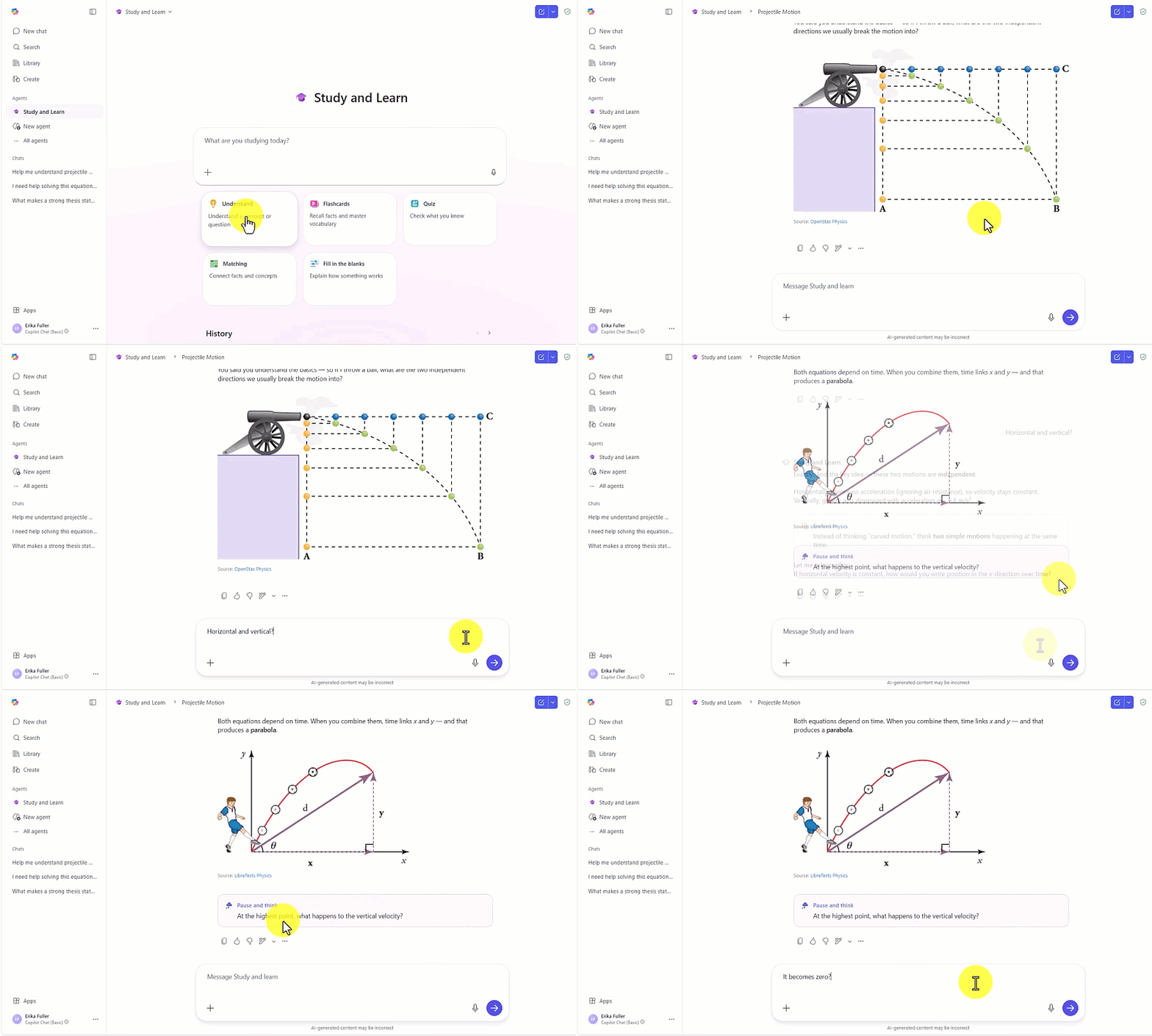
The commercial and pedagogical implications of Microsoft’s latest deployment extend far beyond individual classrooms. By successfully reframing artificial intelligence from a transactional "answer engine" into a developmental coaching partner, the tech sector is signaling a maturation in educational technology design.
Industry analysts observe that as institutional budgets tighten and demands for measurable learning outcomes intensify, software providers must demonstrate tangible cognitive value rather than superficial novelty. The success of the Study and Learn Agent will likely be measured by longitudinal studies tracking student retention rates, conceptual mastery, and the reduction of academic integrity violations in digitally enhanced learning environments. If schools can successfully deploy compliant, learning-first AI tools at scale, it may permanently alter the paradigm of independent study, shifting educational norms away from rote memorization and toward deeply personalized, active cognitive engagement.
For educational leadership teams seeking to operationalize this technology, immediate priorities include reviewing IT configuration documentation, conducting administrative enablement workflows, and preparing faculty to guide students in leveraging AI responsibly. As linguistic expansions roll out globally over the upcoming months, the Study and Learn Agent stands poised to become a foundational benchmark for how artificial intelligence can safely and effectively augment human instruction in the twenty-first century.