


Artificial intelligence has officially crossed the threshold from a novelty experiment into the foundational infrastructure of modern education. According to the latest Microsoft AI in Education Report released in mid-2026, a staggering 92 percent of students and education leaders, alongside 88 percent of educators, have already integrated AI tools into their school-related activities. Yet, as institutional adoption reaches near-saturation, school districts and universities face a more complex, high-stakes challenge: ensuring that artificial intelligence actively promotes critical thinking and deep cognitive engagement rather than merely accelerating productivity or serving as a shortcut for homework.
To address this pedagogical evolution, Microsoft Corporation announced a sweeping rollout of new AI-powered teaching capabilities and student-focused learning tools integrated directly into Microsoft 365 Education. Designed in close collaboration with educators through the Education Insiders Program, these innovations transition AI from a simple "answer engine" into an interactive, pedagogical coach. Alongside these technological deployments, Microsoft is expanding its professional development framework to meet an urgent global demand for structured AI training among teachers and academic leaders.
The Push Beyond Productivity: What the Data Reveals
The necessity for specialized educational AI stems from a profound shift in how classrooms operate globally. The 2026 Microsoft special report—which surveyed 3,345 respondents across K-12 and higher education sectors in the United States, United Kingdom, Australia, Brazil, Japan, and Saudi Arabia—reveals that the primary hurdle is no longer access, but institutional support and governance.

The empirical findings underscore a significant appetite for continuous professional development. Sixty-six percent of educators and 52 percent of students indicated a desire for monthly or quarterly AI training. Furthermore, educators are demanding clearer, standardized guidance regarding the ethical and responsible use of machine learning in academic environments. The stakes are perceived as exceptionally high: 87 percent of educators and education leaders, alongside 79 percent of students, agree that mastering effective and responsible AI utilization is vital for long-term student career readiness.
Despite widespread enthusiasm, early adoption models occasionally fostered concerns over academic integrity and cognitive atrophy, with critics warning that generative AI might bypass the struggle required for true learning. Microsoft’s latest suite of tools directly tackles this critique by anchoring technological design in established learning sciences, ensuring that students remain active participants in their own education.
A Chronology of Educational AI Transformation
The rapid integration of generative AI into schools has unfolded in distinct phases over the past several years, culminating in the current wave of customized learning technologies:
- Early Experimentation Phase (2022–2023): Following the public release of advanced generative models, schools experienced a sudden influx of unstructured AI usage. Educational institutions initially reacted with reactive bans, concerns over plagiarism, and uncertainty regarding data privacy.
- Policy and Framework Development (2024–2025): Recognizing that bans were unsustainable, educational authorities and technology providers began drafting governance frameworks. International bodies, including the European Commission and the Organisation for Economic Co-operation and Development (OECD), initiated collaborative efforts to establish baseline definitions for AI literacy.
- The Shift to Pedagogical Integration (2026): The current era is defined by intentional design. Technology firms are no general-purpose tools deploying generic chatbots; instead, they are releasing purpose-built learning agents grounded in educational research, backed by institutional IT controls and structured teacher training programs.
From Answer Engines to Interactive Learning Coaches

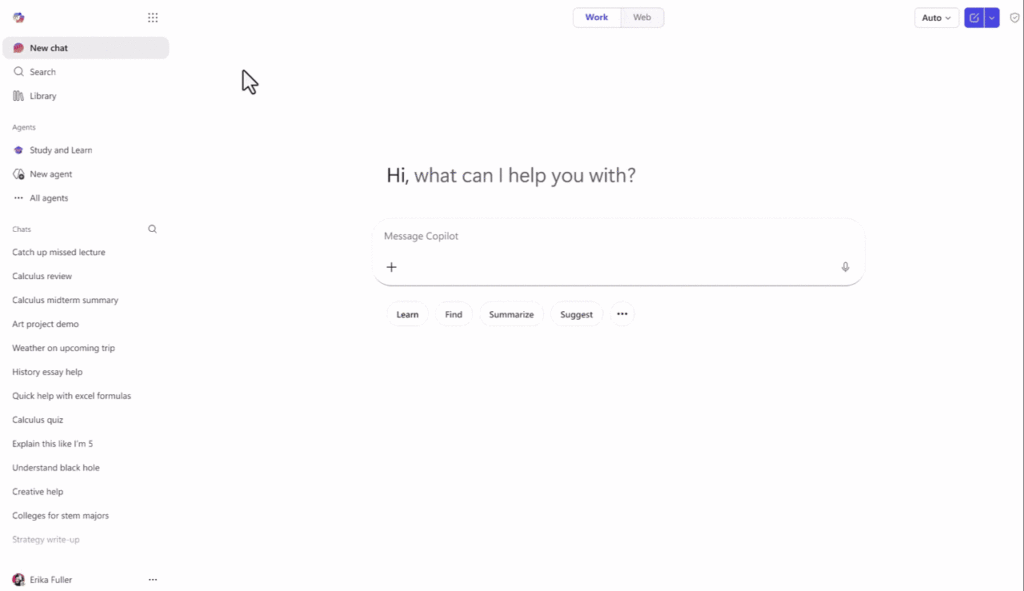
At the center of Microsoft’s new product announcements is the Study and Learn Agent, an advanced capability built into Copilot Chat at no additional cost for Microsoft 365 Education users aged 13 and older. Rather than providing direct answers to complex queries, the Study and Learn Agent functions as an interactive cognitive coach. Utilizing research-based scaffolding techniques, the tool helps students deconstruct difficult concepts, work methodically through multi-step problems, and refine their writing skills without performing the underlying cognitive work for them.
The system incorporates interactive practice modalities—such as automatically generated flashcards, customized quizzes, and matching exercises—paired with immediate formative feedback. These features are specifically engineered to foster long-term knowledge retention and encourage independent problem-solving.
Institutional flexibility remains a cornerstone of the rollout. Information technology administrators retain full oversight; they must first explicitly enable Copilot Chat for K-12 populations, which subsequently activates the Study and Learn Agent by default. In the coming months, educators will gain the administrative capacity to assign specific Study and Learn workflows directly through Microsoft 365 Assignments, aligning AI interactions with formal curriculum requirements.
Complementing the Study and Learn Agent is the introduction of Copilot Notebooks within the Microsoft 365 Copilot application. This secure workspace allows students to aggregate disparate learning materials—including lecture slides, teacher handouts, course readings, and personal notes—into a centralized, verifiable hub. Students can query the AI for assistance grounded strictly in their uploaded source documents, transforming static notes into dynamic, interactive study guides for self-testing.
To streamline accessibility, Microsoft is also introducing "Teach and Learn" taskbar shortcuts directly on Windows devices, offering students and educators immediate, personalized access to these learning environments.

Empowering Educators Through Global Frameworks and Credentials
Technology alone cannot transform academic outcomes; educators must feel confident and adequately trained to guide students through the nuances of digital literacy. To bridge the persistent skills gap identified in their research, Microsoft has expanded its professional development ecosystem.
The Microsoft Elevate for Educators initiative has opened applications for its advanced Expert tier. This program provides teachers and school administrators with community networks, verifiable credentials, and institutional capacity-building resources designed to modernize pedagogical strategies safely.
Furthermore, Microsoft has aligned its training pathways with international standards. The company has supported the AI Literacy Framework developed jointly by the European Commission, the OECD, and CodeAI. This framework provides policymakers, curriculum designers, and classroom teachers with a standardized playbook detailing the core competencies students should acquire regarding artificial intelligence before completing their formal education.
To operationalize this standard, Microsoft collaborated with the International Society for Technology in Education (ISTE) and the Association for Supervision and Curriculum Development (ASCD) to launch the "AI Literacy for Educators" credential pathway. This curriculum maps directly to international benchmarks, offering teachers a recognized credential in navigating ethical AI integration.

Implications for the Future of Schooling
The rapid convergence of artificial intelligence and formal education carries profound implications for school districts, policymakers, and software developers alike. As educational institutions transition from cautious hesitation to proactive integration, the definition of digital literacy is expanding beyond basic computer skills to encompass algorithmic awareness, prompt engineering ethics, and critical evaluation of machine-generated outputs.
Industry analysts note that by embedding privacy protections, robust IT governance, and pedagogical science directly into software suites already ubiquitous in schools, technology providers are alleviating administrative friction. However, the long-term success of these initiatives will depend heavily on equitable access to professional development. Without sustained investment in teacher training—particularly in under-resourced school districts—the digital divide risk morphs into an "AI literacy divide."
As the academic year draws to a close and institutions look toward future enrollment cycles, the overarching message from educational technologists is clear. The conversation has decisively shifted away from whether artificial intelligence belongs in the classroom. Instead, the modern educational mandate focuses entirely on how schools can harness secure, well-supported, and student-centered AI tools to cultivate the critical thinking skills required for an increasingly complex world.