



The landscape of modern education has entered a decisive phase as artificial intelligence transitions from an experimental novelty to a foundational pillar of classroom infrastructure. According to the latest Microsoft AI in Education Report, adoption rates among educational stakeholders have reached unprecedented heights. Data from the comprehensive global study indicates that 92 percent of students and education leaders, alongside 88 percent of educators, have already integrated AI applications into their school-related routines. However, this widespread utilization has brought institutional focus to a more complex challenge: ensuring that AI actively supports deep learning and critical thinking rather than merely serving as a tool for accelerated task completion and administrative productivity.
The findings from the special report underline a critical gap between current technology deployment and pedagogical support. While early experimentation has successfully normalized AI within schools, achieving meaningful educational outcomes requires deliberate institutional backing. The survey revealed that 66 percent of educators and 52 percent of students desire monthly or quarterly professional training regarding artificial intelligence, alongside a clear demand for explicit governance and guidance concerning responsible use. In response to these evolving needs, technology developers and educational policymakers are working in tandem to introduce secure, research-grounded solutions that align with established learning sciences.
Main Facts and the Technological Shift
Addressing the clear demand for guided educational technology, Microsoft Corporation announced a comprehensive suite of AI-powered teaching capabilities and student-centered learning tools integrated directly into Microsoft 365 Education. Designed in collaboration with the Education Insiders Program—a global network of practicing teachers and academic leaders—these new features aim to reshape daily instructional workflows. Rather than functioning as standalone utilities, the newly introduced capabilities are embedded within existing software environments, backed by institutional-grade privacy and security protections that provide school districts and universities with consistent, trusted deployment models.
At the core of this rollout is a deliberate shift in how artificial intelligence interacts with students. Traditionally utilized as a rapid answer engine, the new generation of educational AI is engineered to function as an interactive learning coach. This approach seeks to preserve the cognitive effort required for genuine comprehension. By prioritizing instructional scaffolding over instantaneous answers, the newly released tools encourage students to work through complex problems independently while receiving immediate, tailored feedback that fosters long-term knowledge retention.

Chronology and Background Context
The rapid integration of generative artificial intelligence into academic environments began accelerating globally following the widespread public release of large language models in late 2022 and 2023. Initially met with widespread academic panic regarding academic integrity, plagiarism, and the potential erosion of foundational writing skills, educational institutions quickly realized that banning the technology was neither sustainable nor beneficial for workforce preparation.
By 2024 and 2025, schools moved from reactionary prohibitions to structured policy experimentation. Districts began establishing task forces to draft ethical guidelines for generative AI use. Recognizing the need for empirical data on how these technologies were truly affecting classrooms, research initiatives were launched globally. Between February 13 and March 9, 2026, PSB Insights conducted a major quantitative survey for Microsoft, polling 3,345 respondents across K-12 and higher education sectors in the United States, the United Kingdom, Australia, Brazil, Japan, and Saudi Arabia. The survey captured insights from educators, academic leaders, IT administrators, and students aged 13 and older, weighting global data based on World Bank educational expenditure estimates.
The data gathered during this period confirmed that while usage was ubiquitous, the pedagogical framework lagged behind student adoption. Recognizing this gap, educational technology developers intensified their reliance on educator feedback loops, culminating in the mid-2026 announcement of targeted learning tools designed to address the specific demand for structured, safe, and academically rigorous AI applications.
Supporting Data and Global Insights
The empirical evidence compiled in the 2026 Microsoft special report highlights both the enthusiasm for and the anxieties surrounding artificial intelligence in global classrooms. The data reveals a universal acknowledgment that digital literacy must encompass advanced technological comprehension to prepare students for a rapidly evolving global economy.

Key data points from the study outline the current state of educational AI adoption:
- 92 percent of students and education leaders actively utilize AI for school-related purposes.
- 88 percent of educators report regular professional or instructional use of AI tools.
- 66 percent of educators express a strong desire for monthly or quarterly professional development training focused on artificial intelligence.
- 52 percent of students request more structured guidance regarding the responsible application of AI in their studies.
- 87 percent of educators and education leaders agree that mastering effective and responsible AI usage is essential for student career readiness.
- 79 percent of the surveyed students share the belief that AI competency is a prerequisite for their future professional success.
These figures demonstrate that the debate has shifted away from whether artificial intelligence belongs in schools. Instead, institutional focus is squarely concentrated on governance, teacher training, and the pedagogical validity of the tools being deployed.
Core Innovations: From Answer Engine to Learning Coach
To address the pedagogical concerns raised by educators, the newly introduced features within Microsoft 365 Education are specifically tailored to promote independent analytical thought. The technological architecture of these updates introduces distinct tools designed for both students and instructional staff.
Study and Learn Agent
Operating within Copilot Chat at no additional cost for Microsoft 365 Education users aged 13 and older, the Study and Learn Agent transforms conversational AI into an interactive tutoring partner. Grounded in established learning-science principles, the agent is engineered to prevent shortcuts that bypass critical thinking. Instead of supplying direct answers to homework or essay prompts, the system employs scaffolded questioning. It guides students through complex problem-solving processes, assists in structural writing development, and generates interactive practice modules such as digital flashcards, quizzes, and matching exercises. Institutional flexibility remains a priority: IT administrators retain full control, requiring them to first enable Copilot Chat for K-12 environments before student access is provisioned by default. Furthermore, upcoming updates will allow educators to directly assign specific Study and Learn tasks through digital assignment workflows.
Copilot Notebooks
Designed as a dedicated, secure workspace for academic research and study preparation, Copilot Notebooks integrates directly into the Microsoft 365 Copilot application. Students can aggregate diverse source materials—including lecture slides, assigned readings, handwritten notes, and classroom handouts—into a single centralized repository. The AI assistance is strictly bounded and grounded within these provided sources, preventing hallucination and ensuring students remain focused on curriculum-aligned content. Additionally, new study guide generation features allow learners to transform their compiled course documents into customized self-testing modules for exam preparation.

Device Integration and Institutional Governance
To minimize friction in daily academic routines, Microsoft has incorporated Teach and Learn shortcuts directly into the taskbars of Windows devices, granting students and teachers immediate, personalized access to their AI workspaces. For institutional leaders, IT directors, and school board administrators, the entire ecosystem is built with enterprise-grade governance, robust data privacy protections, and seamless network integration, allowing for safe, district-wide deployments that comply with regional educational standards.
Professional Development and Training Frameworks
Technology alone cannot solve the instructional challenges posed by the digital age; educators require structured professional development to effectively integrate these tools into their lesson plans. Recognizing this imperative, industry leaders and international governing bodies have collaborated to establish standardized frameworks for artificial intelligence literacy.
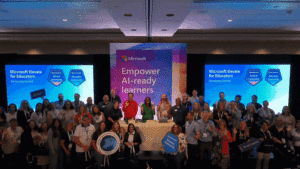
The Microsoft Elevate for Educators initiative provides a comprehensive ecosystem consisting of professional communities, digital credentials, and capacity-building resources designed to assist teachers and school administrators in modernizing their pedagogical practices. Complementing this effort, Microsoft has provided foundational support for the AI Literacy Framework developed jointly by the European Commission, the OECD, and CodeAI. This framework offers a shared international playbook for policymakers, curriculum designers, and classroom teachers, defining the baseline knowledge and competencies students should acquire by the conclusion of their formal schooling.
In alignment with these international standards, educational organizations including ISTE and ASCD have introduced the AI Literacy for Educators credential pathway. This professional certification program maps directly to the Expert tier of the Microsoft Elevate for Educators platform, which is currently accepting applications from qualified teaching professionals seeking to validate their instructional technology competencies.
Implications and Broader Industry Impact

The widespread introduction of structurally governed artificial intelligence into schools carries significant implications for the future of education, labor markets, and software development. As academic institutions increasingly reject unmitigated generative tools in favor of scaffolded, learning-science-backed applications, the tech industry faces mounting pressure to align product development with pedagogical best practices.
From an economic perspective, the consensus among 87 percent of educators regarding AI career readiness signals a fundamental transformation in vocational preparation. School districts are no longer viewing digital literacy as an elective computer science module, but as a cross-curricular competency comparable to traditional literacy and numeracy. However, this transition exposes existing disparities in digital infrastructure and teacher training budgets. Districts with fewer financial resources may struggle to implement the continuous professional development demanded by their teaching staffs, potentially widening the equity gap between well-funded suburban districts and under-resourced urban or rural schools.
Moreover, the emphasis on data privacy and institutional control reflects a maturing market response to early regulatory concerns. By requiring administrative authorization before deploying student-facing AI agents, technology providers are accommodating strict data protection laws, such as the Family Educational Rights and Privacy Act (FERPA) in the United States and the General Data Protection Regulation (GDPR) in Europe.
Conclusion
As academic calendars transition from the conclusion of the academic year toward preparations for the subsequent term, the educational sector stands at a critical juncture. The foundational question facing institutions is no longer whether artificial intelligence will occupy a space in the modern classroom, but how deliberately that technology will be shaped to serve human intellect. By combining rigorous institutional safeguards, pedagogically sound learning coaches, and comprehensive professional training frameworks for educators, the education community aims to harness the efficiency of artificial intelligence while safeguarding the critical thinking skills essential for the next generation of learners.