



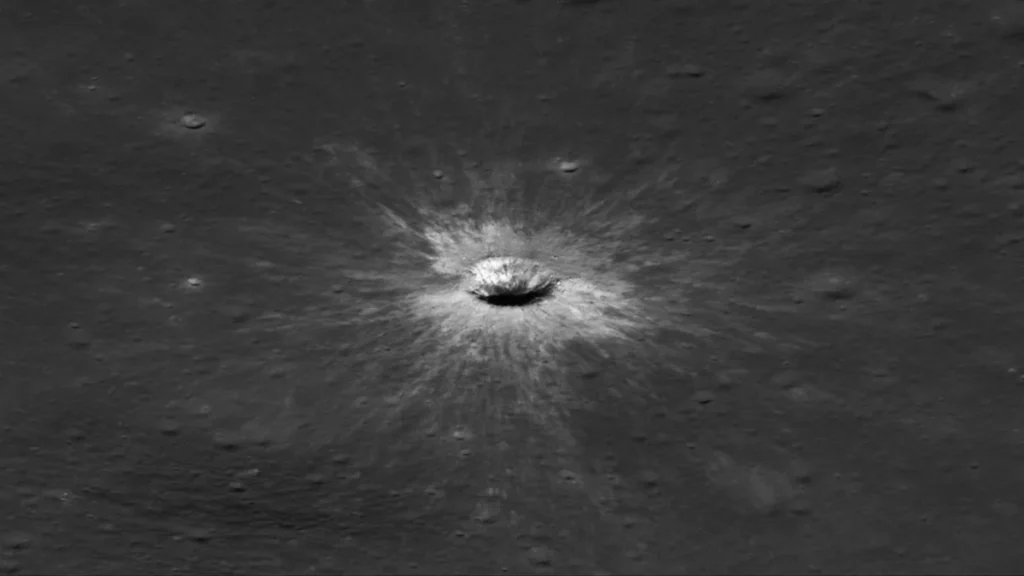
The lunar surface, long perceived by observers as a static and unchanging monument of cosmic history, is in reality an active combat zone pelted by an unceasing barrage of space debris. Because the Moon lacks an atmosphere to burn up incoming meteoroids, objects ranging from microscopic dust particles to massive asteroids strike its dusty landscape with unmitigated force. While astronomers estimate that approximately 140 coffee table-sized asteroids and comets impact the lunar surface annually—each generating craters roughly 30 feet in diameter—truly massive impacts are exceedingly rare.
Recently, however, observations from NASA’s long-standing Lunar Reconnaissance Orbiter (LRO) have revealed a colossal new scar on the lunar landscape. Documented in a pair of studies published in the journal Science Advances, an asteroid or comet roughly the size of a three-to-six-story building collided with the Moon’s eastern edge. The resulting impact formed a massive depression measuring 728 feet wide and 141 feet deep—stretching out to roughly the length of two football fields. Named the McGetchin crater in honor of the late renowned lunar scientist Tom McGetchin, this formation represents the largest newly created impact crater ever documented within the solar system in real-time, offering researchers a once-in-a-century opportunity to study the immediate aftermath of a major celestial collision.
The Discovery and Chronology of an Anomalous Impact
The discovery of the McGetchin crater was not the result of a targeted observation, but rather the product of meticulous routine data analysis. Since its launch in June 2009, the LRO has revolutionized lunar science by mapping the Moon in unprecedented detail, enabling researchers to pinpoint more than 1,000 newly formed craters and over 100,000 surface changes driven by primary impacts or secondary debris showers.
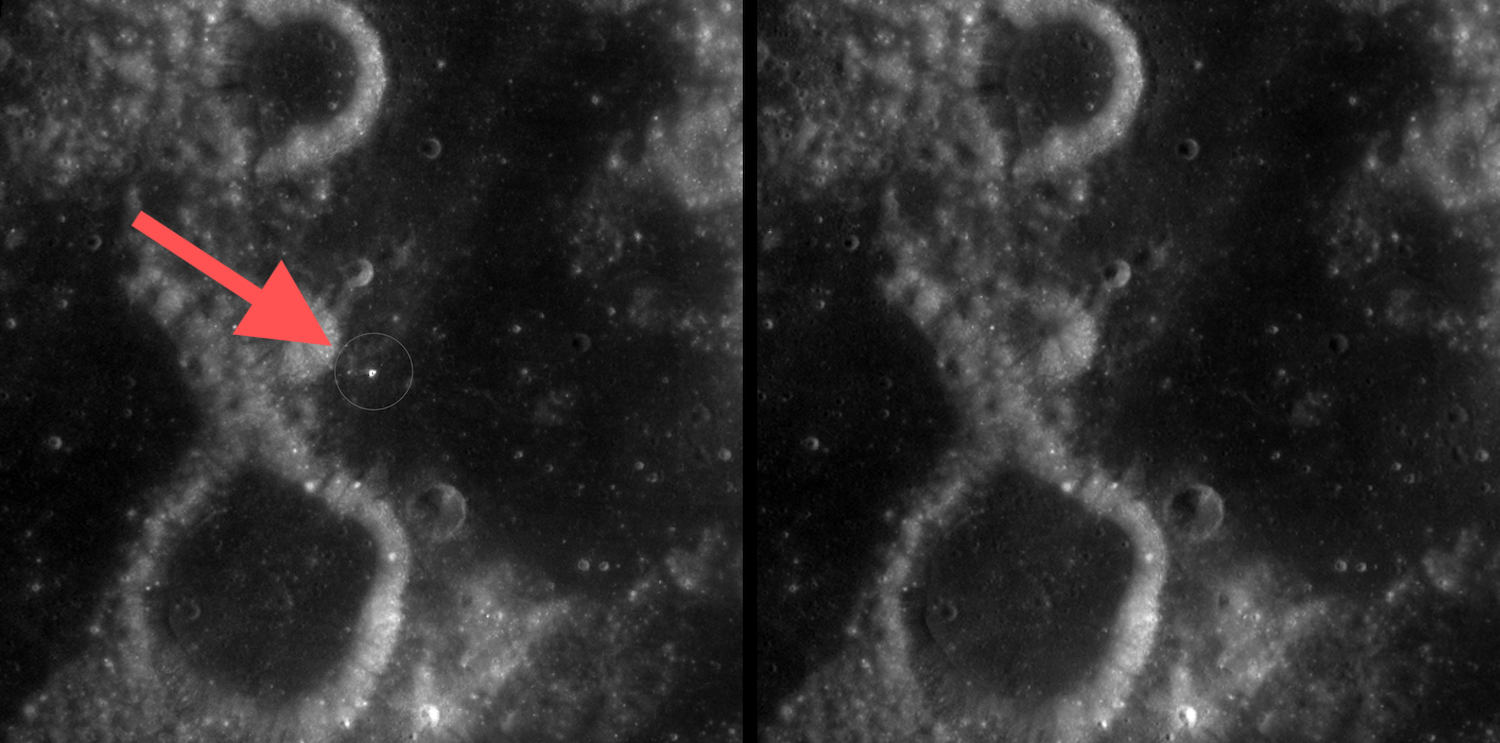
The timeline of the event was narrowed down through orbital imaging sweeps. The impact occurred during a brief window between April 11 and May 22, 2024, when a massive space rock struck the lunar terrain. However, the event went unnoticed for over a year. It was not until October 24, 2025, that image-processing specialist Robert Wagner, working with data collected by the LRO Wide-Angle Camera, spotted a striking visual anomaly: a massive, luminous circle encased by a distinct darker halo.
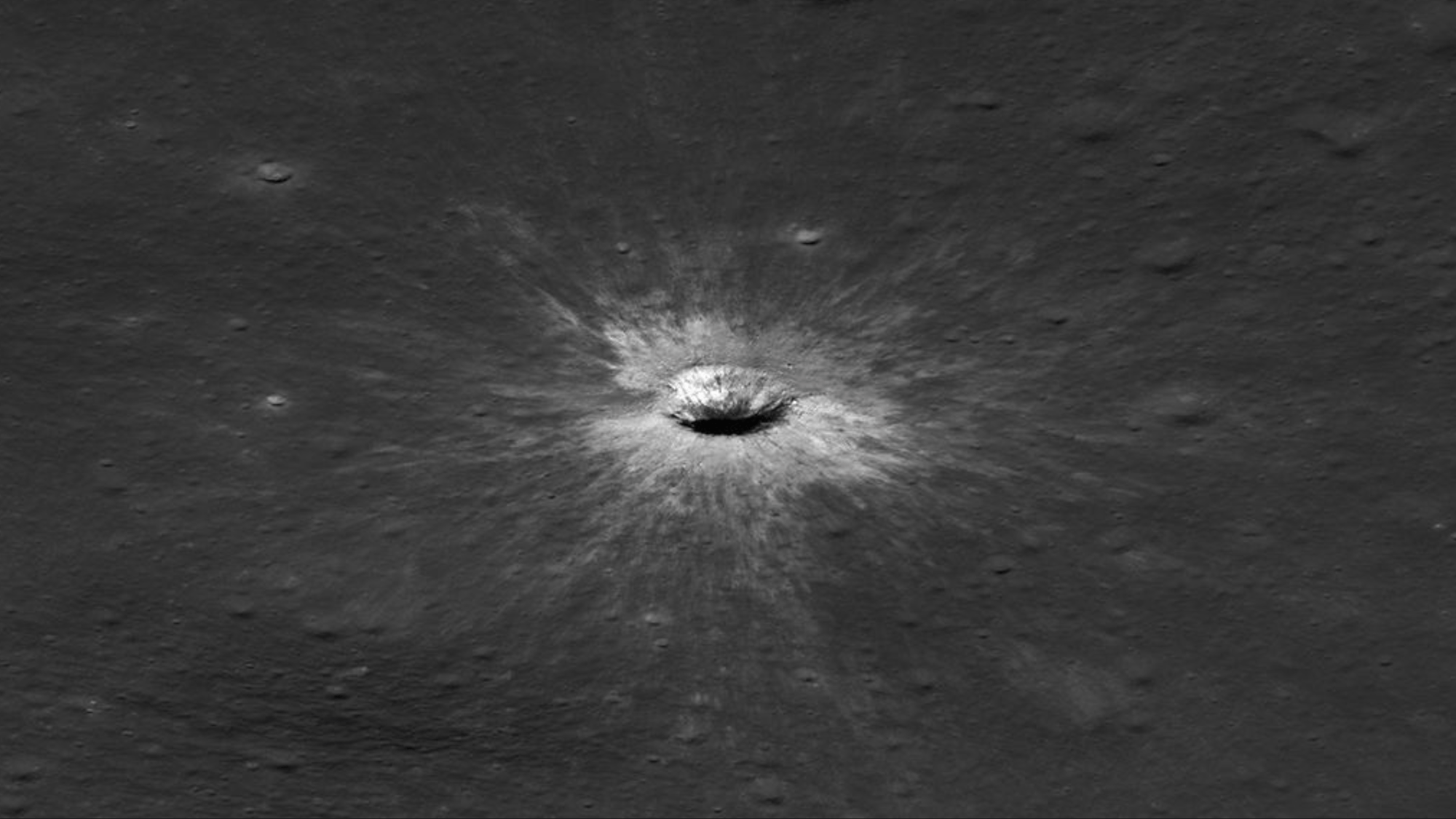
Recognizing that the formation did not resemble standard geological anomalies or routine sensor glitches, Wagner initiated a comprehensive verification process. Confirming a new lunar impact requires more than simply toggling between historical "before" and "after" photographs. Specialized processing software frequently flags false positives caused by shifting solar angles, topographic shadows, and subtle lighting variations.
To validate the find, Wagner conducted a meticulous pixel-by-pixel examination of the surrounding terrain, searching for microscopic ejecta blankets—the telltale spray of pulverized regolith thrown outward during high-velocity impacts. The forensic analysis confirmed his initial hypothesis. The surrounding region featured the most prominent and extensive impact debris pattern ever recorded by the orbital camera suite, confirming a violent and exceptionally large collision.
Supporting Data and Thermal Analysis
Subsequent analyses utilizing advanced instruments onboard the LRO have begun to unpack the physics of the cataclysmic event. Following the optical confirmation, researchers turned to the Diviner Lunar Radiometer Experiment, an instrument capable of measuring thermal emissions from the lunar surface.
Thermal scans revealed a striking anomaly surrounding the newly formed crater: a four-mile-wide thermal halo that registered roughly 16 degrees Fahrenheit cooler than the ambient nighttime temperatures of the surrounding terrain. Planetary scientists explain that this sudden temperature drop occurs because high-energy impacts forcefully disrupt and aerate the upper layers of the lunar regolith. The loosened, uncompacted soil loses its thermal retention capabilities, creating a distinct cold signature detectable by infrared sensors long after the dust settles.
Further geometric measurements established the sheer scale of the cavity. Spanning 728 feet in diameter and plunging 141 feet deep, the McGetchin crater dwarfed typical baseline impacts. To better understand the mechanics of the collision, researchers are currently leveraging the LRO’s high-resolution Narrow-Angle Camera, which captures surface imagery at a staggering resolution of three feet per pixel. These granular images allow scientists to model the projectile’s trajectory, estimate its mass, and calculate the kinetic energy released upon impact—data critical for refining planetary defense models and understanding the bombardment history of the inner solar system.
Implications for Planetary Science and Future Exploration
The identification of the McGetchin crater carries profound implications for multiple fields of space science, ranging from lunar geomorphology to human spaceflight safety. For decades, scientists have relied on crater-counting techniques to estimate the relative ages of planetary surfaces across the inner solar system, assuming a relatively steady rate of asteroid impacts over geological timescales. Catching a massive, century-scale impact event in the act provides an invaluable calibration point for these crater chronology models, helping researchers refine the mathematical equations used to date surfaces on the Moon, Mars, and Mercury.
Furthermore, the discovery underscores the dynamic and potentially hazardous nature of the lunar environment. As space agencies worldwide—including NASA through its Artemis program—prepare to establish sustainable human infrastructure on the lunar surface, understanding the frequency and severity of unmitigated meteoroid impacts is paramount. While the statistical probability of a habitat or astronaut being struck by a building-sized asteroid remains remarkably low, the sheer kinetic energy of smaller, more frequent impacts poses a continuous operational risk to surface assets, communication arrays, and unshielded equipment.
As researchers continue to analyze the telemetry and high-resolution imaging returned by the Lunar Reconnaissance Orbiter, the McGetchin crater stands as a stark reminder of the violent cosmic forces continuously shaping our celestial neighbor. This rare astronomical event not only yields unprecedented insights into impact mechanics, but also reaffirms the critical value of sustained orbital monitoring in safeguarding our understanding of the solar system.