



The rapid integration of artificial intelligence into the modern workplace has triggered an unexpected paradox: while emerging technologies demand higher levels of critical thinking and analytical oversight, they are simultaneously eroding the foundational human capabilities required to manage them. According to a comprehensive global study released by the IBM Institute for Business Value (IBV), titled "Designing the Thinking Organization," business leaders and employees find themselves at odds over who is truly prepared to evaluate, supervise, and navigate AI-driven workflows.
Conducted in partnership with Oxford Economics between April and June 2026, the study draws on extensive research across 28 countries, capturing insights from 1,500 Chief Human Resources Officers (CHROs) and senior workforce strategy executives spanning 21 geographies and 23 industries, alongside 8,800 full-time employees. The resulting data exposes a glaring disconnect between executive expectations and employee realities, highlighting that workforce transformation is currently outpacing deliberate corporate restructuring.

The Evolution of the AI Skills Paradox
To understand the current friction in the enterprise landscape, one must examine the timeline of AI adoption over recent years. Following the widespread commercial availability of generative artificial intelligence models starting in late 2022 and accelerating through 2024 and 2025, organizations rushed to integrate automated tools to boost productivity. Initial corporate strategies centered heavily on deployment, cost reduction, and operational speed.
However, by 2026, the conversation shifted dramatically from mere adoption to governance, quality control, and human-AI collaboration. As algorithms began handling routine writing, data analysis, coding, and administrative tasks, employers realized that human intervention remained necessary to prevent hallucinations, systemic bias, and operational errors. Consequently, executive priorities pivoted toward critical thinking, problem framing, and the ability to audit AI outputs.
Yet, this shift revealed an unforeseen vulnerability. As software systems shoulder more of the cognitive load, employees are increasingly decoupled from the foundational exercises that build and maintain analytical competence. When algorithms draft the memos, generate the code, and synthesize the research, the human workforce is gradually stripped of the iterative practice needed to sharpen those very skills.
A Closer Look at the Data: The Executive-Employee Disconnect
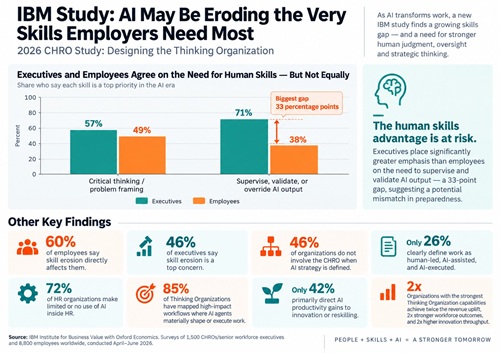
The IBM and Oxford Economics study illuminates several critical gaps between boardroom expectations and front-line experiences. While 52 percent of surveyed employees reported that their assigned daily tasks changed significantly over the past year due to AI integration, only 26 percent of organizations have formally defined their workflows across human-led, AI-assisted, and AI-executed categories. This structural vacuum suggests that work is evolving organically through reactive, day-to-day adaptations rather than intentional, top-down design.

Furthermore, profound perceptual divides exist regarding the oversight of automated tools. While 57 percent of executives and 49 percent of employees acknowledge critical thinking and problem framing as paramount for AI-enabled environments, the consensus dissolves when discussing accountability. Fully 71 percent of executives prioritize the ability to supervise, validate, or override AI outputs. In stark contrast, only 38 percent of employees share this priority. A separate measure within the findings underscores this gap further: only 29 percent of employees rank independent human judgment as a primary daily requirement.
This 33-percentage-point divergence concerning AI oversight highlights a dangerous complacency among workers who may trust automated solutions too implicitly, contrasting sharply with executive anxiety over the potential fallout of unmonitored machine errors.
Distinguishing the Skills Gap from Skill Erosion

Corporate learning and development departments have long wrestled with the traditional "skills gap"—the delta between the capabilities job seekers possess and the competencies employers require. To bridge this gap, approximately 80 percent of enterprises have implemented reskilling roadmaps designed to help workers collaborate alongside advanced technologies.
However, IBM argues that traditional reskilling frameworks fail to address a distinct and insidious phenomenon: skill erosion. While reskilling focuses on teaching workers new proficiencies, it does little to prevent the atrophy of existing capabilities that diminish when automated systems take over the underlying mechanics of a job.
The empirical evidence underscores this threat. While 46 percent of executives view skill erosion as a pressing organizational concern, an alarming 60 percent of employees report that it directly affects their professional daily lives. Among the workforce segment worried about erosion, three out of four respondents state that AI has already begun to erode at least some of their core professional competencies, with critical thinking cited most frequently as the capability in greatest decline.

Implications for Enterprise Workforce Strategy
The implications of the IBM study stretch far beyond human resources departments, presenting a fundamental challenge to the architecture of the modern knowledge economy. If foundational competencies degrade faster than organizations can cultivate advanced oversight skills, enterprises risk creating a brittle operational ecosystem dependent on systems that few workers are genuinely qualified to audit.
Experts suggest that addressing this crisis requires a complete overhaul of workflow design. Rather than delegating entire cognitive processes to algorithms, organizations must intentionally engineer "human-in-the-loop" checkpoints that force workers to engage critically with incoming data. This means restructuring daily responsibilities so that employees regularly practice problem framing, ethical evaluation, and manual verification, thereby inoculating their cognitive faculties against atrophy.

Moreover, CHROs and senior workforce strategists must look beyond standard productivity metrics. Reinvesting AI-driven efficiencies into continuous, active capability-building—rather than viewing automation purely as a labor-reduction mechanism—will be vital for long-term sustainability.
As businesses continue to navigate the maturation of artificial intelligence, the findings from the IBM Institute for Business Value serve as a cautionary signal. Technology can drastically accelerate output, but without deliberate organizational redesign and a proactive defense against skill erosion, the very tools meant to elevate human potential may ultimately undermine the intellectual foundation upon which modern enterprises depend.