



The rapid integration of artificial intelligence into the modern workplace is precipitating a profound metamorphosis of the managerial role, moving beyond traditional concerns of job elimination and hiring impacts to unlock unprecedented opportunities for mid- and senior-level leaders. While anxieties surrounding AI’s potential to automate tasks and displace workers persist, a deeper analysis reveals a more optimistic trajectory for leadership, one centered on augmenting human capabilities and fostering a more people-centric approach to management. This shift, often overlooked amidst the broader discourse on AI’s disruptive potential, promises to redefine what it means to lead, placing a premium on uniquely human skills.
Historically, many individuals ascend to managerial positions based on their technical proficiency or mastery of specific tasks, rather than inherent aptitude for leading and developing people. This often results in the "player-coach" dilemma, where individuals excel at execution but struggle to effectively guide and inspire their teams. The advent of AI, however, is poised to fundamentally alter this dynamic. By augmenting individual capacity and fostering the rise of the "Superworker"—an employee empowered by AI to achieve higher levels of productivity and self-management—AI is freeing up employees to focus on more complex and strategic endeavors. Yet, this surge in technological capability is also accompanied by a palpable increase in worker apprehension, with reports indicating record levels of stress and uncertainty as individuals grapple with the implications of AI for their career trajectories.
In this evolving landscape, the manager’s role is transitioning from an orchestrator of tasks to a dedicated facilitator of growth, development, and well-being. This human-centric approach to leadership, underpinned by skills such as empathy, coaching, and emotional intelligence, is becoming paramount. As AI increasingly handles the mechanical aspects of work, managers will be empowered to dedicate more time and energy to nurturing their teams, recognizing skills, and fostering engagement. Currently, HR-related responsibilities constitute approximately 10 percent of a manager’s workload. Projections suggest this figure could surge to as high as 90 percent in the near future, underscoring the dramatic reallocation of managerial focus.
AI-Driven Work Redesign: A Paradigm Shift in Organizational Structures
The accelerating integration of AI into daily operations is not merely optimizing existing processes; it is fundamentally redesigning work itself. This necessitates a critical re-evaluation of organizational hierarchies and the skill sets required for leadership. For managers who may lack robust interpersonal skills, the question arises: will they adapt to these new demands, or will their roles be redefined or even phased out? The inherent difficulty in cultivating strong people skills suggests that AI’s pervasive influence will compel organizations to rethink their structures and leadership pathways.
Sectors such as software engineering, which have historically struggled to find individuals adept at both technical excellence and effective people management, will experience this transformation acutely. With AI poised to automate a significant portion of coding tasks, companies will be compelled to redefine skill profiles and the very nature of management responsibilities within these domains. Instead of solely focusing on technical output, managers in these fields will need to pivot towards nurturing creativity, fostering collaboration, and guiding the ethical development and deployment of AI technologies.
Crucially, managers will remain indispensable architects of this AI-driven work design. Their domain-specific expertise will be vital in reinventing workflows, championing AI adoption, and steering their teams through the complex transition. By modeling effective AI utilization and demonstrating new, collaborative ways of working, managers will lead by example, fostering a culture of continuous learning and adaptation.
The Manager as a "Personalizer" of Employee Development
The evolving role of the manager is also blurring the lines with traditional human resources functions. As HR departments have become more decentralized and employee experience has risen in strategic importance, the responsibilities of performance management, coaching, and career development have increasingly fallen to frontline managers. This shift reflects a growing recognition that managers, in their day-to-day interactions, possess a far greater influence on the employee experience than HR departments alone. Data consistently indicates that managers are the primary drivers of employee engagement, satisfaction, and retention.
Historically, performance management was often a top-down, annual or semi-annual process overseen by HR. The current trend, however, emphasizes continuous coaching, regular feedback, and proactive career development conversations. This approach empowers employees and fosters a more supportive and growth-oriented work environment. Despite this evolution, a persistent challenge remains: while organizational leadership may prioritize employee outcomes, managers are still frequently evaluated and rewarded based on traditional business metrics. This can create a disconnect, making it difficult for managers to fully embrace and prioritize the human-centric aspects of their roles when faced with competing demands.
The emergence of AI in learning and development (L&D) is set to further revolutionize employee growth. AI-powered platforms can now provide personalized learning paths, tailored coaching, and immediate feedback, a phenomenon aptly termed the L&D AI "revolution." This raises the question of whether AI will supplement or supplant the manager’s role in development. The prevailing sentiment is that AI will serve as a powerful augmentative tool, simplifying and enhancing the often-complex work of people management for both leaders and their teams.
Harnessing AI to Address Complex People Challenges
For managers who find the nuances of people management challenging, AI offers a vital support system. In organizations early in their AI adoption journey, employees have reported a preference for receiving constructive feedback from AI systems. This is often attributed to the depersonalized nature of AI feedback, which can make it easier to digest and act upon without the emotional weight sometimes associated with direct human critique.
Managers often experience trepidation when delivering difficult feedback. AI can mitigate this by depersonalizing the process and providing tactical guidance, ensuring consistency and thoughtfulness in performance discussions. AI tools can offer conversation frameworks, generate performance insights based on objective data, and provide coaching tips, thereby demystifying and easing the often-ambiguous and stressful aspects of management, particularly for those who may not naturally excel in soft-skill domains.
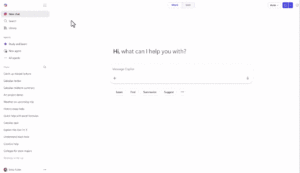
The practical application of this is transformative. Managers who once viewed HR-related tasks, such as performance reviews or development planning, as burdensome add-ons to their primary responsibilities—like sales targets, product launches, or campaign management—will find relief. AI interfaces, designed to understand the manager, their team, and the business context, can now handle a significant portion of these tasks. Instead of navigating complex HR platforms, managers can receive prompts directly within their everyday communication tools like Teams or Slack. For instance, an AI might prompt a manager to provide feedback on an employee’s performance, offering suggested content grounded in actual productivity metrics. The manager can then review, validate, and expand upon this AI-generated input, significantly streamlining the process.
The Dawn of AI-Powered HR Systems
The advent of responsive AI HR systems is making this vision a reality. These systems can automatically extract relevant information from various sources and integrate it into Human Capital Management (HCM) platforms. Furthermore, they can generate personalized development conversation guides for managers, complete with best practices and relevant HR policies, to ensure productive and successful interactions. Even the scheduling of these meetings can be automated, freeing up valuable managerial time.
The implications are clear: AI will make managers more productive by streamlining managerial tasks and embedding them within their daily workflows. Their approach to management will become more personalized, driven by enhanced access to relevant data and insights. Overall, their management skills will improve, bolstered by an ever-present "co-pilot" offering guidance and support.
In essence, the strategic approach to understanding and planning for AI’s impact on managers should be viewed through a lens of augmentation and empowerment. While the initial introduction of AI into the workplace may usher in an era of change and uncertainty, the future promises a seamless integration of AI support for managers, akin to AI-augmented junior colleagues. This support will add tangible value in ways that are currently difficult to fully envision, enabling leaders to operate at unprecedented levels of effectiveness.
The ultimate takeaway is that becoming an AI-empowered "Supermanager" involves embracing both the technological advancements and the fundamentally human aspects of leadership. By harmonizing these elements, managers can unlock exponential outcomes for themselves and their teams, navigating the evolving professional landscape with enhanced capability and strategic foresight. This transformative journey is not about replacing human leadership, but about elevating it to new heights of efficiency, personalization, and impact.