


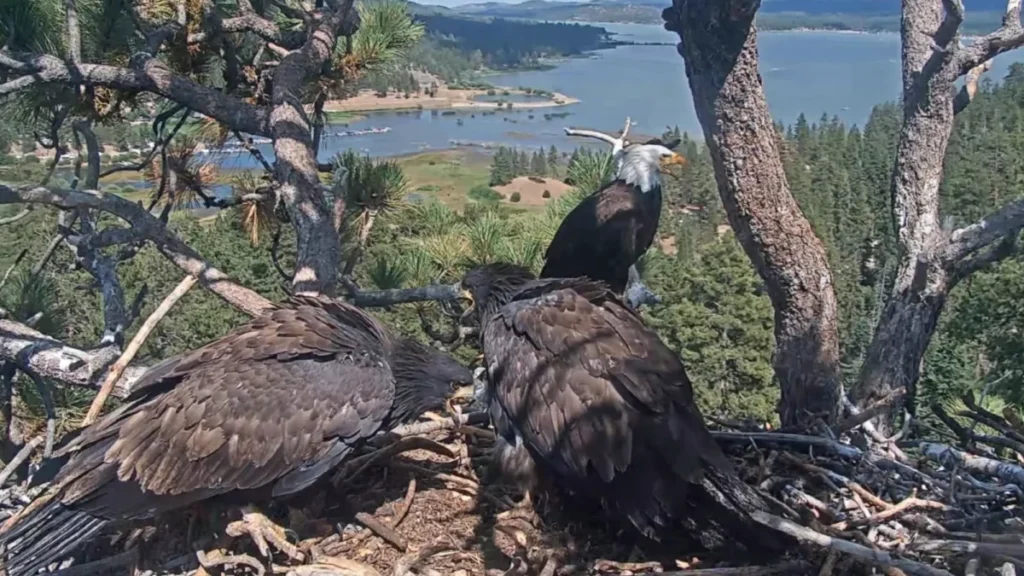
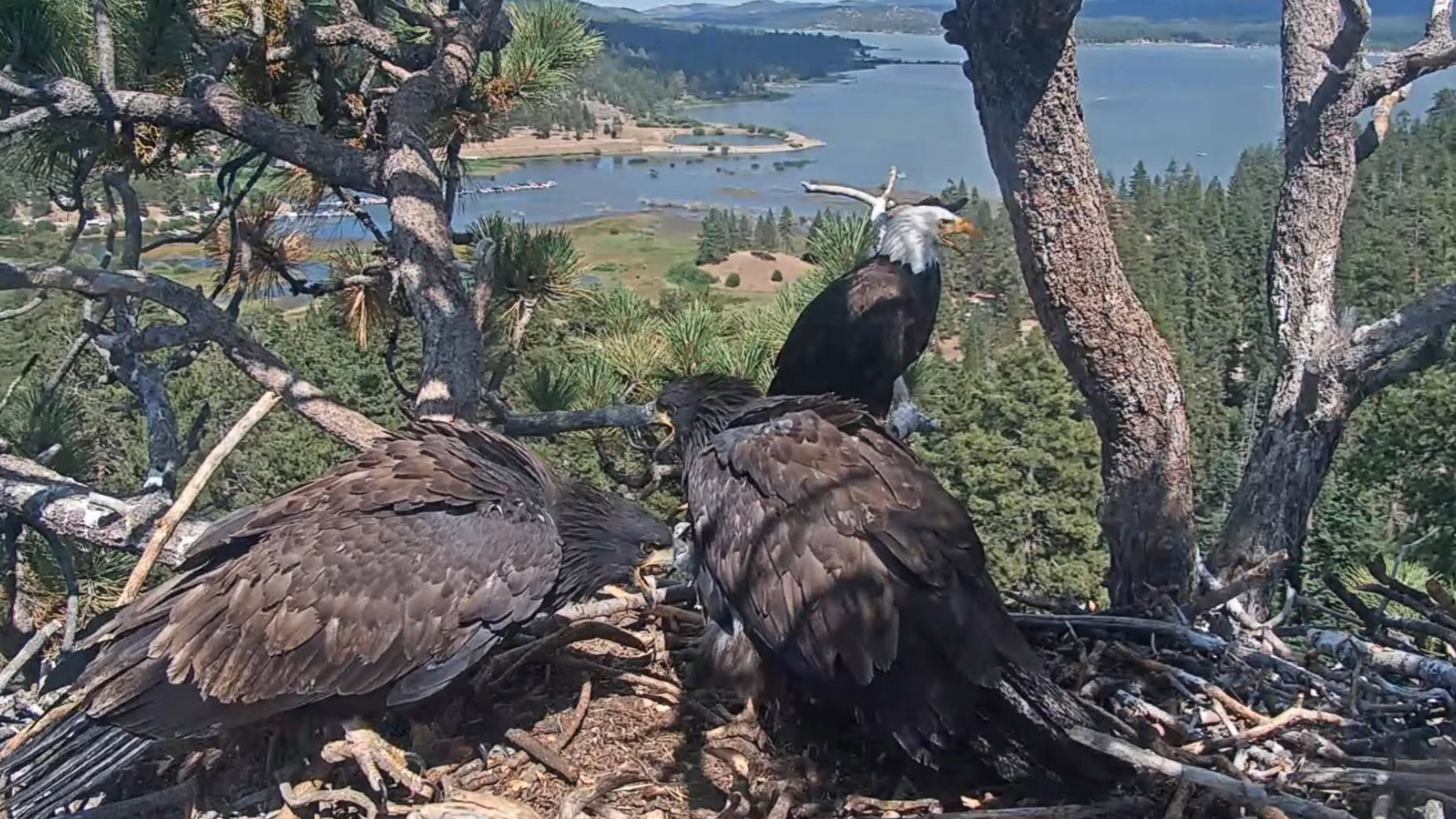
While the renowned female bald eagle Jackie remains in critical condition at the Ojai Raptor Center, her long-term mate Shadow has assumed full responsibility for their nest in the San Bernardino National Forest. Shadow is currently providing sole care for their two subadult offspring, Sandy and Luna, as the family navigates an unprecedented period of separation. The situation has drawn international attention to the Big Bear Valley, where the avian family’s daily life is documented through a 24-hour livestream operated by the nonprofit Friends of Big Bear Valley (FOBBV).
Recent observations from the nest camera indicate that Shadow is successfully managing the demands of the household, which include hunting for food and defending the territory. This defense is particularly vital as several other subadult eagles have been observed encroaching on the Big Bear Lake area. In a notable display of developing instinct, the subadult Luna was recently observed assisting Shadow by chasing away an intruder that attempted to land near the nest. This behavior suggests that despite the absence of their mother, the young eagles are continuing to hit critical developmental milestones under Shadow’s watchful eye.
Clinical Status and Medical Challenges for Jackie
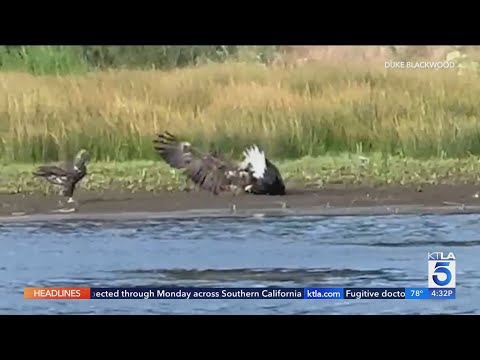
Approximately 170 miles west of the Big Bear nest, Jackie is undergoing intensive medical treatment in Ojai, California. Her condition was upgraded from life-threatening to stable but critical after she was discovered following a violent territorial dispute. Video footage captured near Dana Point recently confirmed that Jackie was involved in a physical altercation with two other adult bald eagles, a conflict that left her with severe trauma.
According to veterinary reports from the Ojai Raptor Center, Jackie is currently suffering from anemia and significant inflammation affecting her kidney function. While she has shown signs of resilience—including eating independently and exhibiting enough energy to resist handling by medical staff—her long-term prognosis remains guarded. Veterinarians are currently investigating the underlying cause of her systemic inflammation.
A primary concern for the medical team is the potential presence of environmental toxins. Toxicology reports are pending to determine if Jackie has been exposed to rodenticides, zinc, or lead. Lead toxicity is a particularly grave threat to North American raptors. Data from the American Eagle Foundation indicates that a lead fragment no larger than a grain of rice can be lethal to a mature bald eagle. Lead often enters the eagle’s system through the consumption of gut piles left by hunters or carcasses of animals shot with lead ammunition. A single 150-grain lead bullet has the potential to contain enough fragments to poison up to ten eagles, highlighting a significant anthropogenic threat to the species.
Behavioral Analysis and the Future of the Pair Bond
The temporary dissolution of the Jackie and Shadow partnership has raised questions regarding the social structure and future of the Big Bear nest. Friends of Big Bear Valley recently consulted with eagle experts to determine how Shadow might react if Jackie’s recovery is prolonged. While eagles are wild animals with unpredictable individual behaviors, experts suggest that the pair’s multi-year bond is a strong stabilizing factor.
Shadow is unlikely to seek a new mate in the immediate future, as bald eagle pair bonds are typically reinforced by hormonal cycles. In the Big Bear region, these hormones generally peak between late December and early January. FOBBV representatives noted that Jackie typically exhibits hormonal shifts earlier than Shadow, often becoming "frisky" in the early winter, while Shadow is known to experience what observers call the "December grumpies" until his own hormonal levels increase. Unless a new female aggressively displaces Jackie during this critical window, it is expected that Shadow will remain focused on his current brood.
A Chronology of the 2025-2026 Nesting Seasons
The current crisis follows a series of high-stakes nesting seasons for the pair, who first began their partnership in 2018. Their journey has been marked by both significant loss and remarkable survival, reflecting the harsh realities of the Southern California wilderness.
The 2025 Season: Weather and Loss
In early 2025, Jackie laid three eggs, all of which hatched successfully in March. However, the family was soon struck by a severe spring storm that deposited two feet of snow on the nest. The extreme cold and high winds proved fatal for one of the three chicks. The two survivors, later named Sunny and Gizmo, eventually fledged, but the loss underscored the vulnerability of the species to inclement weather during the early stages of life.
The 2026 Season: Predation and Success
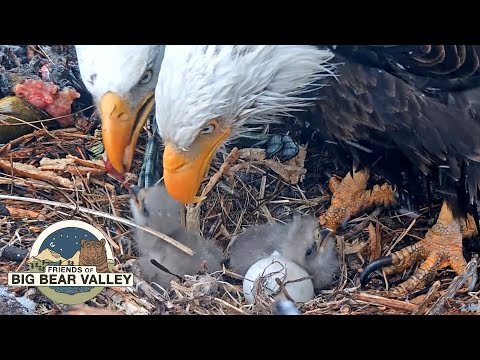
The 2026 season began with a setback when ravens destroyed the first clutch of eggs in January. Undeterred, Jackie and Shadow produced a second clutch. Chick 1, later named Sandy, hatched on April 4 at 9:33 p.m. PDT. Chick 2, named Luna, followed on April 5 at 8:30 a.m. These two eagles have reached the subadult stage and are the current focus of Shadow’s parenting efforts.
Ecological Context and Fledging Statistics
The development of Sandy and Luna is reaching a critical juncture. Bald eagle chicks typically remain in the nest for 10 to 14 weeks. During this period, they must master "branching"—the act of hopping to nearby limbs—and strengthening their flight muscles before their first official flight, or fledge.
Survival statistics for young eagles are sobering. According to the National Audubon Society and FOBBV, approximately 70 percent of bald eagles survive the fledgling stage. The transition from nest-bound chick to independent hunter is fraught with peril. Beyond natural predators such as hawks, ravens, and great horned owls, young eagles face significant risks from human infrastructure. Scavenging on roadkill often brings fledglings into the path of oncoming vehicles, which is a leading cause of injury and death for young raptors in populated areas.
Once they successfully fledge, Big Bear eagles have been known to travel vast distances. While FOBBV does not utilize tracking tags, historical data from Southern California populations shows that fledglings can migrate as far south as Baja California and as far north as British Columbia. Some have even been identified as far east as Yellowstone National Park.
Conservation Efforts and Community Impact
The plight of Jackie and Shadow has catalyzed a major conservation movement in Southern California. Environmental groups are currently engaged in a fundraising campaign to secure $10 million for the protection of the eagles’ foraging grounds. The "Save Moon Camp" initiative aims to prevent the development of key lakeside habitats that Jackie and Shadow rely on for hunting. Proponents of the land acquisition argue that preserving this corridor is essential for the long-term viability of the bald eagle population in the San Bernardino Mountains.
In addition to habitat preservation, the Ojai Raptor Center has launched a Bald Eagle Recovery Campaign to fund the specialized care required for Jackie’s rehabilitation. The cost of treating a bird in critical condition—involving blood transfusions, specialized diets, and 24-hour monitoring—is substantial.
Analysis of Implications for the Big Bear Ecosystem
The absence of Jackie from the Big Bear Valley is more than a sentimental loss for livestream viewers; it represents a temporary shift in the local ecological balance. Jackie and Shadow are the "apex" pair of the valley, and their presence helps regulate the local population of prey species and maintains territorial boundaries that keep other raptors at bay.
If Jackie is unable to return to the wild, the void she leaves could lead to a period of instability in the local eagle hierarchy. However, the resilience shown by Shadow and the burgeoning instincts of Sandy and Luna provide a measure of optimism. The fact that the subadults are already participating in nest defense suggests that Jackie’s parenting has equipped them with the necessary skills for survival.
The ongoing monitoring of the nest serves as a vital educational tool, offering researchers and the public a rare, unvarnished look at avian recovery and paternal care in the wild. As toxicology results for Jackie are finalized and Shadow continues his vigil in the San Bernardino National Forest, the story of these eagles remains a poignant example of the intersection between wildlife resilience and human-led conservation efforts. The community remains watchful, hoping for a successful rehabilitation and an eventual reunion in the heights of the Big Bear Valley.