



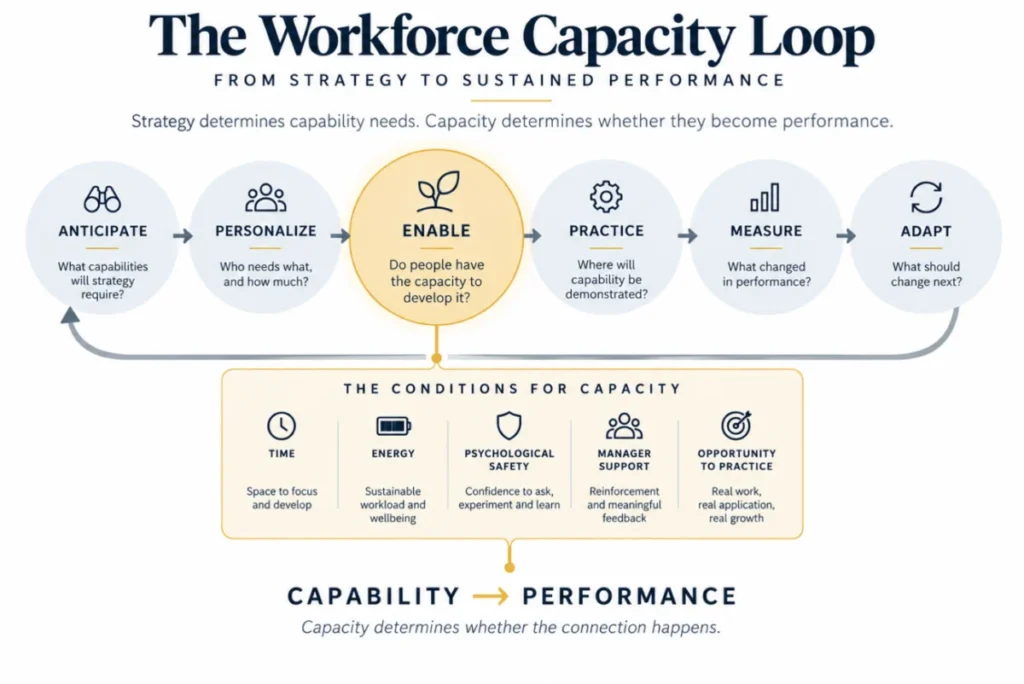
As organizations approach 2027, the traditional model of corporate learning and development (L&D) is facing an existential reckoning. For years, the primary objective of talent leaders has been to maximize the availability of educational content, operating on the assumption that if the information is accessible, the workforce will naturally adapt. However, a growing body of evidence suggests that the bottleneck for organizational growth is no longer access to training—it is the finite capacity of the human worker to absorb, process, and apply rapid-fire changes.
The current corporate environment is defined by an unprecedented frequency of disruption. According to data from the 2025 Deloitte Human Capital Trends report, the average employee is now subjected to 10 planned enterprise changes annually, a fivefold increase from the two changes recorded in 2016. This shift has created a pervasive sense of fatigue. Global workforce surveys indicate that approximately 66% of employees feel overwhelmed by the velocity of workplace evolution, while nearly 50% express significant anxiety that the pace of change will render their current skill sets obsolete, effectively leaving them behind in the professional landscape.
Chronology of the Shift: From Scarcity to Overload
The trajectory leading to this moment began in the mid-2010s, a period marked by the initial digital transformation initiatives. During this phase, the primary challenge was the "skill gap"—a lack of access to high-quality training materials. Companies responded by investing heavily in learning management systems (LMS) and expansive course catalogs.
By 2020, the onset of the global pandemic accelerated remote work and digital tool adoption, forcing a massive, unplanned investment in digital literacy. By 2023, the emergence of generative AI shifted the landscape again. The PwC 2026 Global AI Jobs Barometer indicates that the skills required for roles heavily exposed to AI are currently evolving at a rate more than twice as fast as those in less-exposed positions. This rapid acceleration has moved the challenge from a "lack of content" to a "lack of bandwidth."
The current dilemma is that the institutional response to every new technological shift remains largely unchanged: deploy a new training module. However, when employees are asked to navigate organizational restructuring, adopt AI workflows, and hit traditional performance KPIs simultaneously, the result is often a degradation of actual capability.
The Economic Distinction: Capability vs. Capacity
Industry analysts are increasingly distinguishing between "capability"—the objective ability to perform a task—and "capacity"—the systemic environment that allows for that performance. An employee may possess the intellectual capability to use a new AI software, but if they lack the time, psychological safety, or energy to practice that skill, the organization fails to realize the return on its training investment.
In this context, the role of the learning leader is shifting from that of a "content provider" to an "architect of conditions." If an organization provides an exhaustive library of courses but fails to allocate time for employees to apply those lessons, it is inadvertently contributing to its own performance gaps. The data suggests that when performance fails to meet benchmarks, the traditional reflex is to "add more training." This, however, is a misdiagnosis. The real question for 2027 leadership is not "How do we teach this?" but "What performance problem are we solving, and does it require learning at all?"
Implications for Organizational Design

The implications of this capacity crisis are profound for executive strategy. If employee energy is treated as a non-renewable resource, the mandate for 2027 is the reduction of friction. Personalized learning, once viewed as a way to provide more content, must now be utilized as a way to provide less.
AI-driven personalization should no longer aim to curate an elaborate curriculum for every individual. Instead, it should aim to find the "shortest credible path" between an employee’s current state and the required performance output. This might mean replacing a four-hour course with a five-minute, AI-assisted performance support tool embedded directly into the workflow. If an AI can provide real-time guidance for a complex task, the need for deep, theoretical training diminishes, allowing the employee to maintain their productivity while acquiring the necessary skill.
Furthermore, the data suggests that the "reskilling" imperative is shifting toward human-centric traits. The PwC 2026 analysis highlights that as AI takes over routine processing, human roles are increasingly requiring higher-order capabilities: strategic judgment, empathy, and complex problem-solving. These are not skills easily acquired through passive, digital learning; they require coaching, mentorship, and significant opportunity for authentic practice.
The Role of Psychological Safety and Resilience
The conversation regarding "resilience" in the workplace is also undergoing a necessary revision. Historically, resilience has been treated as a personal trait that employees should cultivate to better absorb organizational change. However, there is growing consensus that this is an unfair burden to place on the individual. When an employee is hit with 10 major changes in a year, the failure is not in their personal resilience—it is in the organization’s inability to manage the cumulative demand.
Psychological safety is the critical variable in this equation. In environments where employees fear that admitting a skill gap will be perceived as a performance failure, they are less likely to seek help, less likely to experiment with new workflows, and more likely to experience burnout. For 2027, building an environment where employees can transparently acknowledge what they do not know is a prerequisite for any successful capability initiative. Without this safety, the organization remains blind to its actual skill gaps, leading to the deployment of "check-the-box" training that does not translate into actual performance.
Strategic Recommendations for 2027
As leadership teams finalize their 2027 agendas, the following framework is being proposed by organizational development experts to manage the capacity loop:
- Diagnose Before Prescribing: Before launching any training initiative, determine if the barrier to performance is a lack of skill or a systemic constraint, such as poorly designed workflows or conflicting priorities.
- Embed Support in the Flow of Work: Shift from training events to "performance support." Utilize AI to provide information at the moment of need rather than asking employees to store information they may not use immediately.
- Prioritize Energy Management: Evaluate organizational change initiatives based on their cumulative impact on employee time and cognitive load. If the change capacity is exhausted, additional training will likely be counterproductive.
- Redefine Success Metrics: Move away from "completion rates" as a success metric for L&D. Instead, track the speed and quality of performance improvement in the workflow.
- Empower Managerial Support: Managers are the primary conduits of capacity. Ensure they are trained not just to manage results, but to provide the feedback and practice opportunities necessary for team development.
The paradox of the current era is that while technology has made the dissemination of knowledge almost instantaneous, it has also accelerated the rate of skill obsolescence. The organizations that thrive in 2027 will not be those that offer the most extensive libraries of content. They will be the ones that recognize the limitations of human attention.
By treating human capacity as a precious and finite resource, companies can shift the focus from the quantity of training to the quality of performance. In an age where information is abundant, the most valuable commodity is the focus and energy required to turn that information into sustained, meaningful work. The mandate for the coming years is clear: build the capabilities the organization needs at the pace the market demands, without exhausting the very people tasked with delivering that growth. Learning is an abundant resource, but human capacity is not.