

The intersection of artificial intelligence and formal education has entered a critical new phase, prompting technology developers, labor unions, and academic institutions to reconsider the balance between automated innovation and foundational human pedagogy. Microsoft, drawing on five decades of engagement in the education sector, has formally released a comprehensive, five-principle framework designed to govern the deployment of artificial intelligence across global classrooms, administrative offices, and research institutions.
This strategic initiative arrives at a time of profound transformation and mounting anxiety. While artificial intelligence offers unprecedented capabilities—ranging from the hyper-personalization of learning trajectories and the reduction of administrative workloads to the acceleration of complex academic research—it simultaneously introduces acute systemic vulnerabilities. Educators, administrators, and parents worldwide have raised urgent questions regarding academic integrity, data privacy, and whether emerging technologies threaten to diminish critical student cognition. In response to these concerns, Microsoft’s newly articulated guidelines attempt to establish a baseline of trust, ensuring that technological advancement remains subservient to human-centric pedagogical goals.
Background Context and Industry Pressures
The integration of generative artificial intelligence into educational settings has accelerated at a dizzying pace since the late 2010s, culminating in widespread availability of advanced large language models by the mid-2020s. Initially met with a mixture of enthusiasm and alarm, tools like ChatGPT and specialized educational assistants quickly overwhelmed institutional policies. Many school districts and universities responded to the sudden influx of generative technology by enacting outright bans, fearing widespread plagiarism, cognitive offloading, and the erosion of foundational critical-thinking skills.
However, subsequent research and classroom adoption patterns demonstrated that prohibition was largely ineffective; students continued to utilize artificial intelligence independently, often without institutional guidance or safety parameters. Recognizing this vacuum, technology providers, labor organizations, and policy-making bodies began seeking collaborative frameworks to bridge the gap between restriction and unfettered adoption. The current landscape is defined by an urgent need to formalize ethical standards that protect vulnerable populations—particularly minors—while equipping the future workforce with necessary digital competencies.
The Five-Principle Framework for Trusted AI in Education
To navigate this complex environment, Microsoft’s holistic strategy rests upon five foundational pillars, each addressing a distinct dimension of institutional deployment, classroom integration, and economic preparation.
- Safety, Privacy, Security, and Transparency by Design
The first principle mandates that every artificial intelligence system deployed in an educational context must incorporate robust safeguards designed to protect student privacy, mitigate bias, and ensure total operational transparency. Institution leaders, the company argues, should never be forced to choose between technological innovation and data security.
A major milestone in realizing this principle occurred recently through a landmark agreement between Microsoft and the American Federation of Teachers (AFT), representing one of the first formal pacts of its kind between a major technology corporation and a premier North American teachers’ union. This agreement introduced the Privacy and Safety Standard for Schools, establishing strict boundaries on how educational products can utilize student and educator telemetry. The standard mandates mandatory human oversight for consequential administrative decisions, guarantees institutional ownership of generated intellectual property, and provides verifiable accountability frameworks. By open-sourcing these benchmarks, Microsoft has effectively challenged other technology developers to meet elevated trust thresholds across the sector.
- Educator-Centric Classroom Integration
The second pillar asserts that technology must augment, rather than replace, professional pedagogical judgment. Educators remain the indisputable center of gravity in the learning environment.
To operationalize this principle, Microsoft has emphasized collaborative product development through initiatives such as the Education Insiders Program, which invites teachers and administrators to test and refine software prior to commercial release. This methodology directly informed the creation of Teach in Microsoft 365 Copilot, a specialized environment engineered to streamline instructional workflows, adapt curricular materials for diverse learning needs, and reduce non-teaching administrative burdens.
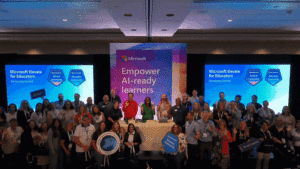
Real-world deployments illustrate the quantitative impact of this approach. In Australia, Brisbane Catholic Education reported a 275 percent increase in learner agency among vulnerable and at-risk student cohorts following targeted technological integration. Similarly, Miami Dade College documented a 15 percent increase in student pass rates and a 12 percent reduction in course dropout rates after deploying Microsoft 365 Copilot within institutional workflows. To support these transitions, the Microsoft Elevate for Educators program has provided professional development and accredited AI literacy pathways to more than 17 million participants over the past year.
- Safeguarding Student Cognition and Critical Thinking
Addressing the widespread fear of cognitive offloading—a phenomenon where students rely on machines to perform complex thinking, creating the illusion of competence without durable learning—the third principle insists that educational AI must be grounded firmly in established learning science.
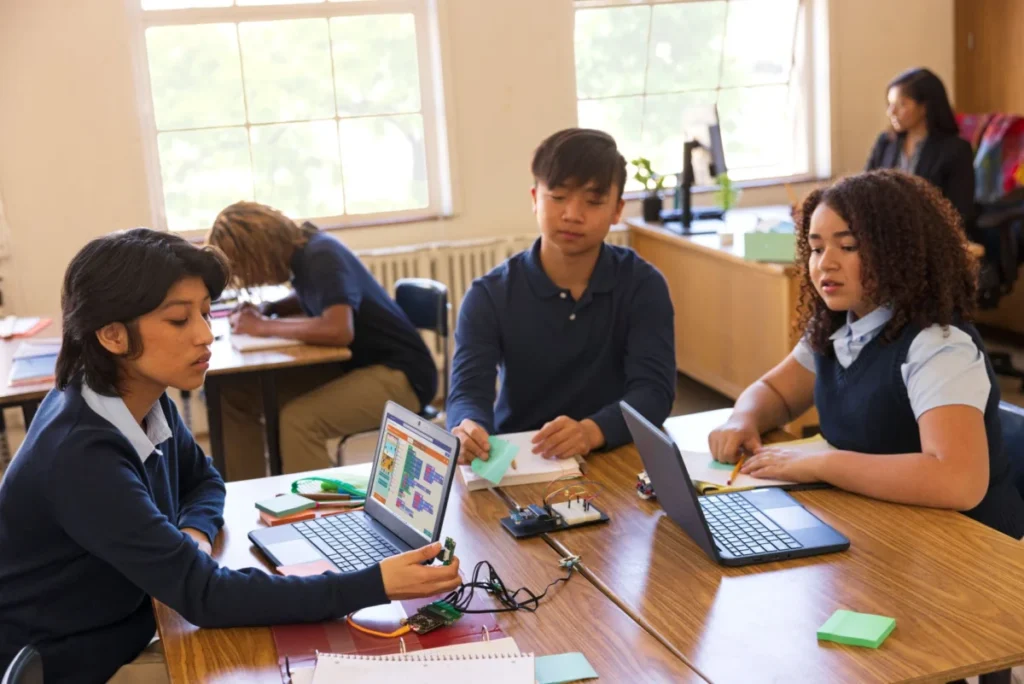
Education requires deliberate friction; the cognitive struggle of working through difficult concepts is frequently where the most enduring learning occurs. Tools designed primarily for speed often bypass this essential developmental struggle. To counter this, Microsoft has engineered its educational tools to be age-appropriate by default. For younger demographics, platforms like Minecraft Education build foundational computational literacy, while Learning Accelerators deliver targeted, personalized feedback. As students advance, specialized tools such as the Study and Learn Agent utilize scaffolded questioning and interactive practice to guide learners toward solutions independently, rather than providing direct answers. Furthermore, K-12 deployments feature default-off Copilot Chat settings, requiring active administrative enablement as students mature.
- Strengthening Institutional Systems and Research
The fourth principle focuses on the systemic health of educational institutions, recognizing that schools, colleges, and universities often struggle with fragmented data silos and constrained operational resources.
When applied responsibly, artificial intelligence can unify disparate administrative systems, enabling data-driven decision-making and early intervention for struggling students. A notable case study is Broward County Public Schools, which faced significant budget deficits across its 235-school district. By integrating Microsoft 365 Copilot with its existing infrastructure, the district successfully identified operational inefficiencies, projecting between $40 million and $50 million in facilities savings over a five-year period—resources that can be directly reinvested into classroom instruction.
In higher education and medical research, secure environments built on platforms like Microsoft Azure are transforming institutional capabilities. At the University of North Carolina, medical researchers utilize secure, compliant data environments to manage sensitive clinical information, currently supporting more than 25 active medical studies under strict privacy controls.
- Preparing Students for the Emerging AI Economy
The final principle addresses the macroeconomic implications of technological diffusion. According to data from the AI Economy Institute, artificial intelligence literacy and specialized digital skills currently command wage premiums of up to 40 percent—frequently surpassing the immediate financial returns associated with traditional advanced degrees.
This disparity threatens to create a new socio-economic divide defined not merely by who has access to technology, but by who possesses the critical judgment and practical skills required to translate that access into economic mobility. To mitigate this risk, educational institutions are rapidly embedding AI literacy across multidisciplinary curricula. Institutions such as Auburn University have deployed faculty training courses across dozens of partner universities, while Babson College has integrated interdisciplinary AI laboratories across all academic departments. Collaborative programs, including expanded partnerships with North America’s Building Trades Unions (NABTU) and the introduction of digital career-exploration tools like the Jobs Machine, further ensure that non-traditional and vocational educational pathways remain robust in an automated economy.
Implications and Future Outlook
The comprehensive strategy articulated by Microsoft reflects a broader maturation phase within the technology and education sectors. As generative artificial intelligence transitions from an experimental novelty to core infrastructure, the focus has shifted decisively away from unchecked capability and toward governance, trust, and human agency.
Industry analysts note that framework agreements between multinational technology firms and labor organizations will likely serve as a regulatory template for future software deployments. By voluntarily submitting to strict privacy standards, human-in-the-loop validation, and age-gated functionality, developers are attempting to preempt heavier legislative mandates while rebuilding institutional confidence.
Ultimately, the long-term success of artificial intelligence in education will not be measured by the sophistication of algorithms alone, but by the extent to which these tools preserve the irreplaceable human partnership among educators, students, and families. As institutions continue to adapt, the collective objective remains clear: leveraging technological innovation to expand access, deepen understanding, and secure economic opportunity for the next generation of global learners.