



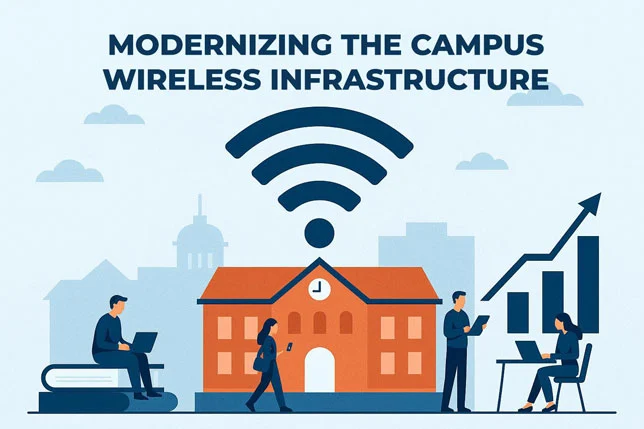
For colleges and universities globally, the imperative to update campus wireless infrastructure has transcended mere technical upgrades; it has become a strategic necessity for institutional resilience and innovation. To adequately support the promise of emerging technologies and meet the evolving operational expectations of a modern university constituency, forward-looking IT leaders are embarking on comprehensive network modernizations, rebuilding their digital foundations from the ground up to secure a future-ready state. This shift reflects a profound understanding that connectivity is no longer a utility but the central nervous system of the academic enterprise.
Institutions are now planning for multi-year, full modernizations of their campus wireless infrastructure. These ambitious plans are designed not only to integrate the speed and capabilities of the latest Wi-Fi standards but also to equip campuses with the agility to respond swiftly to a burgeoning wave of AI-driven applications, the proliferation of new Bring Your Own Device (BYOD) technologies that saturate bandwidth, and the explosive growth of data repositories generated by novel research programs. The objective is clear: universities aim to be perpetually prepared to transform new technologies and practices into tangible opportunities for innovation, ultimately yielding a significant return on investment (ROI) in their wireless infrastructure.
This strategic pivot is further illuminated by recent industry insights, including a study released by Cisco in April 2026, titled "The State of Wireless." This inaugural report offers crucial data for strategists grappling with the radical shifts occurring within the wireless ecosystem. Gary DePreta, Cisco’s senior vice president of U.S. public sector, underscores the criticality of this transformation, stating, "It’s not about the technology or tools; it’s about delivering the best experience possible." This sentiment highlights a user-centric approach that prioritizes the seamless interaction of students, faculty, administrators, and researchers with the digital environment.
The Accelerating Demands on Campus Networks
The evolution of wireless technology on college campuses has been a rapid trajectory, moving from nascent experimental networks in the late 1990s to the pervasive, mission-critical infrastructure of today. Early Wi-Fi deployments were often supplementary, providing basic internet access for a handful of laptops. The 2000s saw increased adoption with Wi-Fi 4 (802.11n), accommodating the rise of personal laptops and early smartphones. The 2010s ushered in Wi-Fi 5 (802.11ac), marked by the explosion of BYOD and the initial foray into cloud-based applications. By the mid-2010s and early 2020s, Wi-Fi 6 (802.11ax) became prevalent, designed to handle high-density environments and burgeoning IoT devices.
The COVID-19 pandemic served as a profound catalyst, accelerating the adoption of hybrid learning models and remote work to an unprecedented degree. This period starkly exposed the vulnerabilities and limitations of existing network infrastructures, forcing institutions to rapidly scale their capabilities. The post-pandemic landscape solidified hybrid learning as a permanent fixture, integrating synchronous and asynchronous instruction, virtual labs, and online collaboration tools into the core of academic delivery. This shift placed immense and sustained pressure on campus networks, demanding not just more bandwidth but also enhanced reliability, security, and low latency.
Beyond hybrid learning, several other dynamics are reshaping wireless infrastructure requirements in higher education:
- Artificial Intelligence (AI) Integration: AI is rapidly permeating all facets of university life, from AI-powered research simulations and intelligent campus management systems to personalized learning platforms and advanced data analytics. These applications are inherently data-intensive, requiring robust network backbones capable of handling massive data transfers and real-time processing, often at the edge. The latency-sensitive nature of many AI applications demands a network infrastructure designed for immediate responsiveness.
- Internet of Things (IoT) Proliferation: Campuses are transforming into smart environments, integrating a vast array of IoT devices. These include smart sensors for energy management, environmental monitoring, security cameras, digital signage, smart classroom technologies, and even wearable devices used in health and sports science programs. Each device, while perhaps individually low-bandwidth, collectively generates a continuous stream of data, demanding extensive network capacity and sophisticated management tools.
- Exponential Data Growth: Research programs, particularly in fields like genomics, astrophysics, climate science, and big data analytics, generate petabytes of data that require high-speed access, transfer, and storage. Administrative functions, student information systems, and learning analytics platforms also contribute significantly to data volumes. The efficient movement and secure storage of this data are paramount for research competitiveness and operational effectiveness.
- BYOD Saturation: The average student today brings multiple devices to campus – laptops, smartphones, tablets, smartwatches, gaming consoles, and various smart home devices. Faculty and staff similarly contribute to this dense ecosystem. A single user might simultaneously utilize a laptop for coursework, a smartphone for communication, and a tablet for reading, all demanding seamless connectivity. This device density necessitates advanced network management capabilities to ensure fair bandwidth allocation and prevent congestion.
The Strategic Shift from Upgrade to Modernization
While colleges and universities have consistently upgraded their networks over the years, the current environment demands a fundamental paradigm shift from incremental improvements to comprehensive modernization. As Gary DePreta articulates, "The key thing schools are realizing now is to respond to this not as another technology upgrade, but as a true network modernization for the entire campus. That’s the mindset that’s going to deliver ROI, ultimately." This signifies an understanding that piecemeal solutions are no longer sufficient to address the multifaceted challenges and opportunities presented by contemporary digital demands.
A full-scale modernization entails an end-to-end transformation of the network infrastructure, touching every layer from the physical cabling to the software-defined management planes. This includes:

- Core Network Enhancements: Upgrading the central nervous system of the campus network with higher capacity routers and switches, often employing 100 Gigabit Ethernet (GbE) or even 400 GbE connections, to handle aggregated traffic from across the campus.
- Edge and Access Layer Renewal: Deploying the latest generation of Wi-Fi access points, such as Wi-Fi 6E (802.11ax operating in the 6 GHz band) and planning for Wi-Fi 7 (802.11be, or "Extremely High Throughput"). These standards offer significantly higher speeds, lower latency, and improved capacity in dense environments. Wi-Fi 6E, in particular, leverages a new, uncongested spectrum band, providing dedicated lanes for high-bandwidth applications.
- Robust Security Architecture: With an expanding attack surface due to more devices and data, modernization integrates advanced security measures. This includes adopting a Zero Trust Network Access (ZTNA) model, network segmentation to isolate critical systems, advanced threat detection and response capabilities, and secure access for IoT devices.
- Cloud-Managed Networking: Shifting towards cloud-based network management platforms offers greater agility, centralized control, simplified deployment, and enhanced visibility across the entire network. This allows IT teams to manage complex infrastructures more efficiently and scale resources on demand.
- Network Automation and Analytics: Implementing solutions that automate routine tasks, predict potential issues, and provide deep insights into network performance and user behavior. This data-driven approach enables proactive problem-solving and optimized resource allocation.
- Fiber Optic Backbone: Many modernizations involve upgrading or expanding the campus fiber optic backbone to ensure sufficient capacity for future data loads and to provide reliable connectivity to all buildings.
This comprehensive approach ensures not only that current demands are met but also that the network is "future-proofed" to adapt to unforeseen technological advancements. It provides the flexibility and scalability required to integrate new technologies seamlessly, without necessitating another costly overhaul in just a few years.
Insights from Cisco’s "The State of Wireless" Report
Cisco’s inaugural "The State of Wireless" report, released in April 2026, provides a detailed analysis of these trends within higher education. While specific findings from the report are not detailed in the original article, based on industry trajectory and Gary DePreta’s commentary, several key themes likely emerged:
- High Adoption of Advanced Wi-Fi: The report likely indicates a strong adoption rate of Wi-Fi 6 and 6E across higher education, with significant planning already underway for Wi-Fi 7. Institutions recognize the competitive advantage offered by cutting-edge wireless capabilities.
- Investment in Network Intelligence: A primary focus is on leveraging network analytics and automation to optimize performance, enhance security, and streamline operations. This includes using AI and machine learning within the network to identify anomalies, predict congestion, and automate policy enforcement.
- Security as a Top Priority: The report undoubtedly highlights cybersecurity as the paramount concern for IT leaders, given the sensitive nature of academic research, student data, and intellectual property. Investments in advanced security protocols, identity management, and threat intelligence are likely emphasized.
- Holistic Approach to Modernization: The study likely validates DePreta’s point that a holistic, campus-wide modernization strategy is replacing piecemeal upgrades. This integrated approach is shown to yield better long-term outcomes and ROI.
- Correlation with Institutional Success: The report likely draws a strong correlation between the maturity and robustness of an institution’s wireless network and its ability to attract and retain students, foster innovative research, and achieve operational efficiencies.
DePreta’s emphasis on delivering "the best experience possible" underscores a critical finding: technology, while foundational, is merely an enabler. The ultimate measure of success for network modernization lies in its ability to enhance the user experience across all constituents. For students, this means seamless access to learning resources, reliable connectivity for personal devices, and support for collaborative tools. For faculty, it translates to unhindered access to research tools, high-quality video conferencing for hybrid instruction, and rapid data transfer for intensive computing. For administrators, it enables efficient operations, smart campus initiatives, and secure data management.

Broader Impact and Implications
The commitment to wireless infrastructure modernization carries profound implications across several dimensions of higher education:
- Elevating Academic Excellence and Research: A state-of-the-art network is indispensable for cutting-edge research. It supports high-performance computing clusters, facilitates collaboration with remote research partners, and enables real-time data analysis for complex scientific endeavors. In teaching, it empowers immersive learning experiences, virtual reality labs, and access to rich multimedia content, thereby enhancing pedagogical innovation.
- Enhancing Operational Efficiency and Smart Campus Initiatives: Modernized wireless networks are the backbone for smart campus initiatives. These include intelligent building management systems that optimize energy consumption, smart parking solutions, sophisticated security monitoring systems, and data-driven space utilization tools. Such efficiencies can lead to significant cost savings and improved campus sustainability.
- Improving Student Experience and Recruitment: In an increasingly competitive landscape, a seamless, high-performance network is a significant differentiator for prospective students. Today’s digital natives expect ubiquitous, reliable, and fast connectivity as a basic utility, akin to electricity and water. Institutions that provide a superior digital experience are better positioned to attract and retain top talent.
- Fostering Digital Equity and Access: Modernization efforts must also address digital equity. A robust network ensures that all students, regardless of their socioeconomic background, have equitable access to essential digital resources, online learning platforms, and collaborative tools. This helps bridge the digital divide and promotes inclusivity within the university community.
- Economic Impact and Investment: The substantial investment in wireless infrastructure modernization creates a ripple effect, stimulating the technology sector, supporting local economies through job creation, and fostering partnerships between universities and technology providers. This investment positions universities as leaders in technological adoption and innovation.
Despite the compelling benefits, institutions face challenges in implementing these large-scale modernizations. Funding remains a significant hurdle, often requiring multi-year capital investment strategies. The scarcity of skilled IT personnel capable of designing, deploying, and managing these complex networks is another concern. Furthermore, managing the transition from legacy systems to new infrastructure without disrupting ongoing academic and operational activities requires meticulous planning and execution.
In conclusion, the current wave of wireless infrastructure modernization in higher education is not merely a technical upgrade cycle; it is a strategic imperative. Driven by the relentless march of AI, IoT, hybrid learning, and data proliferation, universities are recognizing that their digital foundation must be as dynamic and adaptable as the knowledge they seek to create and impart. By embracing comprehensive, future-ready network modernization, institutions are not just keeping pace with technological change but actively shaping an environment where innovation thrives, experiences are seamless, and the promise of higher education can be fully realized.