


The release of the Study and Learn agent within the Microsoft 365 Copilot ecosystem marks a significant shift in how artificial intelligence is deployed within academic environments. As educational institutions worldwide grapple with the rapid integration of generative AI in the classroom, Microsoft has introduced a first-party tool specifically designed to prioritize pedagogical integrity over mere information retrieval. Now generally available for all education customers at no additional cost, the Study and Learn agent provides a structured, learning-focused framework for students aged 13 and older, aiming to bridge the gap between technological convenience and cognitive development.
The core philosophy of the Study and Learn agent is predicated on the idea that the learner must remain the primary driver of the intellectual process. Unlike standard large language models (LLMs) that often provide direct answers to complex queries, this agent is engineered to function as a tutor rather than a surrogate. By facilitating guided conversations and interactive activities, the tool assists students in grasping difficult concepts, solving multi-step problems, and refining their writing skills through an adaptive interface that responds to individual student needs in real-time.
The Evolution of AI in the Classroom: From Prohibition to Integration
The journey toward the Study and Learn agent reflects a broader chronological shift in the educational sector’s relationship with artificial intelligence. When generative AI first gained mainstream prominence in late 2022, the immediate reaction from many K-12 and higher education institutions was one of caution, often leading to outright bans on AI tools to prevent academic dishonesty. However, throughout 2023 and 2024, it became increasingly clear that students were continuing to utilize AI independently, often turning to consumer-grade bots that prioritize speed and direct answers over educational value.
Recognizing this trend, Microsoft began developing specialized agents that could align with the objectives of educators. The development of the Study and Learn agent followed a period of extensive feedback from school administrators and IT professionals who demanded more robust guardrails. By mid-2025, the focus shifted toward "Responsible AI," leading to the current release which integrates enterprise-grade privacy with pedagogical science. This timeline illustrates a transition from viewing AI as a threat to academic integrity to viewing it as a scaffold for personalized learning.
Grounding AI in Learning Science Principles
The Study and Learn agent distinguishes itself from general-purpose AI through its adherence to established learning science. Rather than operating as a black box of information, the agent utilizes four specific research-based principles to ensure that every interaction reinforces the student’s retention and understanding of the material.

Scaffolding and Step-by-Step Guidance
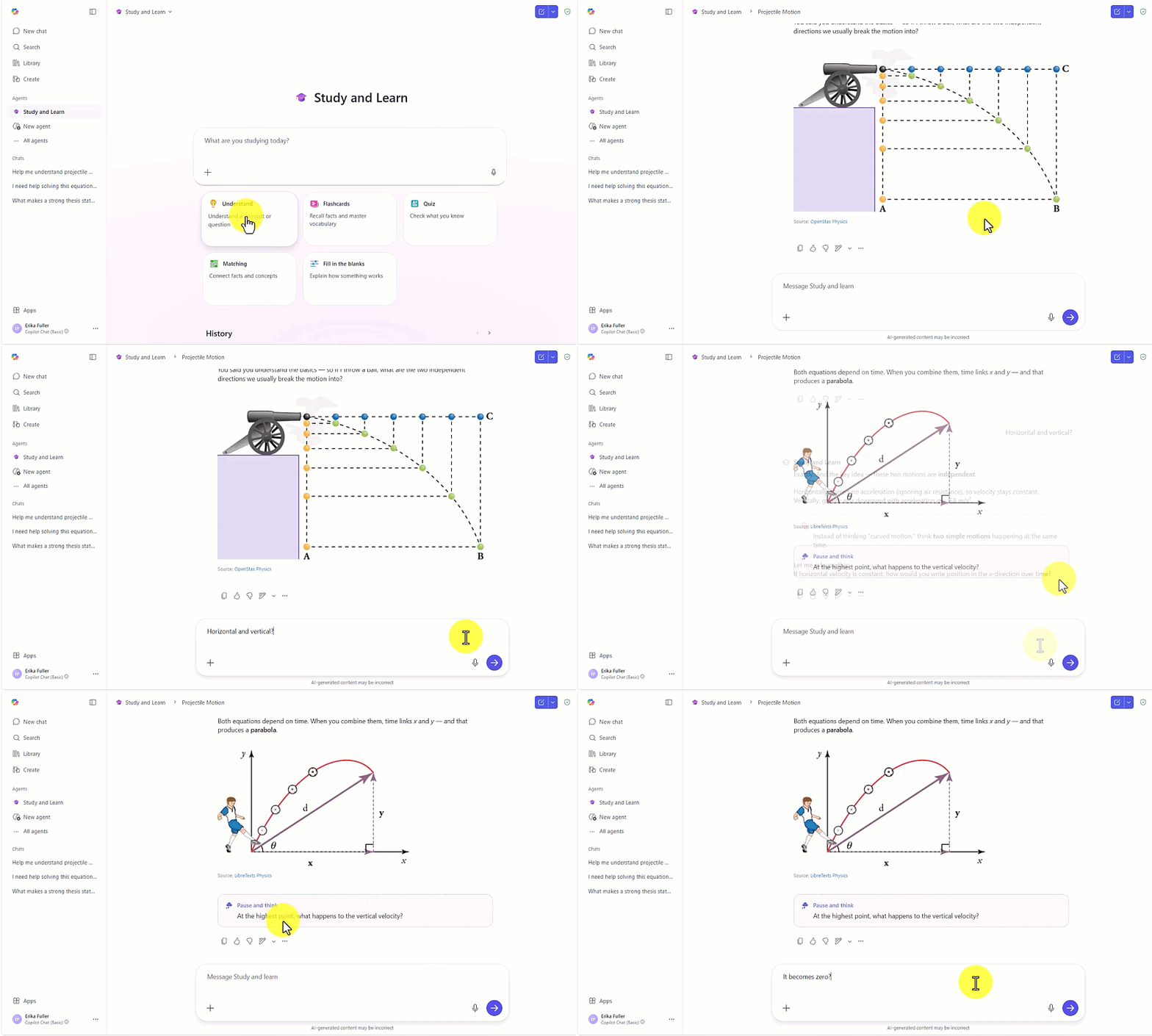
One of the primary features of the agent is its ability to provide "scaffolding." When a student presents a complex problem—such as a calculus equation or a physics concept—the AI does not solve the problem immediately. Instead, it breaks the task into manageable segments, asking the student to complete one step before moving to the next. This mimics the traditional Socratic method used by human tutors, ensuring that the student understands the "why" behind each step.
Retrieval Practice and Active Engagement
The agent encourages active learning by prompting students to recall information they have previously studied. Through the generation of on-the-spot flashcards and matching activities, the tool forces the brain to retrieve information, a process proven to strengthen long-term memory. This moves the student away from passive reading and toward active participation with the subject matter.
Metacognitive Support
By asking students to explain their reasoning or talk through their arguments, the Study and Learn agent fosters metacognition—the awareness and understanding of one’s own thought processes. For instance, when a student is drafting a history essay, the agent might ask questions that challenge the student’s thesis or require them to provide more evidence, thereby sharpening their critical thinking skills.
Immediate Feedback Loops
In a traditional classroom, a student might wait days for feedback on an assignment. The Study and Learn agent provides immediate, constructive feedback that is focused on the process rather than just the final result. This allows students to correct misconceptions in real-time, preventing the "baking in" of incorrect information.
Transforming Copilot Chat into an Interactive Learning Environment
The practical application of the Study and Learn agent extends across various academic disciplines. In biology, for example, a student can engage the agent to quiz them on the cell cycle, with the AI generating visual aids and diagrams to illustrate the differences between mitosis and meiosis. In mathematics, the agent can walk a student through a step-by-step coaching session for complex integration, providing hints rather than solutions.
For humanities students, the agent acts as a collaborative brainstormer. A student writing an analysis of a literary text can discuss their interpretation with the agent, which will then pose counter-arguments or suggest areas where the student’s logic could be bolstered. This interactive experience ensures that the work of learning remains with the student, fostering independent thinking and a deeper sense of academic ownership.

Security, Privacy, and Administrative Control
A critical component of the Study and Learn agent is its integration into the existing Microsoft 365 Education infrastructure. For K-12 institutions, where data privacy and safety are paramount, Copilot Chat is turned off by default for students. Access must be explicitly granted by an IT administrator, ensuring that schools maintain full control over the deployment of AI within their digital environment.
The agent is built on Microsoft’s responsible AI principles, providing enterprise-grade data protection. Unlike free consumer AI tools, the data generated within the Study and Learn agent is not used to train the underlying large language models. This ensures that student interactions remain private and that institutional data is protected under the same security standards as the rest of the Microsoft 365 suite. Students access the tool using their Microsoft Entra ID (formerly Azure Active Directory) school credentials, providing a seamless and secure login experience that does not require additional third-party applications.
Supporting the Broader Educational Ecosystem
The Study and Learn agent is one half of a dual-agent strategy designed by Microsoft to support the entire learning environment. While the Study and Learn agent focuses on the student, the "Teach" agent is designed for educators. This ecosystem approach acknowledges that AI is most effective when it supports both sides of the instructional relationship.
The "Teach" agent assists educators in lesson planning, content creation, and administrative tasks, while the "Study and Learn" agent provides the student-facing support needed to execute those lessons. By providing tools for both parties, Microsoft aims to create a cohesive digital classroom where AI serves as an assistant to human intelligence rather than a replacement for it.
Market Context and Industry Implications
The release of the Study and Learn agent comes at a time when the "EdTech" market is experiencing a massive influx of AI-driven startups. However, many of these startups struggle with the privacy and integration requirements of large school districts. By embedding these capabilities directly into Microsoft 365, Microsoft is positioning itself as the "safe" and "integrated" choice for institutional AI.
Industry analysts suggest that the move toward "learning-first" AI could set a new standard for the industry. According to recent educational surveys, over 60% of students admit to using AI for schoolwork, but a similar percentage of teachers express concern that these tools lead to a decline in critical thinking. By addressing these concerns through pedagogical grounding, Microsoft is attempting to rehabilitate the reputation of AI in the eyes of the academic community.
Implementation and Global Availability
As of the current launch, the Study and Learn agent is optimized for English (United States) and is accessible via the Microsoft 365 Copilot app on both web and desktop platforms. Microsoft has confirmed plans to expand language support in the coming weeks to accommodate a global user base.
For IT administrators, the path to implementation involves three primary steps:
- Verifying the institution’s Microsoft 365 Education licenses.
- Enabling Copilot Chat for the appropriate student groups through the Microsoft 365 admin center.
- Providing students with guidance on how to locate the Study and Learn agent within the Copilot navigation bar.
The general availability of this tool at no additional cost for existing customers represents a significant value proposition for schools already invested in the Microsoft ecosystem. It allows institutions to scale their AI initiatives without the need for additional budget approvals, which is often a major hurdle in public education.
Analysis of Long-term Academic Impact
The long-term implications of the Study and Learn agent suggest a shift in the nature of "homework." If AI can provide step-by-step coaching, the focus of assignments may move away from the final answer and toward the process of discovery. Educators may begin to grade students on the quality of their interactions with the AI tutor—how they phrased their questions, how they responded to prompts, and how they iterated on their work.
Furthermore, the Study and Learn agent could play a vital role in addressing the "homework gap" by providing high-quality tutoring to students who may not have access to private human tutors. By democratizing access to personalized, science-based coaching, Microsoft 365 Copilot has the potential to level the playing field for students from diverse socioeconomic backgrounds.
In conclusion, the Study and Learn agent is more than a technical update; it is a pedagogical intervention. By prioritizing the "learner’s thinking" and integrating robust administrative controls, Microsoft has provided a credible path forward for the responsible use of AI in education. As the tool expands into more languages and subjects, its role in shaping the next generation of independent thinkers will likely become a focal point of educational technology research and policy.