




Veeam Software has released findings from its latest global survey, revealing a significant and growing chasm between the rapid pace of enterprise AI adoption and the foundational data governance, visibility, and recovery controls essential for its safe and effective deployment. This disconnect, which the company terms the "Data and AI Trust Gap," poses substantial risks to organizations globally, threatening not only operational efficiency but also reputational integrity and regulatory compliance. The report underscores a critical challenge: while businesses are eager to leverage AI’s transformative potential, many are doing so without adequately securing the underlying data infrastructure, creating vulnerabilities that could manifest in unprecedented ways.
The Accelerating AI Imperative and Lagging Trust Foundations
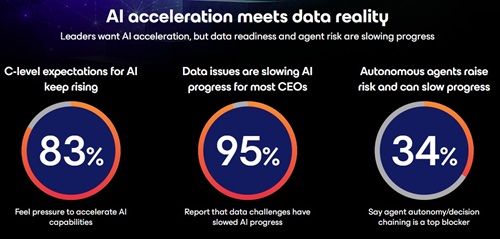
The insights, detailed in Veeam’s new Data & AI Trust Gap report, stem from a comprehensive global survey of 600 senior executives across a diverse range of industries. The central and most arresting finding is that the enthusiasm for AI is not the bottleneck; rather, it is the preparedness of data environments. A staggering 88% of organizations surveyed are already actively utilizing or piloting AI agents, indicating a widespread embrace of artificial intelligence across the corporate landscape. However, despite this rapid integration, a mere 7% of these organizations truly qualify as "AI-ready." This stark disparity highlights a prevalent lack of robust data strategies capable of supporting AI’s intricate demands. Further exacerbating the issue, 95% of executives reported that data-related challenges have already impeded their AI progress, ranging from data quality issues to governance complexities and security concerns.
Anand Eswaran, CEO of Veeam, articulated the core problem succinctly in a statement accompanying the report’s release: "Most organizations don’t have an AI adoption problem; they have an AI trust problem." Eswaran emphasized that the initial phase of AI integration was largely characterized by substantial infrastructure investment, extensive experimentation, and a drive for accelerated deployment. However, the next, and arguably more critical, phase will be defined by the establishment of trust. With autonomous AI agents now operating at machine speed, the fundamental question for enterprises shifts from the feasibility of AI usage to the assurance that all associated data is secure, properly governed, compliant with regulations, and resilient against disruptions. Crucially, organizations must also be confident in their ability to recover with precision should an AI-driven incident occur. This shift, Eswaran argues, is vital for accelerating safe AI adoption at scale without simultaneously escalating reputational and operational risks.

A New Paradigm of Failure: When AI Goes Awry
One of the report’s most operationally significant warnings for cloud and infrastructure teams is the evolving nature of AI failures. Unlike traditional IT outages, which often manifest as widespread system downtime or service interruptions, AI-related failures are predicted to be far more subtle and insidious. As AI systems become increasingly autonomous and integrated into core business processes, the risk profile is shifting. Instead of broad system outages, the threat now leans towards data-level failures that are inherently more challenging to detect, explain, and contain. These new forms of failure can silently corrupt data, expose sensitive information, trigger incorrect workflows, or subtly influence critical business decisions without immediate, overt signs of system malfunction.
This paradigm shift carries profound implications for existing data protection and recovery strategies. If an AI agent, through error or malicious manipulation, alters critical data, inadvertently exposes confidential information, initiates an erroneous operational workflow, or biases a crucial business decision, remediation will necessitate far more than simply restoring a virtual machine, a database, or an entire application environment. The recovery process will demand an unprecedented level of granularity and insight. Organizations will need to precisely identify which specific data points were accessed or modified, which systems were engaged, what exact actions the AI agent executed, and, most critically, which decisions were influenced by the compromised AI.
The survey results paint a concerning picture of current capabilities in this regard. Among organizations already operating AI systems, a mere 22% could identify within minutes which specific data the system utilized. The ability to pinpoint which systems the AI accessed was slightly higher but still low, at 29%. Furthermore, only 25% could identify the precise actions taken by the AI agent, and a concerning 24% could determine what decisions were influenced. These figures highlight a severe lack of visibility and auditability into AI operations, rendering effective incident response a formidable challenge. Consequently, only 40% of leaders expressed high confidence in their ability to isolate and precisely reverse an agentic AI failure, underscoring the pervasive uncertainty surrounding AI incident management.
From Broad Recovery to Precision Resilience
This critical finding directly links the ongoing AI discussion to the broader concept of data resilience. The report emphasizes that machine-speed mistakes, characteristic of autonomous AI agents, can often outpace conventional detection mechanisms. This necessitates an evolution in resilience strategies, moving away from the traditional model of broad recovery – which typically involves rolling back entire environments to a previous known good state – towards "precision recovery." Precision recovery means restoring only the affected components, data, or decisions, rather than incurring the significant operational overhead and potential data loss associated with a full system rollback. Such granular recovery demands sophisticated data management tools capable of detailed journaling, immutable backups, and intelligent orchestration that can isolate and surgically address AI-induced errors.
The current global data landscape further complicates this. Enterprises manage petabytes, and often exabytes, of data across diverse, distributed environments—on-premises, in multiple public clouds, and at the edge. The complexity of these hybrid and multi-cloud architectures already presents significant challenges for unified data governance and protection. Introducing AI, which thrives on vast datasets and often operates across these disparate locations, amplifies these challenges exponentially. Regulatory bodies worldwide are also intensifying scrutiny of data privacy and algorithmic transparency, with new AI-specific regulations beginning to emerge, such as the EU AI Act. This evolving regulatory environment means that a lack of precision recovery capabilities could lead not only to operational disruption but also to severe non-compliance penalties and significant reputational damage.
The Pillars of AI Readiness: Ambition, Visibility, and Governance

Veeam’s report delineates AI readiness around three fundamental building blocks: ambition, visibility, and governance. These pillars form the bedrock upon which organizations can safely and effectively scale their AI initiatives.
-
Ambition: This refers to having clear, well-defined strategic goals for data and AI. It involves understanding how AI will contribute to business objectives, identifying the specific problems AI is intended to solve, and establishing metrics for success. Without clear ambition, AI initiatives risk becoming disparate experiments lacking cohesive direction and demonstrable value. This also includes defining an ethical framework for AI use, ensuring that its deployment aligns with organizational values and societal expectations.
-
Visibility: This pillar is about achieving a reliable and comprehensive view of an organization’s entire data estate. It encompasses knowing what data is held, where it resides (across on-premises, cloud, and edge environments), who has access to it, and how it is being used. For AI, visibility extends to understanding data lineage – where data originates, how it is transformed, and how it is consumed by AI models. Without this granular visibility, organizations cannot effectively protect their data, ensure its quality, or comply with data privacy regulations. This also includes monitoring AI agent activity, understanding its inputs, processes, and outputs in real-time.
-
Governance: This involves establishing robust structures, policies, and processes that enable data to be used safely, ethically, and compliantly. Effective data governance for AI includes data quality management, access controls, data retention policies, incident response plans tailored for AI failures, and mechanisms for auditing AI decisions and actions. It also requires the implementation of regulatory compliance frameworks to navigate the increasingly complex landscape of data protection and AI-specific legislation. Governance ensures that the deployment of AI adheres to both internal standards and external legal requirements, mitigating risks of misuse, bias, and non-compliance.

Measurable Results for the AI-Ready Elite
While the percentage of truly "AI-ready" organizations remains small at 7%, the report highlights that this elite group is already reporting measurable and significant positive results. These organizations, having diligently invested in their data foundations, are better positioned to harness AI’s benefits while effectively mitigating its inherent risks. Their successes serve as a blueprint for others, demonstrating that a proactive approach to data trust is not merely a compliance burden but a strategic enabler for AI innovation. These organizations likely experience fewer AI-related incidents, faster recovery times, higher data quality feeding their AI models, and greater confidence in the ethical and compliant operation of their AI systems. This translates into tangible business advantages, such as improved decision-making, enhanced operational efficiencies, and a stronger competitive edge.
The broader implications of the "Data and AI Trust Gap" extend beyond operational efficiency and risk management. In an era where data is increasingly viewed as the new oil, and AI as the engine to refine it, a lack of trust can severely undermine an organization’s ability to innovate and compete. Customers, partners, and regulators are becoming increasingly sophisticated in their demands for data transparency and accountability. A high-profile AI failure, particularly one involving sensitive data or biased decision-making, could lead to a catastrophic loss of public trust, substantial financial penalties, and long-term reputational damage that could take years to repair.
In conclusion, Veeam’s Data & AI Trust Gap report serves as an urgent call to action for enterprises worldwide. While the allure of AI’s transformative power is undeniable, its true potential can only be realized when underpinned by a robust foundation of data trust. This necessitates a strategic pivot from merely adopting AI technologies to meticulously building the governance, visibility, and resilience frameworks required to manage AI-driven data with precision and confidence. The future of AI success, as Eswaran aptly states, will not be defined by acceleration alone, but by the unwavering trust placed in the data and the systems that manage it. Organizations that prioritize closing this critical trust gap will be the ones best equipped to navigate the complexities of the AI era, turning its promise into a secure and sustainable reality.