




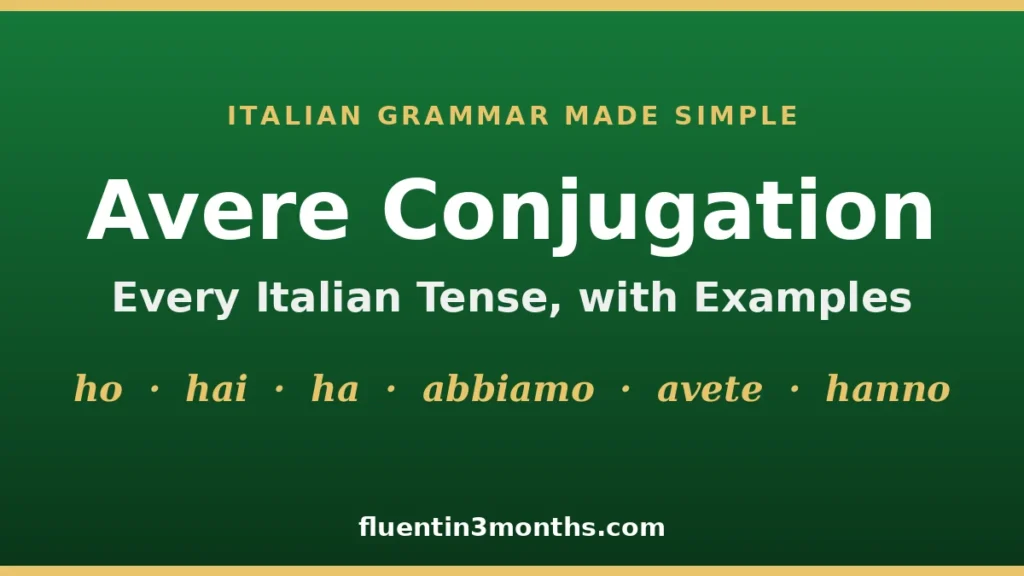
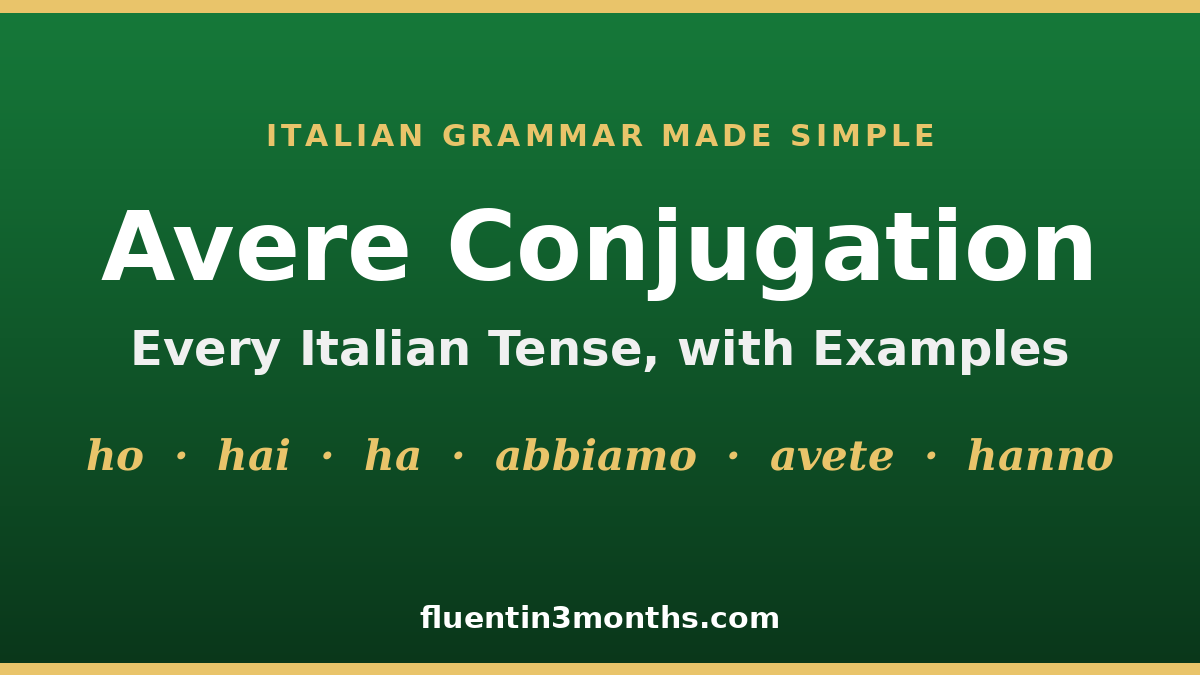
The Italian verb avere, derived from the Latin habēre, stands as one of the most critical structural pillars in the Italian language. While its primary translation is "to have," its functional utility extends far beyond simple possession. It serves as a vital auxiliary verb required for constructing compound tenses across the vast majority of the language’s verb paradigms. For learners and linguists alike, understanding the intricate conjugation patterns and the orthographic importance of the silent "h" is essential for achieving proficiency in Italian.
The Orthographic Significance of the Silent H
One of the most frequent points of confusion for those studying Italian is the presence of the silent "h" in the present tense forms of avere: ho, hai, ha, and hanno. Although phonetically invisible, the "h" serves a vital orthographic function, distinguishing these forms from other common Italian words that sound identical.
Linguistic analysis confirms that the "h" acts as a disambiguation marker. Without it, ho (I have) would be confused with o (or); hai (you have) would merge with ai (to the); ha (he/she/it has) would be indistinguishable from a (to/at); and hanno (they have) would be mistaken for anno (year). This distinction is not merely stylistic but is fundamental to maintaining the syntactical integrity of written Italian. Consistent application of these spelling rules is a standard requirement in both formal correspondence and academic literature.
Historical Evolution and Etymology
The lineage of avere can be traced directly to the Latin verb habēre. Over the centuries, the transition from Vulgar Latin to the Romance languages saw significant phonetic shifts. In Italian, the verb remained largely irregular, a common trait among high-frequency verbs that have been preserved through generations of usage.
Chronologically, the stabilization of the current spelling occurred during the standardization of the Italian language in the late medieval and early Renaissance periods. While other verbs evolved toward more predictable patterns, avere retained its irregular stems—such as the contracted avr- seen in the future and conditional tenses—due to its omnipresence in daily communication. This persistence of irregularity is a testament to its role as a "workhorse" verb; because it is used so frequently, its irregular forms have been reinforced rather than smoothed out by speakers over time.
Functional Roles in Italian Syntax
Avere operates within three distinct functional spheres. First, it denotes literal possession, such as Ho una casa (I have a house). Second, it acts as the primary auxiliary for transitive verbs. When forming the passato prossimo, avere provides the framework, joined by the past participle (e.g., ho mangiato—I have eaten).
Third, and perhaps most culturally significant, is its use in idiomatic expressions that would take the verb "to be" in English. When describing physiological or psychological states, Italian speakers use avere. For instance, while an English speaker says "I am hungry," an Italian speaker says ho fame (I have hunger). Similar constructions apply to thirst (sete), sleepiness (sonno), and physical sensations like feeling cold (avere freddo). Using essere in these contexts is a common error that can cause significant confusion for native speakers, as it fundamentally alters the intended meaning of the sentence.
Comparative Data on Verb Moods
The conjugation of avere is divided into the indicative, subjunctive, conditional, and imperative moods. The indicative mood is the workhorse of factual communication, containing the presente, imperfetto, passato remoto, and futuro semplice.
| Mood | Usage Context |
|---|---|
| Indicativo | Statements of objective fact or certainty. |
| Congiuntivo | Expressions of doubt, emotion, wish, or necessity. |
| Condizionale | Hypothetical situations or polite requests ("would have"). |
| Imperativo | Direct commands or formal suggestions. |
The passato remoto remains a point of regional divergence. In northern Italy, the passato prossimo is the standard for narrative, whereas the passato remoto is frequently utilized in the central and southern regions of the country. For learners, understanding the regional weight of these tenses is crucial for navigating local dialogue, although the passato prossimo is universally understood in written and spoken contexts.
The Subjunctive and Complex Sentence Structures
The congiuntivo (subjunctive) mood is often cited as the most complex aspect of Italian grammar. It is triggered by specific verbs of opinion or emotion, such as credere che (to believe that) or sperare che (to hope that).
For example, the sentence Penso che abbia avuto ragione ("I think he was right") demonstrates the use of the congiuntivo passato. The reliance on the auxiliary avere within the subjunctive mood is essential for expressing nuanced degrees of certainty. Data from linguistic studies suggest that mastery of these forms is the primary indicator of advanced-level proficiency, as it requires the speaker to move beyond simple declarative statements into the realm of abstract and complex thought.
Strategic Implications for Language Acquisition
Educational researchers often categorize avere as a high-priority learning objective. Because it appears in nearly every conversation, the return on investment for memorizing its conjugations is significantly higher than that of regular verbs.
Industry experts recommend a phased approach:
- Foundation: Memorize the six forms of the presente.
- Expansion: Integrate the passato prossimo to discuss past events.
- Nuance: Master the everyday idiomatic expressions to sound more natural.
- Advanced Mastery: Study the congiuntivo and condizionale to increase expressive range.
Official Linguistic Guidelines and Common Pitfalls
Standard Italian pedagogical authorities warn against the "false friend" trap. Many learners attempt to translate English phrases directly, leading to errors like sono fame instead of ho fame. Furthermore, the distinction between avere and essere as auxiliaries is not always governed by a single rule. While transitive verbs almost exclusively take avere, intransitive verbs vary.
As a rule of thumb, students are advised to memorize the auxiliary verb concurrently with the main verb in any new vocabulary list. Using a high-quality dictionary to confirm the auxiliary of a new verb is considered a best practice in professional translation and language study.
Broader Impact on Communication
The versatility of avere ensures that it remains the backbone of the Italian language. Whether one is navigating a formal business meeting or engaging in casual street-level conversation, the ability to manipulate this verb is synonymous with the ability to participate in Italian life.
As globalization continues to place a premium on linguistic agility, the mastery of foundational verbs like avere provides the structural stability required for further language acquisition. By adhering to established orthographic standards and understanding the regional and mood-based variations of the verb, students can achieve a level of communication that is both accurate and authentic. In essence, to have the correct conjugation of avere is to have the key to the Italian language itself.