



The implementation of generative artificial intelligence across the modern enterprise has shifted from an elective pilot phase to a core operational mandate. As organizations move to double their AI investment as a share of revenue, the traditional "cascade" model of corporate learning—where knowledge is designed at the executive level and pushed downward—is failing to keep pace with the rapid evolution of technology. While chief learning officers (CLOs) often report high completion rates on mandatory AI training dashboards, the reality on the ground frequently tells a different story: a fragmented workforce where some teams leverage AI to revolutionize their workflows, while others treat it as a burdensome administrative mandate to be avoided. The difference between these two groups is not technical aptitude, but the presence of an organizational culture that prioritizes the circulation of knowledge over the mere installation of tools.
The Failure of the Cascade Model
For decades, the standard architectural approach to organizational learning has been unidirectional. Leadership identifies a competency gap, develops a curriculum, and pushes that information through the corporate hierarchy. This model operates on a single-loop learning logic: it can correct an error or improve an output, but it cannot interrogate the governing assumptions that created the process in the first place.
Consider a recent, representative case study involving a multi-unit organization. Eighteen months after a corporate-wide rollout of an AI-powered copilot, the enterprise found itself in a state of operational stasis. On paper, the project was a success: every manager was certified, and interactive dashboards showed 95% completion rates across all business units. However, longitudinal analysis revealed that usage was starkly divided. A minority of teams had integrated the tool, fundamentally altering how they drafted, reviewed, and handed off work. Conversely, the majority of the workforce kept the tool open but unclicked, viewing the initiative as a temporary mandate.
The failure was not one of technology, but of social infrastructure. Both the adopters and the skeptics were constrained by the same psychological barrier: the fear of professional exposure. For the skeptical, admitting "I do not know how to use this" was perceived as a confession of obsolescence. For the adopters, sharing a workaround or a unique use case carried the risk of being labeled as "going rogue" by management. Consequently, both groups remained silent, and the organization’s collective intelligence remained stagnant.
The Data Gap: Why Tech-First Strategies Fall Short
Recent industry reports underscore the widening chasm between investment and return. According to Deloitte’s Global Human Capital Trends, while 70% of business leaders identify speed and organizational nimbleness as their primary competitive strategy through 2029, 59% of organizations continue to pursue a purely tech-focused approach to AI implementation. This technical myopia is proving costly. Organizations that prioritize the human-centered design of AI tools—focusing on trust, psychological safety, and workflow integration—are 1.6 times more likely to achieve their expected return on investment compared to those that view AI solely as a software deployment.
The friction is palpable at the management layer. Udemy’s 2026 Global Learning and Skills Trends Report indicates that 88% of employees believe effective leadership is critical to the success of AI initiatives, yet only 48% believe their direct managers possess the necessary readiness to guide them. This creates a dangerous paradox: the very leaders tasked with reinforcing the new curriculum are often the least prepared to lead, yet they operate in a culture where they feel unable to voice their own uncertainty.
Shifting to a Circulatory System
To move beyond the limitations of the cascade, forward-thinking organizations are adopting a "circulation" model. In this framework, the frontline is not the final recipient of instructions, but a primary source of institutional knowledge. This requires double-loop learning, where the organization actively encourages the questioning of the governing assumptions behind AI usage.

This transition relies on the development of "adaptive intelligence"—the collective capacity of an organization to sense a signal, question the assumption behind it, and act on findings in real-time. This is not achieved through platform migrations or new software, but through the deliberate engineering of psychological safety.
Key strategies currently being deployed by high-performing firms include:
- Rapid-Cycle Inquiry: Organizations are replacing lengthy, post-rollout surveys with "flash" focus groups and brief, standing workflow walk-throughs. These sessions allow for the immediate surfacing of workarounds that often prove to be more efficient than the original training manuals.
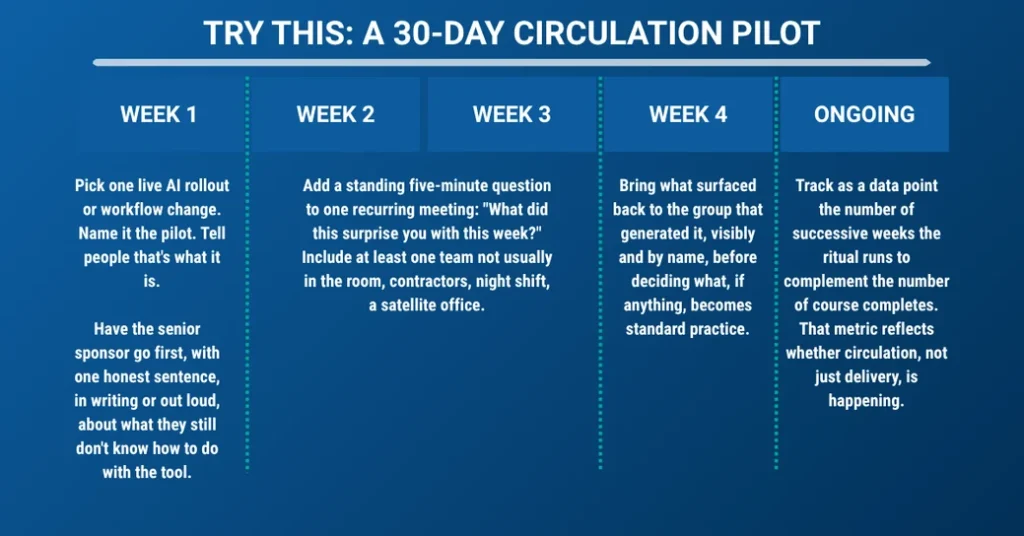
- Modeling Vulnerability: A critical component of circulation is leadership presence. When a senior leader openly acknowledges their own fumbling with an AI prompt, they set a new organizational norm. By making "not knowing" an acceptable state, they lower the barrier to entry for the rest of the staff.
- Trait-Mapping vs. Org-Charting: Rather than assigning AI adoption tasks based on formal job descriptions, successful companies are mapping individual strengths—such as future-focus, idea generation, and interpersonal sensitivity—to specific projects. This allows for the creation of reconfigurable, high-performance teams that assemble around the work rather than the hierarchy.
The Role of Agentic AI in Listening
Technology itself is now being repurposed to support this circulatory flow. Some firms have begun using agentic AI as an "early-warning system" to monitor for divergences in practice. By identifying teams that are independently developing unique, successful use cases, the AI provides L&D leaders with data-driven insights on where innovation is happening.
However, this application carries significant ethical and operational risks. For this system to be effective, it must be introduced as a collaborative tool, not a surveillance mechanism. If employees perceive that their AI usage is being monitored to identify who is "behind," the very candor required for the system to function will evaporate. The goal is not to track individual performance, but to identify the "signals of excellence" that can be scaled across the organization.
Redefining the L&D Curriculum
As AI becomes increasingly capable of teaching the "how"—the procedural aspects of drafting, modeling, and planning—the role of the CLO is undergoing a fundamental transformation. The traditional curriculum is being rendered obsolete by the tool itself. In its place, the new core curriculum is centered on judgment: when to trust an AI output, how to interrogate it for bias, and how to act when an AI provides a confident but incorrect answer.
"Soft skills" have effectively become the "power skills" of the AI era. Reflexivity, the capacity to sit with ambiguity, and the ability to navigate complex, human-machine workflows are now the primary drivers of organizational performance. The challenge for L&D leaders is to shift their focus from curriculum ownership to learning architecture.
The Competitive Advantage of Connection
As we look toward the next two fiscal quarters, the organizations that will gain the greatest competitive advantage are those that treat learning circulation as core infrastructure rather than a change-management exercise. This requires a shift from a mechanistic mindset—which views the organization as a series of cause-and-effect processes—to a systems mindset, which prioritizes multidirectional loops and human-centered design.
The transition from a cascade to a circulatory model is not merely a tactical adjustment; it is a structural necessity. By building systems that allow knowledge to flow freely across levels, teams, and departments, organizations can move at the speed of their own collective curiosity. In an era of constant technological disruption, the ability to learn and iterate is the only sustainable advantage. The organizations that succeed in the next decade will be those that create an environment where the most valuable piece of information—"I found a better way to do this"—is not hidden, but celebrated and circulated as the new standard.