


The Spanish verb ir, which translates to "to go," stands as one of the most fundamental yet linguistically complex pillars of the Spanish language. As a high-frequency verb, it is essential for the construction of everyday communication, travel logistics, and future-oriented discourse. However, its conjugation pattern deviates significantly from standard morphological rules, presenting a notable challenge for learners and a point of interest for historical linguists. By examining the structural irregularities, historical evolution, and pragmatic utility of ir, one gains a deeper understanding of the mechanisms governing the Spanish language.
Historical Context and Linguistic Origins
The irregularity of ir is not a modern development but rather the result of a process known as suppletion, which occurred over centuries as the language evolved from Vulgar Latin. In linguistics, suppletion refers to the phenomenon where a single paradigm is filled by forms derived from different etymological roots.
The verb ir essentially draws its various forms from three distinct Latin sources. The present indicative forms (such as voy and vamos) are derived from the Latin vadere (to go/to proceed). The past tense forms (such as fui and fuiste) originate from the Latin esse (to be), specifically the perfect tense. This historical merger explains why the preterite conjugation of ir is identical to that of ser. The imperfect tense (such as iba) traces its origins to the Latin ire (to go). Because these roots were never fully regularized into a single morphological pattern, the resulting verb remains a patchwork of historical remnants that users must memorize as a distinct, irregular unit.
Chronology of Usage and Practical Application
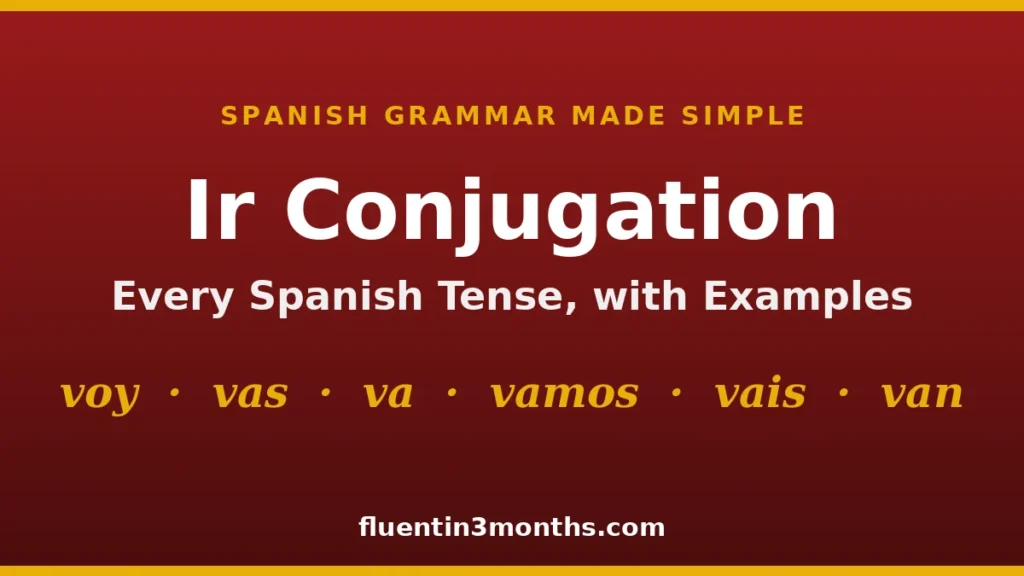
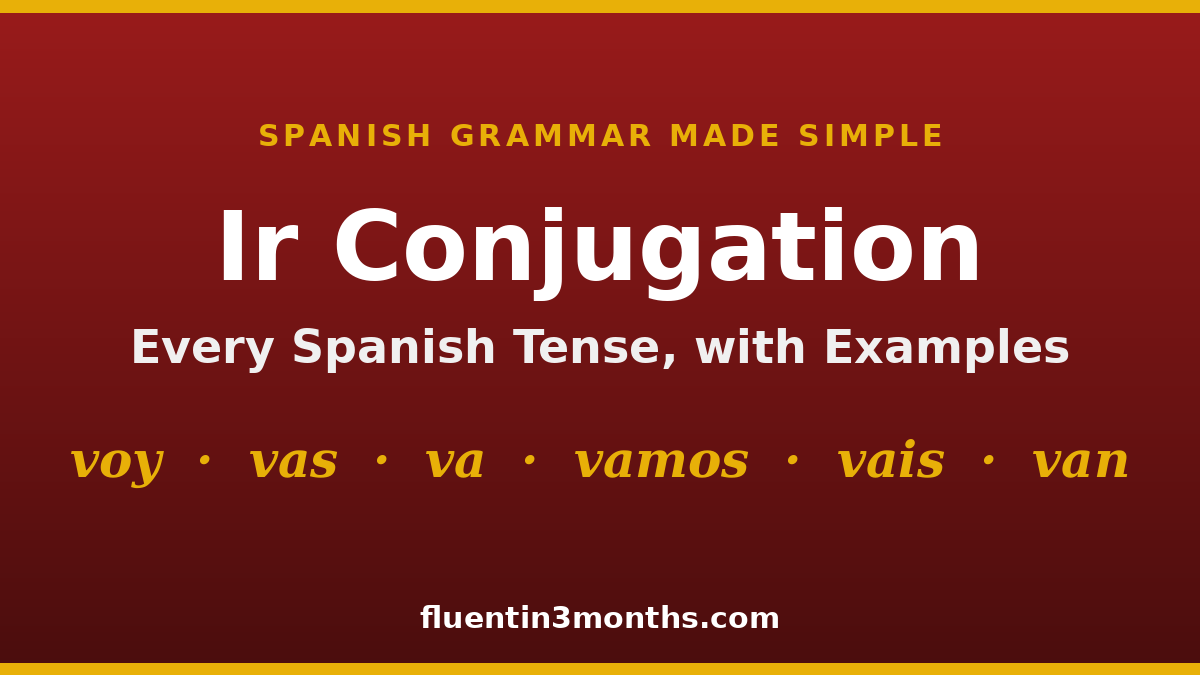
For the non-native learner, the mastery of ir is categorized by frequency of use. Educational data suggests that prioritizing specific tenses significantly accelerates conversational fluency. The present indicative—voy, vas, va, vamos, vais, van—serves as the primary functional tool for daily interactions.
Beyond simple movement, ir functions as a structural auxiliary. The construction ir + a + infinitive provides a streamlined method for expressing the near future. This construction is functionally preferred over the synthetic future tense in most colloquial contexts, as it allows speakers to express intent or upcoming actions without the need for complex future-tense conjugations. Research indicates that speakers who prioritize the acquisition of this specific construction reach a threshold of "functional fluency" faster than those who focus on the full range of seventeen available tenses.
Data-Driven Analysis of Verb Tenses
The indicative mood remains the backbone of the verb’s utility. Below is the distribution of the simple indicative tenses, which are essential for narrative consistency:
| Pronoun | Present | Preterite | Imperfect | Future | Conditional |
|---|---|---|---|---|---|
| Yo | voy | fui | iba | iré | iría |
| Tú | vas | fuiste | ibas | irás | irías |
| Él/Ella/Ud | va | fue | iba | irá | iría |
| Nosotros | vamos | fuimos | íbamos | iremos | iríamos |
| Vosotros | vais | fuisteis | ibais | iréis | iríais |
| Ellos/Uds | van | fueron | iban | irán | irían |
The imperfect tense, characterized by iba, ibas, iba, serves as a rare example of an irregular imperfect, as most Spanish verbs follow a predictable pattern. Linguistic analysts note that because ir is one of the few verbs that do not follow standard thematic vowel changes in the imperfect, it is frequently cited in pedagogical studies as a "memory anchor" for students.
Comparative Syntax: The Subjunctive Mood
The subjunctive mood introduces a layer of subjective intent, doubt, or hypothetical scenarios. The forms vaya (present) and fuera/fuese (imperfect) are critical for navigating complex sentence structures. The existence of two interchangeable forms in the imperfect subjunctive (-ra and -se) reflects regional linguistic variations. In modern Latin American Spanish, the -ra suffix is statistically more prevalent in spoken discourse, while the -se suffix maintains a higher frequency in formal or literary writing in parts of Spain.
The Imperative and Command Structures
The imperative mood, used for directives, presents an interesting case of orthographic and phonetic shifts. The informal command ve is a stark departure from the infinitive ir. Furthermore, the command form for "we" (vamos) is shared with the present indicative, creating a unique situation where context—rather than grammatical form—must dictate whether a speaker is stating a fact or issuing a collective suggestion.
Scholarly and Pedagogical Perspectives
Experts in applied linguistics suggest that the difficulty of ir is often overstated by focusing on rote memorization of every possible tense. A more efficient approach, favored by modern language acquisition programs, is the "core-form" method. This involves mastering the present indicative and the near-future construction first, then layering on the preterite and imperfect as needed for storytelling.
The overlap between ir and ser in the preterite tense—where fui functions for both "I went" and "I was"—is often a source of confusion. However, pedagogical analysis indicates that this is rarely an issue in real-time communication. Because ir is almost always followed by a preposition indicating destination (e.g., a or hacia), the ambiguity is resolved almost immediately upon the utterance of the subsequent word.
Broader Linguistic Implications
The persistence of ir as an irregular verb serves as a testament to the conservatism of high-frequency words in human language. Because the verb is used so frequently in daily survival—to indicate travel, plans, and direction—it has resisted the "regularization" that has smoothed out less common verbs. Language evolution typically forces high-frequency words to remain irregular because they are so deeply embedded in the cultural lexicon that they are resistant to the standardizing pressures of children and new learners.
For students and professionals alike, ir represents the intersection of history and utility. It is not merely a word to be conjugated; it is a structural element of the Spanish language that requires an understanding of both its historical weight and its modern, flexible application. By breaking down the verb into its core components—the present indicative, the near-future construction, and the essential past tenses—learners can navigate the complexities of Spanish with greater confidence and accuracy.
As usage data continues to show, those who master the "high-utility" forms of ir gain a disproportionate advantage in conversational speed and clarity. The verb remains a definitive example of how language, while following rules, is also a living record of the ancient roots that continue to shape the way we communicate today.