


The modern executive landscape is littered with the remnants of ambitious strategic plans that failed to materialize. Research from the Harvard Business Review and other institutional analysts consistently indicates that approximately 67% to 90% of organizations fail to execute their stated strategies effectively. Despite months of planning, clear goal-setting, and resource allocation, progress often grinds to a halt within two quarters. While many leadership teams reflexively attribute this stagnation to a nebulous "culture problem," the evidence suggests a more clinical reality: organizations often lack the structural mechanisms required to translate high-level intent into daily operational decision-making.
Culture is frequently misunderstood as a collection of values, mission statements, or office perks. However, from an organizational design perspective, culture is the sum of the decisions made by employees every day. When an organization’s strategic momentum stalls, it is rarely due to a lack of talent or commitment. Rather, it is a failure of the "operational infrastructure"—the systems, communication channels, and decision-making frameworks that define how work actually flows through an enterprise.
The Anatomy of Strategic Failure
A chronological look at a typical failed initiative often reveals a consistent pattern. In the first phase, leadership develops a robust plan. By the third month, the initiative is communicated throughout the organization. By the sixth month, the "drift" begins: departments begin prioritizing their individual KPIs over the enterprise goal, meetings focus on reporting status updates rather than resolving bottlenecks, and the initial enthusiasm of the workforce begins to wane.
This phenomenon, often labeled as a failure of engagement, is fundamentally a failure of clarity and accountability. When employees at the front lines—those who make the hundreds of micro-decisions that define a company’s performance—lack a clear framework, they default to local optimization rather than systemic success.
Empirical Context and Performance Data
The gap between strategy and execution has been quantified by several longitudinal studies. A study by the Balanced Scorecard Institute found that 85% of executive teams spend less than one hour per month discussing strategy. This disconnect between the "thinkers" and the "doers" creates an environment where employees operate in a vacuum.
Furthermore, the rise of artificial intelligence has introduced a new layer of complexity. While AI offers the potential to automate routine tasks, it does not solve for the human element of decision-making. In fact, organizations that implement advanced technology without first refining their operational culture often find that they have simply accelerated the pace of their dysfunction. Digital transformation efforts, for instance, have a notoriously high failure rate; McKinsey & Company reports that roughly 70% of digital transformations fall short of their objectives, primarily due to resistance to change and a lack of organizational alignment.
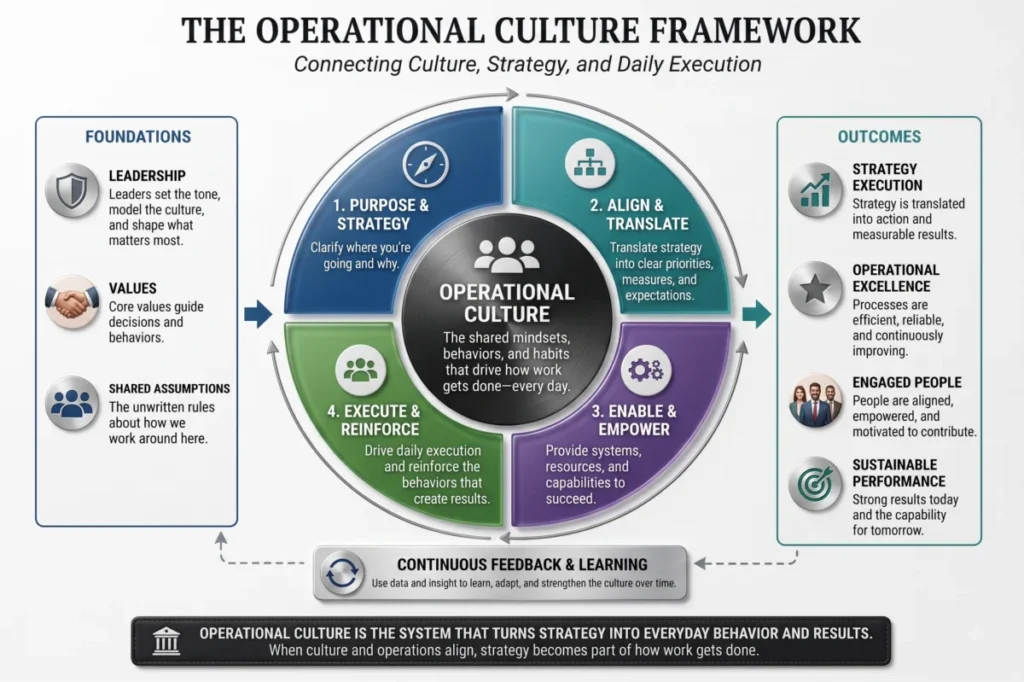
The Operational Culture Framework
To bridge the gap between intent and outcome, management experts are increasingly shifting their focus from "cultural values" to "operational capabilities." This shift recognizes that culture is an operational asset that can be designed, measured, and optimized. The framework rests on four pillars:
1. Clarity: The North Star of Execution
Clarity is the reduction of ambiguity. In high-performing organizations, every employee understands not just the "what" of the strategy, but the "how." This requires a systematic approach to communicating priorities. When an employee understands how their specific task contributes to the broader organizational mission, they are empowered to make decisions that align with that mission without waiting for senior-level approval.

2. Accountability: Beyond Compliance
Accountability is often mistaken for punitive oversight. In reality, it is the process of delegating both the responsibility and the authority for outcomes. Effective accountability exists when an organization’s operating rhythm—the cycle of meetings, reviews, and feedback loops—reinforces ownership. When ownership is distributed, the organization becomes more agile and less dependent on "heroic" leadership from the top.
3. Collective Intelligence: The Power of Diverse Expertise
Isolated expertise is a common barrier to execution. Many organizations suffer from "siloed intelligence," where critical information remains trapped within departments. The most successful firms create structures for "surfacing dissent." This is grounded in the concept of psychological safety, where employees feel secure enough to challenge assumptions or flag potential failures early. This collective intelligence allows an organization to identify roadblocks before they derail a project.
4. Adaptability: Learning at Velocity
The case of Kodak serves as the perennial cautionary tale for the 21st century. Despite owning the technology that would eventually disrupt their primary revenue stream, the firm lacked the operational capability to shift its business model. Adaptability is the capacity to learn faster than the market changes. It requires an organizational architecture that treats "failure" as a data point for iterative improvement rather than a terminal event.
Implications for Modern Leadership
For organizational leaders, the imperative is clear: the focus must move away from top-down directives and toward the creation of environments that facilitate effective decision-making. This requires an audit of existing systems. Leaders must ask themselves:
- Do our performance evaluations reward the behaviors we claim to value?
- Do our meeting structures promote collaborative problem-solving or merely status reporting?
- Is our organizational structure designed to empower the people closest to the work?
The transition from a "values-based" culture to an "operational" culture is a significant shift in philosophy. It necessitates that leadership stops viewing culture as a soft HR initiative and starts viewing it as an operational capability akin to supply chain management or financial planning.
Broader Impact and Future Outlook
As the global economy becomes increasingly volatile, the ability to execute strategy with precision will become a primary competitive advantage. The organizations that thrive in the next decade will be those that have institutionalized these four capabilities.
When an organization treats its operational culture as a design project, it gains the ability to scale. It stops being reliant on the charisma or insight of a few executives and begins to function as a self-correcting system. This is the ultimate objective of leadership: to create a structure where the organization’s performance is a natural consequence of its design, rather than a frantic, last-minute effort to overcome its own internal friction.
Ultimately, the failure to execute is almost never a failure of the people. It is a failure of the infrastructure that those people operate within. By investing in clarity, accountability, collective intelligence, and adaptability, leaders can ensure that their strategy is not just a document on a shelf, but a daily, measurable, and successful reality. The task ahead for modern management is not to change the people, but to change the conditions under which they work, ensuring that the environment itself supports the mission. The transition from "culture as values" to "culture as operations" represents the next evolution in organizational excellence.