




A familiar scenario unfolds daily across higher education institutions: a seasoned faculty member, minutes before a critical hybrid lecture, grapples with malfunctioning audiovisual equipment. The camera might be misaligned, the projection screen unresponsive, or the primary display defaulting to an incorrect input – challenges that interrupt the flow of instruction and demand immediate intervention from an already overstretched IT department. This widespread issue, often dismissed as an unavoidable cost of modern academic technology, is, in fact, a symptom of a deeper, systemic problem: the neglect of foundational infrastructure in the design and deployment of learning spaces. The chasm between the glossy promise of new AV technology and its often-frustrating reality in the classroom is not a technology failure, but an infrastructure crisis.
The Pervasive Problem of Misaligned Priorities in AV Procurement
For years, the procurement process for campus audiovisual systems has operated in a fundamentally flawed sequence. Typically, architectural plans for a new or renovated learning space are drawn, and budgets are allocated, often without early or substantive input from the dedicated AV and IT teams who understand the intricate operational demands of these environments. This top-down approach often pre-determines aspects like room layout, power availability, and even initial equipment brands, fixing critical parameters before the core question — "What must this space achieve pedagogically and operationally?" — has been adequately addressed.
Only after these preliminary decisions are made and purchase orders signed does the AV team enter the fray, tasked with the unenviable challenge of retrofitting sophisticated technology into an often-unsuitable structural framework. This involves improvising solutions for mounting displays, routing complex cabling, installing racks, ensuring adequate power management, and integrating wireless network infrastructure. The analogy is stark: imagine purchasing a high-performance sports car only to discover the only available roads are riddled with potholes and unpaved sections. The car, in this scenario, is not the problem; the road beneath it is. When critical elements like display mounting systems, structured cabling pathways, robust rack enclosures, intelligent power management, efficient AV signal distribution, and ubiquitous wireless connectivity are treated as afterthoughts, the inevitable outcome is learning environments that operate intermittently, demand constant troubleshooting, and crucially, lack the adaptability required to respond to evolving pedagogical models – a reality forcefully demonstrated by recent global shifts in education.
A Historical Perspective: From Analog to Hybrid Demands
The evolution of campus AV infrastructure provides crucial context. For decades, AV systems were largely analog and relatively static, consisting of overhead projectors, VCRs, and basic sound systems. Infrastructure needs were simpler: power outlets, conduit for video cables, and perhaps an audio jack. The digital revolution brought projectors, then flat-panel displays, and eventually networked control systems. Yet, the underlying infrastructure planning often lagged, treating these new components as direct replacements rather than fundamentally changing the ecosystem.
The true inflection point arrived with the COVID-19 pandemic in early 2020. Universities worldwide were thrust into an unprecedented demand for remote and hybrid learning capabilities almost overnight. Classrooms that were once designed for in-person lectures suddenly needed to support simultaneous in-room and remote participants, requiring high-quality cameras, microphones, advanced streaming capabilities, and robust network bandwidth. This urgent pivot exposed the brittleness of existing AV infrastructure on a massive scale. Campuses scrambled to deploy new equipment, often bypassing meticulous planning in favor of speed, further exacerbating the foundational weaknesses. The result was a patchwork of solutions, inconsistent user experiences, and a surge in IT support tickets, highlighting a significant return on investment challenge for institutions that had poured millions into what appeared to be advanced technology.
The Financial and Operational Burden of Neglected Infrastructure
The financial implications of this reactive approach are substantial. According to industry reports, higher education institutions collectively spend billions annually on AV technology. However, a significant portion of this investment is effectively undermined by poor infrastructure. Studies suggest that up to 30% of an IT department’s time can be consumed by reactive troubleshooting, much of it related to preventable AV issues. This translates to immense operational costs in terms of staff hours, lost instructional time, and the premature replacement of equipment damaged by inadequate power or environmental conditions.
"We constantly hear from IT directors about the ‘break-fix’ cycle they’re trapped in," notes Dr. Eleanor Vance, a consultant specializing in educational technology infrastructure. "They invest in the latest cameras and interactive displays, only to find their teams spending more time fixing cable pulls or power surges than innovating with the new tech. The hidden cost of faculty frustration and lost learning opportunities is even higher." Faculty members, too, voice their concerns. A recent informal survey among university professors indicated that over 60% reported experiencing AV malfunctions at least once a month, leading to delays, stress, and a perceived devaluation of their teaching efforts. "It’s disheartening," commented Professor Mark Jensen of a state university, "when you’ve prepared a dynamic hybrid lesson, but then spend the first fifteen minutes trying to get the remote students to hear you, or the in-room projector to sync. It disrupts the flow and diminishes the learning experience for everyone."

Embracing the "Ecosystem First" Paradigm
The solution necessitates a fundamental, albeit profound, shift in institutional thinking: moving from a technology-first approach to an "ecosystem first" design philosophy. Instead of selecting specific technologies and then attempting to build the room around them, institutions must begin by asking foundational questions: What are the primary pedagogical functions of this learning space? What specific teaching and learning formats must it reliably support (e.g., active learning, lecture capture, remote collaboration, blended synchronous)? How will the system be serviced and maintained over its lifecycle? And critically, how can it scale or adapt to future technological advancements and evolving educational needs?
When these strategic questions drive the procurement and design process, every layer of the infrastructure is recognized as a critical architectural decision. This includes:
- Display and Projector Mounting Systems: Ensuring secure, accessible, and aesthetically integrated mounting that accounts for sightlines, adjustability, and future upgrades.
- Projection Screens: Selecting appropriate screen types, sizes, and mounting mechanisms for optimal viewing in varying ambient light conditions.
- Rack Systems and Power Distribution: Implementing robust, organized rack enclosures with intelligent power management units (PMUs) that provide surge protection, remote monitoring, and sequenced power-up/shutdown capabilities.
- Structured Cabling and Cable Management: Designing comprehensive, labeled cabling pathways that support current and future bandwidth needs, minimize interference, and facilitate easy maintenance and troubleshooting. This includes fiber optics, high-quality copper, and appropriate conduits.
- PTZ and Fixed Cameras: Strategically positioning cameras for optimal capture of instructors, students, and whiteboards, considering lighting, field of view, and network connectivity.
- Wireless Access Points (WAPs): Ensuring ubiquitous and high-bandwidth wireless coverage not just for devices, but for streaming AV content, controlling systems, and enabling interactive learning applications.
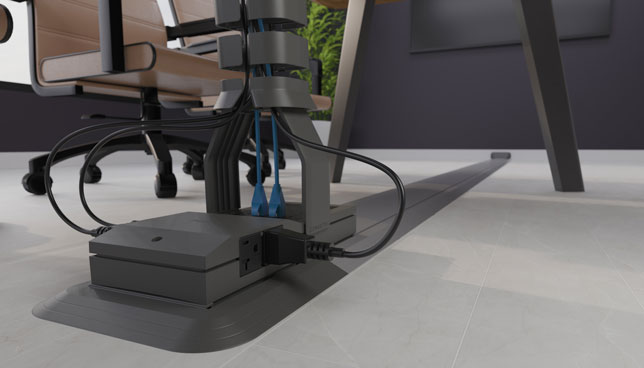
- Floor Connectivity Systems: Integrating flexible floor boxes and access points in active learning spaces to support reconfigurable furniture and spontaneous collaboration without cable clutter or tripping hazards.
- Acoustics and Environmental Controls: Considering room acoustics, lighting, and HVAC as integral parts of the AV experience, impacting microphone performance, display visibility, and user comfort.
The Practical Payoff: Standardization, Efficiency, and Future-Proofing
This integrated, infrastructure-first approach yields immediate and significant practical benefits, most notably standardization. When infrastructure decisions are made intentionally and consistently across a campus, IT and AV support teams transition from troubleshooting disparate, one-off configurations to managing a coherent, predictable system. A technician familiar with the rack layout, cabling schema, and power distribution in Building A can confidently troubleshoot an issue in Building F. This isn’t merely about efficiency; it’s about restoring sanity to IT operations, reducing burnout, and enabling staff to focus on proactive maintenance and strategic technology adoption rather than constant firefighting.

Moreover, standardization leads to substantial cost savings. Bulk purchasing of standardized components, streamlined installation processes, and reduced training requirements for technicians all contribute to a more economical total cost of ownership. Beyond immediate savings, a well-designed infrastructure is inherently more future-proof. It provides the backbone and flexibility to integrate new technologies as they emerge, without requiring a complete overhaul. When infrastructure is treated as the constant variable, technology itself becomes more adaptable and reliable.
Statements from Stakeholders: A Unified Vision
University leadership is increasingly recognizing this critical shift. "Our priority is to provide an equitable and engaging learning experience, whether students are on campus or accessing content remotely," stated Dr. Sarah Chen, Provost of a major research university. "To do that, our technology must be invisible and reliable. We’ve learned the hard way that cutting corners on infrastructure ultimately costs us more in faculty time, student satisfaction, and IT resources. We are now mandating early involvement from our AV and IT teams in all capital projects."
AV integrators and consultants echo this sentiment, advocating for a collaborative design process. "The most successful projects we undertake are those where we’re brought in at the architectural conceptualization stage," explains David Thompson, CEO of a leading AV integration firm. "When we can advise on power loads, cable pathways, and equipment placement before walls are built, the outcome is exponentially better. It reduces change orders, minimizes costly rework, and ultimately delivers a more robust and user-friendly system for the university."
Broader Implications: Educational Equity and Institutional Reputation

The implications extend far beyond operational efficiency. A robust AV infrastructure directly impacts educational equity. In hybrid learning models, a stable connection, clear audio, and visible content are paramount for remote students to participate fully and equitably with their on-campus peers. When infrastructure falters, it creates a two-tiered learning experience, disadvantaging those who cannot physically be present.
Furthermore, a university’s technological sophistication and reliability play a significant role in its reputation and ability to attract and retain top faculty and students. In an increasingly digital world, a seamless, high-quality learning environment is a competitive differentiator. Institutions that consistently deliver reliable, cutting-edge AV experiences are perceived as forward-thinking and dedicated to pedagogical excellence. Conversely, persistent technological failures can erode confidence and damage an institution’s image.
A Path Forward: Redefining "AV Decisions"
Designing learning environments as integrated ecosystems does not necessitate a complete overhaul of every single classroom overnight. Instead, it signals a strategic shift in the sequence of decisions and a broader redefinition of what constitutes an "AV decision." It means:
- Early Engagement: Involving AV and IT experts from the earliest stages of architectural planning for any new construction or renovation project.
- Needs-Based Design: Starting with pedagogical and operational requirements, rather than focusing on specific hardware.
- Holistic View: Considering power, networking, physical space, acoustics, and environmental factors as integral components of the AV system.
- Standardization: Developing campus-wide standards for infrastructure components to simplify deployment, maintenance, and user experience.
- Long-term Planning: Adopting a lifecycle approach that factors in maintenance, upgrades, and future scalability from the outset.
By consciously prioritizing the hidden layer of infrastructure, universities can move beyond the daily frustrations of unreliable technology and build learning environments that are truly resilient, adaptable, and capable of supporting the dynamic future of higher education. This strategic investment in the foundation will ultimately deliver on the promise of advanced AV technology, transforming it from a source of constant headaches into a seamless enabler of exceptional teaching and learning.