


Numerical literacy in the Turkish language serves as a fundamental pillar for any individual seeking to navigate the social, commercial, or administrative landscapes of the Republic of Turkey. As the nation continues to strengthen its position as a transcontinental hub for tourism, real estate, and international trade, the ability to communicate values, dates, and quantities in the local vernacular has moved from a convenience to a strategic necessity. For the millions of expatriates and short-term visitors who enter the country annually, understanding the Turkish numbering system—a system characterized by its remarkable mathematical regularity and logical structure—is the first step toward cultural and economic integration.
The Foundation of the Turkish Counting System
The Turkish numbering system is rooted in a highly consistent decimal structure that lacks many of the irregularities found in Romance or Germanic languages. Unlike French, which employs a base-20 logic for certain numbers, or English, which utilizes unique terms for "eleven" and "twelve," Turkish follows a strictly additive pattern. The primary challenge for the learner lies not in complex grammar, but in the memorization of the basic building blocks and the application of vowel harmony.
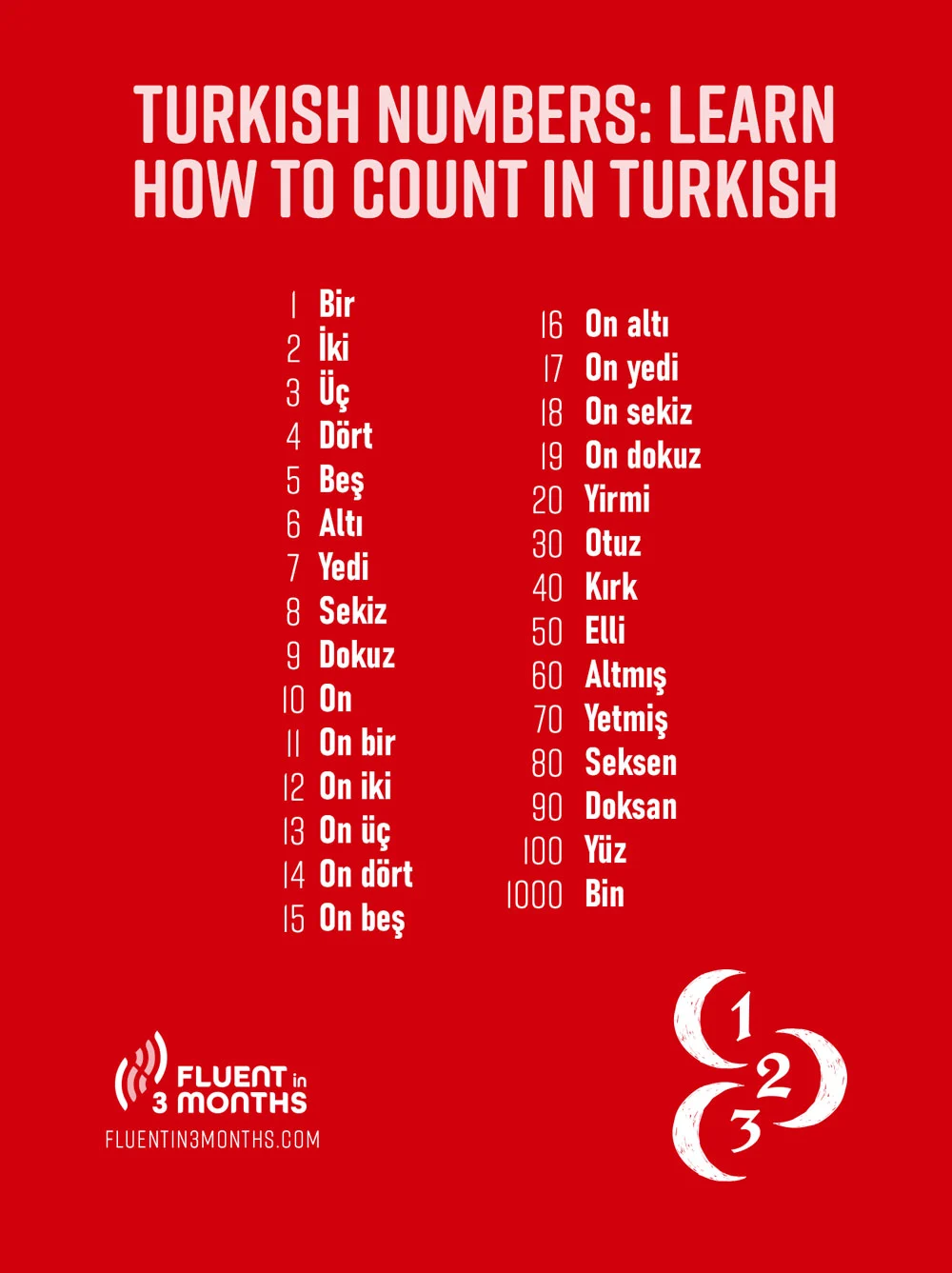
The cardinal numbers from one to ten provide the essential vocabulary for all subsequent numerical constructions:
1 – Bir
2 – İki
3 – Üç
4 – Dört
5 – Beş
6 – Altı
7 – Yedi
8 – Sekiz
9 – Dokuz
10 – On
Linguistic analysts point out that these ten words are the most frequently used numerical terms in daily Turkish life. From requesting a specific number of items at a local pazar (market) to identifying gate numbers at Istanbul’s international airports, these single-digit figures form the bedrock of communication.
The Logic of Aggregation: 11 Through 99
Once the primary digits are mastered, the Turkish system reveals its architectural simplicity. To form numbers between 11 and 19, one simply places the word for ten (on) before the single digit. For example, eleven is expressed as on bir (literally "ten one"), and nineteen is on dokuz ("ten nine"). This pattern persists without exception, providing a streamlined learning curve for non-native speakers.
The progression into higher double-digit numbers requires learning the specific terms for each multiple of ten:
20 – Yirmi
30 – Otuz
40 – Kırk
50 – Elli
60 – Altmış
70 – Yetmiş
80 – Seksen
90 – Doksan
To construct any number between these intervals, the speaker follows the same additive logic used in the teens. To say 23, one combines yirmi (20) and üç (3). To say 45, one combines kırk (40) and beş (5). This transparency in the linguistic structure reduces the cognitive load on the speaker, allowing for rapid calculation and verbalization during fast-paced transactions.
Scaling Up: Hundreds, Thousands, and Millions
In the context of the Turkish economy, where the Turkish Lira (TRY) often involves larger denominations due to historical inflationary trends and currency valuations, proficiency in large numbers is critical. The word for one hundred is yüz. Unlike English, which often requires the word "one" before "hundred," Turkish speakers simply say yüz for 100. For multiples of a hundred, the multiplier is placed first: iki yüz (200), beş yüz (500), and so on.
The same logic applies to thousands (bin). One thousand is bin, while five thousand is beş bin. This systematic approach extends into the millions (milyon) and billions (milyar). In real estate transactions or corporate financial reporting, these terms are ubiquitous. For instance, a property priced at 3,500,000 TL would be articulated as üç milyon beş yüz bin Türk Lirası.
Linguistic Mechanics: Ordinal Numbers and Vowel Harmony
A distinctive feature of the Turkish language is its use of suffixes to alter the meaning of base words. Ordinal numbers (first, second, third) are formed by adding a suffix to the cardinal number. However, this process is governed by the rules of four-way vowel harmony, a cornerstone of Turkic linguistics. The suffix changes based on the last vowel of the number: -ıncı, -inci, -uncu, or -üncü.
- First: Birinci (from bir)
- Second: İkinci (from iki)
- Third: Üçüncü (from üç)
- Fourth: Dördüncü (from dört)
- Fifth: Beşinci (from beş)
- Sixth: Altıncı (from altı)
These ordinal numbers are essential in daily life for identifying floors in a building (kat), positions in a queue, or dates in a historical context. In official documentation, these are often abbreviated using a period after the numeral (e.g., 1. for birinci), similar to the German system.
Economic Context: Numbers in Commerce and Currency
The practical application of Turkish numbers is most visible in the nation’s vibrant commercial sector. Since the redenomination of the Turkish Lira in 2005, which removed six zeros from the old currency, the management of prices has become more standardized, yet the volatility of the exchange rate in recent years has made price-watching a national pastime.
When shopping, prices are expressed in Lira and kuruş (cents). A price tag of 15.50 TL is read as on beş lira elli kuruş. In informal settings, the word kuruş is often omitted if the context is clear. Furthermore, when discussing weights and measures—essential for the agricultural trade that defines much of Turkey’s export economy—the metric system is used exclusively. One might ask for iki kilo domates (two kilos of tomatoes) or beş yüz gram peynir (five hundred grams of cheese).
Temporal and Social Applications
Timekeeping in Turkey utilizes both the 12-hour and 24-hour systems. In formal announcements, such as train schedules or television broadcasts, the 24-hour clock is standard. A flight departing at 18:00 is described as saat on sekiz. In casual conversation, the 12-hour clock is used, often supplemented by terms for "half" (buçuk) and "quarter" (çeyrek).
Age and personal identification also rely heavily on numerical accuracy. To state one’s age, the formula is [Number] + yaşındayım (I am … years old). For example, otuz yaşındayım (I am 30 years old). In administrative settings, providing one’s T.C. Kimlik Numarası (Turkish Republic Identification Number)—an 11-digit sequence—is a mandatory requirement for everything from opening a bank account to receiving medical care.
Chronology of Learning: A Strategic Approach for Newcomers
Language educators specializing in Turkish as a foreign language suggest a tiered approach to numerical mastery. The following timeline represents a standard progression for a dedicated learner:
- Week 1: Mastery of 1–10 and the concept of zero (sıfır). Focus on pronunciation, particularly the dotted and dotless "i" and the "ü" sound.
- Week 2: Introduction to multiples of ten (20–90) and the additive logic for intermediate numbers (21–99).
- Week 3: Expansion into the hundreds and thousands. Practice reading price tags and dates (years).
- Week 4: Application of ordinal suffixes and vowel harmony. Learning to tell time and express fractions.
Expert Analysis: The Broader Impact of Numerical Literacy
Linguistic experts argue that the transparency of the Turkish numerical system reflects a broader cultural emphasis on logic and efficiency. Dr. Mehmet Arslan, a sociolinguist based in Ankara, notes that "the ease with which a foreigner learns Turkish numbers often serves as a ‘gateway’ to the rest of the language. It builds immediate confidence in high-stakes environments like the Grand Bazaar or a government office."
From a macroeconomic perspective, the standardization of numerical communication supports Turkey’s "Vision 2053" goals, which aim to further integrate the Turkish economy with global markets. As digital transformation sweeps through Turkish banking and e-commerce (with platforms like Trendyol and Hepsiburada leading the way), the digital representation of numbers remains consistent with the spoken linguistic rules, ensuring a seamless transition between physical and virtual trade.
Conclusion and Practical Reference
In summary, the Turkish numbering system is an elegantly designed tool that rewards the learner with immediate practical utility. By mastering the basic digits and understanding the rules of aggregation and harmony, visitors and residents can participate fully in the social and economic life of the country. Whether it is negotiating a contract, understanding a utility bill, or simply asking for the time on a street in Izmir, numbers are the universal language that bridges the gap between the foreign observer and the local participant.
Summary Reference Table for Key Numerals:
- 0: Sıfır
- 10: On
- 20: Yirmi
- 50: Elli
- 100: Yüz
- 500: Beş yüz
- 1,000: Bin
- 1,000,000: Bir milyon
As Turkey continues to evolve as a global power, the importance of these linguistic foundations will only grow, making the study of Turkish numerals an essential endeavor for any global citizen.