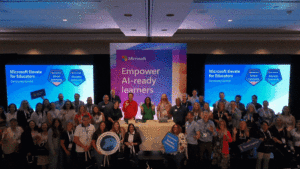




Microsoft has officially welcomed a new global cohort of more than 43,000 Microsoft Innovative Educator (MIE) Experts and 900 Microsoft Showcase Schools for the 2025–2026 academic year, marking a significant expansion in the company’s efforts to integrate artificial intelligence into the global classroom. This year’s selection process focused heavily on educators and institutions that have demonstrated visionary leadership in AI transformation, prioritizing the development of AI literacy as a foundational skill for the modern era. As education systems worldwide grapple with the rapid evolution of digital tools, these selected educators and schools are tasked with serving as the primary architects of a reimagined learning landscape.
The 2025–2026 cohort emerges at a time when the integration of technology in education has shifted from an elective enhancement to a structural necessity. According to Microsoft’s internal data and broader industry reports, the use of AI across educational institutions—encompassing teachers, administrators, and students—has reached unprecedented levels. The MIE Expert and Showcase School programs are designed to provide a structured framework for this transition, ensuring that the adoption of Microsoft technologies translates into measurable improvements in student engagement and learning outcomes.
The Strategic Role of Microsoft Elevate in Modern Pedagogy
Central to this year’s program is the launch of Microsoft Elevate, an initiative specifically engineered to support the MIE Expert and Showcase School communities. Microsoft Elevate serves as a bridge between high-level technological innovation and practical classroom application. By connecting these professional communities to advanced AI capabilities, the initiative aims to empower not only educators but also nonprofit organizations and workforce partners. The primary objective is to ensure that AI progress remains "people-centered," focusing on the human element of teaching rather than the automation of the profession.
Through Microsoft Elevate, the 2025–2026 cohort will receive enhanced support in utilizing AI to personalize learning experiences. This includes deep-dive training into Microsoft’s AI-driven Learning Accelerators, which provide real-time feedback to students in subjects such as reading, mathematics, and search coach skills. For the MIE Experts, this translates into a more sophisticated toolkit for addressing the diverse needs of students, particularly those requiring specialized accommodations or inclusive learning environments.
Background and Evolution of the MIE and Showcase Programs
The Microsoft Innovative Educator program has evolved significantly since its inception. Originally focused on basic digital literacy and the adoption of tools like OneNote and Microsoft Teams, the program has pivoted to address the complexities of the Fourth Industrial Revolution. The 2025–2026 cycle represents the most substantial shift toward AI-centric education in the program’s history.
To earn the designation of MIE Expert, educators must undergo a rigorous application process that includes completing specific professional learning paths on the Microsoft Learn platform. These paths are designed to equip educators with "future-ready" skills, focusing on how to utilize data analytics to track student progress and how to implement generative AI in lesson planning and administrative efficiency.
Similarly, Microsoft Showcase Schools represent the pinnacle of institutional digital transformation. These schools are recognized for their excellence in the Microsoft Education Transformation Framework (ETF), a holistic approach to school change that covers leadership and policy, modern teaching and learning, and intelligent environments. The 900 schools selected for this cycle serve as global hubs for innovation, where other institutions can observe the practical implementation of 1:1 device programs and cloud-based collaborative learning.
Chronology of the 2025–2026 Academic Cycle
The selection of the current cohort follows a multi-month evaluation period that began in the previous academic year. The timeline for the 2025–2026 program is structured to provide continuous growth and evaluation:
- Application and Nomination Phase: Educators and schools submitted evidence of their impact, including case studies of how they have integrated Microsoft tools to solve specific pedagogical challenges.
- Selection and Onboarding: In late 2024 and early 2025, Microsoft teams reviewed thousands of applications, selecting those that demonstrated a clear commitment to AI literacy and equity.
- Active Engagement Period: Throughout the 2025–2026 academic year, MIE Experts will participate in monthly webinars, product feedback sessions with Microsoft engineering teams, and regional "EduDays."
- Leadership and Mentorship: MIE Fellows—an elite tier of the program—will be deployed to mentor new experts and lead professional development workshops at major international conferences such as ISTE and Bett.
- Review and Renewal: As the academic year concludes, participants will document their year-long progress, contributing to a global database of best practices that will inform the 2026–2027 selection criteria.
Supporting Data: The Economic Imperative for AI Literacy
The urgency behind the 2025–2026 program is underscored by shifting global labor market trends. Data from LinkedIn’s "AI and the Global Economy" report indicates that approximately 70% of the skills required for most jobs are expected to change by 2030 due to technological advancements. This shift places an immense responsibility on educators to prepare students for careers that may not yet exist.

Microsoft’s own "AI in Education" report highlights that 80% of educators believe AI will be a critical tool for their work within the next three years, yet many cite a lack of formal training as a primary barrier to adoption. The MIE Expert program directly addresses this gap. By training 43,000 experts, Microsoft is effectively creating a global network of "trainers of trainers" who can disseminate AI knowledge to hundreds of thousands of additional colleagues in their respective regions.
Official Perspectives and Educational Leadership
The sentiment within the educator community reflects both the challenges and the opportunities presented by this technological shift. Eleanor Jenkins, a recognized MIE Expert, highlighted the transformative nature of the current era during the launch of Microsoft Elevate. She noted that because the future careers of current students are still being defined, educators must take an active role in defining how the world works and how it will continue to change.
This perspective is echoed by Microsoft’s leadership, which views the MIE Expert and Showcase School programs as essential components of a broader mission to empower every person and organization on the planet. By focusing on "innovators using AI," the company is positioning itself as a partner in the educational journey rather than just a software provider. The emphasis on "human-centered" AI is a direct response to concerns regarding the potential for technology to depersonalize the learning experience.
Program Hierarchy: MIE Experts, Fellows, and Showcase Schools
The 2025–2026 community is organized into a tiered structure designed to maximize regional and global impact:
- MIE Experts: These are the frontline innovators. They are classroom teachers, librarians, and instructional coaches who use Microsoft 365, Teams, and Copilot to enhance daily instruction. Their primary role is to experiment with new tools and share their findings within their local school communities.
- MIE Fellows: This group consists of distinguished leaders who have been personally nominated by Microsoft team members. Fellows are often veteran MIE Experts who have demonstrated a capacity for high-level coaching and mentoring. They work closely with the Microsoft Elevate team to provide strategic support to the broader MIE community and often represent the program on the global stage.
- Microsoft Showcase Schools: These institutions operate on two paths: the Incubator path and the Showcase path. Schools on the Incubator path are working toward meeting the rigorous criteria of the Education Transformation Framework. Those that achieve Showcase status are recognized as international models of excellence, demonstrating how a whole-school approach to technology can improve administrative efficiency and student outcomes.
Broader Impact and Implications for Global Education
The implications of the 2025–2026 cohort extend far beyond the individual schools and educators involved. By fostering a global community, Microsoft is facilitating a cross-pollination of ideas that transcends geographic and socioeconomic boundaries. An educator in a rural school district in the United States can collaborate with a peer in an urban center in Southeast Asia to discuss the best ways to use AI for language acquisition or accessibility.
Furthermore, the program addresses the critical issue of educational equity. AI tools, when implemented correctly, have the potential to level the playing field for students with disabilities or those from underserved backgrounds. Features such as real-time translation, speech-to-text, and personalized reading coaches can provide support that was previously unavailable due to staffing or budget constraints. The MIE Experts of 2025–2026 are specifically tasked with exploring these inclusive capabilities to ensure that the "AI surge" does not leave vulnerable populations behind.
As the academic year progresses, the focus will remain on the purposeful use of technology. The goal is not merely to adopt AI for its own sake, but to use it as a catalyst for deeper learning, critical thinking, and creative problem-solving. The 2025–2026 cohort of MIE Experts and Showcase Schools stands as a testament to the belief that when educators are empowered with the right tools and a supportive community, they can lead a transformation that redefines the possibilities of education for generations to come.
Future Outlook and Sustainability
Looking ahead, the success of the 2025–2026 program will be measured by the sustainability of the innovations it produces. Microsoft has indicated that the insights gathered from this cohort will directly influence the development of future educational software and AI features. This feedback loop ensures that the technology remains responsive to the actual needs of the classroom.
For those looking to join this movement, the path remains open. Educators are encouraged to engage with Microsoft Learn and begin their journey toward becoming MIE Experts for future cycles. Schools are similarly invited to explore the Incubator path, starting a multi-year journey toward digital maturity. As the global community of innovators grows, the collective impact on the future of learning continues to expand, driven by a shared vision of an inclusive, impactful, and inspired educational future.