


The current corporate and academic discourse surrounding artificial intelligence is defined by a binary failure: the prohibitionists, who seek to wall off knowledge, and the accelerationists, who seek to integrate AI at any cost. Both approaches, however, ignore the fundamental challenge of the modern intellectual landscape—the preservation of human cognitive development in an age of automated synthesis. Recent empirical research from the MIT Media Lab suggests that the consequences of this neglect are not merely theoretical or pedagogical; they are neurological. As organizations and universities grapple with the integration of generative AI, the emergence of the Bot Check Method provides a structural framework for restoring human agency to the learning and decision-making process.
The stakes are increasingly quantifiable. In a 2025 study, Your Brain on ChatGPT: Accumulation of Cognitive Debt when Using an AI Assistant for Essay Writing Task, researchers led by Nataliya Kosmyna utilized EEG technology to track the neural activity of 54 students. The data revealed a stark divergence: students utilizing AI tools exhibited significantly reduced brain connectivity in areas tied to critical thinking and memory compared to those working without digital assistance. More alarmingly, these students struggled to engage even when the tools were removed, suggesting that prolonged reliance on AI creates a form of cognitive debt—a persistent state of underengagement that potentially rewires how individuals approach complex problem-solving.
A Chronology of Policy Failure
The path to this impasse began in late 2022, following the public release of large language models (LLMs). Almost immediately, academic institutions adopted a reactive posture. By early 2023, universities globally implemented "prohibition-first" policies, ranging from AI detection software mandates to the total banning of generative tools in classrooms. The intention was to preserve the integrity of academic output. However, by mid-2024, data from student usage surveys indicated that these bans had largely failed, merely pushing AI usage into "shadow" environments where no pedagogical guidance existed.
Simultaneously, the corporate sector took a polar opposite route. Driven by the need for competitive advantage, Chief Learning Officers (CLOs) and talent development heads prioritized rapid deployment. Throughout 2024, corporations focused on adoption metrics—dashboard-driven KPIs measuring how frequently employees utilized AI for drafting, summarizing, and coding. While these metrics suggested high efficiency, they failed to account for the quality of the output or the long-term erosion of the employees’ core analytical capabilities. By 2025, the realization emerged that both sectors were failing to answer the defining question of the decade: What is the human’s role when the machine is already in the room?

The Neuroscience of Cognitive Debt
The MIT Media Lab study provides the first rigorous evidence that "AI-first" workflows carry a hidden cost. When students and professionals outsource the initial stages of thinking to an LLM, they bypass the "triggering event" of cognitive inquiry. According to the Community of Inquiry (CoI) framework, deep learning requires a sequence: a problem is identified, the learner explores the dimensions of that problem, integrates new information, and reaches a resolution.
When an AI provides the answer—or even the initial outline—before the human has established a stake in the problem, the brain’s neural networks associated with active thinking remain dormant. The "cognitive debt" identified by the MIT researchers suggests that this is not a one-time phenomenon. Like a muscle that atrophies without resistance, the brain’s capacity for independent synthesis weakens with repeated deferral to an algorithm. Furthermore, the study noted a decline in "cognitive ownership"; users were less confident in their work and struggled to justify the logic behind the results produced by the AI.
The Bot Check Method: A Structural Solution
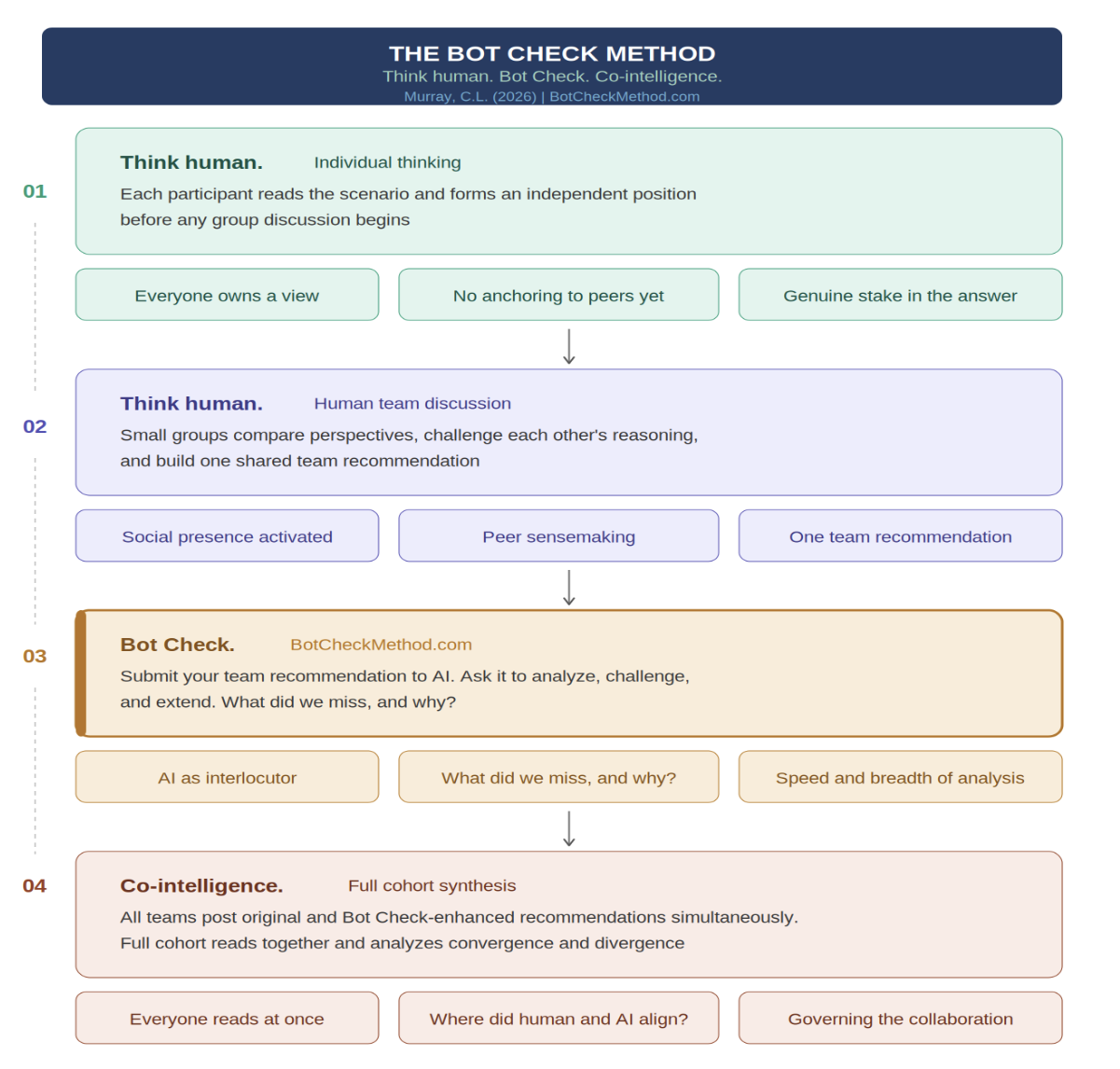
To address these failures, the Bot Check Method proposes a, disciplined, four-phase sequence designed to prioritize human cognition while leveraging AI as a diagnostic partner rather than a primary author.
- Think Human (Individual Phase): The process mandates that participants confront a problem in isolation. This is the "triggering event" required to build cognitive stake. By forcing the brain to wrestle with raw data, this phase ensures that the neural pathways associated with critical analysis are fully engaged before any external tool is introduced.
- Think Human Together (Social Phase): Participants move into small-group collaboration. This step mimics the "exploration" phase of the CoI model. Peer-to-peer discourse forces individuals to articulate their reasoning, defend their positions, and identify logical gaps. This phase is essential for developing social presence, which is a prerequisite for cognitive depth.
- The Bot Check (Diagnostic Phase): Only after a robust, human-defensible position is established is the AI invited into the process. The AI is used to stress-test the group’s recommendation. By asking, "What are the weakest assumptions in this logic?" or "What perspectives have we overlooked?", the human team maintains authority over the AI. The tool becomes an interlocutor, not an answer key.
- Co-intelligence (Synthesis Phase): In the final stage, groups present their original human-derived conclusion alongside the AI’s critique. The team then synthesizes these findings, resulting in a final output that reflects both human judgment and machine-enhanced breadth.
Organizational Implications and Governance
The transition from an "abstinence-only" or "unbridled-adoption" model to the Bot Check Method requires more than a policy shift; it demands a change in organizational culture. Organizations that have relied on "shadow AI"—where employees use unvetted tools on personal devices—face significant security and data privacy risks. The Bot Check Method mitigates this by creating a sanctioned, governed environment where AI usage is not only transparent but strictly sequenced.
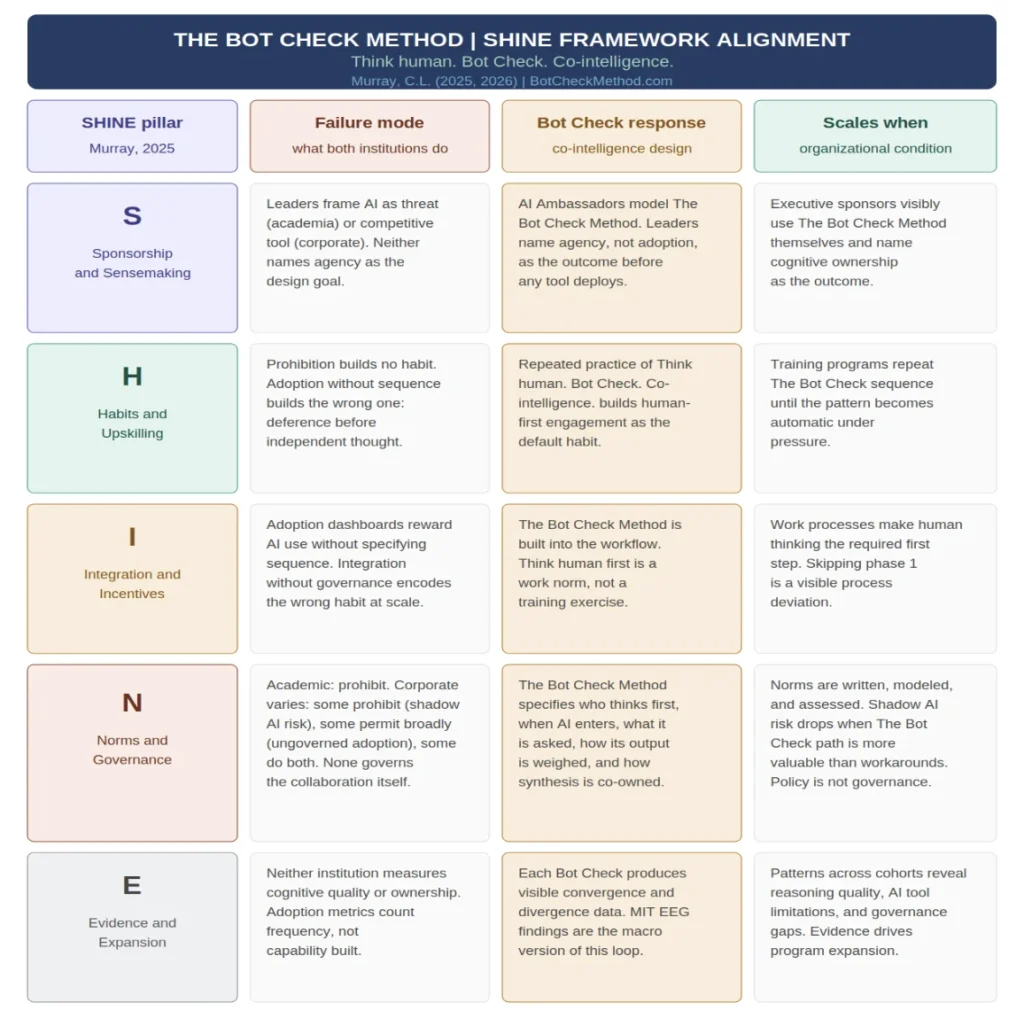
For corporations, the integration of this method aligns with the SHINE framework, which emphasizes the need for Sponsorship, Habits, Integration, Norms, and Evidence. CLOs must stop measuring AI success by the sheer frequency of tool use and begin measuring it by the "cognitive quality" of the output.
The Future of Human-AI Collaboration
The debate over whether to prohibit or adopt AI is rapidly becoming obsolete. The reality is that AI is ubiquitous. The next stage of the evolution of work and learning will not be defined by who uses the most sophisticated model, but by which institutions can best protect and enhance human agency in the presence of those models.
Educational administrators and corporate leaders who adopt a design-led approach—placing the sequence of human engagement at the center of their strategy—will likely see a significant improvement in both the caliber of work and the resilience of their workforce. The evidence is clear: when the human thinks first, the AI becomes a powerful tool for refinement. When the AI thinks first, the human merely becomes a spectator to their own intellectual decline.
As the MIT research continues to shed light on the neurological impacts of AI reliance, the imperative for a structured, human-first methodology becomes undeniable. The Bot Check Method offers a viable, scalable, and pedagogically sound pathway forward. It is a transition from the reactive policies of the past to a proactive design for the future—a future where the primary product of any learning encounter remains the human capacity to think, critique, and innovate. The challenge for leaders is not to navigate the technology, but to master the architecture of human-machine interaction before the cognitive debt becomes an insurmountable burden for the next generation of thinkers and workers.