



The modern evolution of eyewear has expanded far beyond basic vision correction and aesthetic accessorizing into the realm of integrated microelectronics and advanced med-tech. As the boundaries between fashion, biology, and digital computing blur, industry leaders are racing to redefine what everyday frames can achieve. Nowhere is this transformation more evident than within the sprawling research and development facilities of EssilorLuxottica, the world’s largest eyewear conglomerate.
To understand how high-performance lenses, AI-driven frames, and over-the-counter hearing solutions move from futuristic concepts to mainstream retail, a look inside the company’s Milan design hubs and subsequent global industry summits reveals a coordinated push to fundamentally alter human sensory experience.
The Milan Genesis: Forecasting Trends and Engineering the Future
The journey of a pair of frames often begins years before they ever reach a retail shelf. In July 2025, industry analysts and media representatives were invited to Milan—the global epicenter of fashion—to observe how EssilorLuxottica integrates aesthetic foresight with optical engineering.
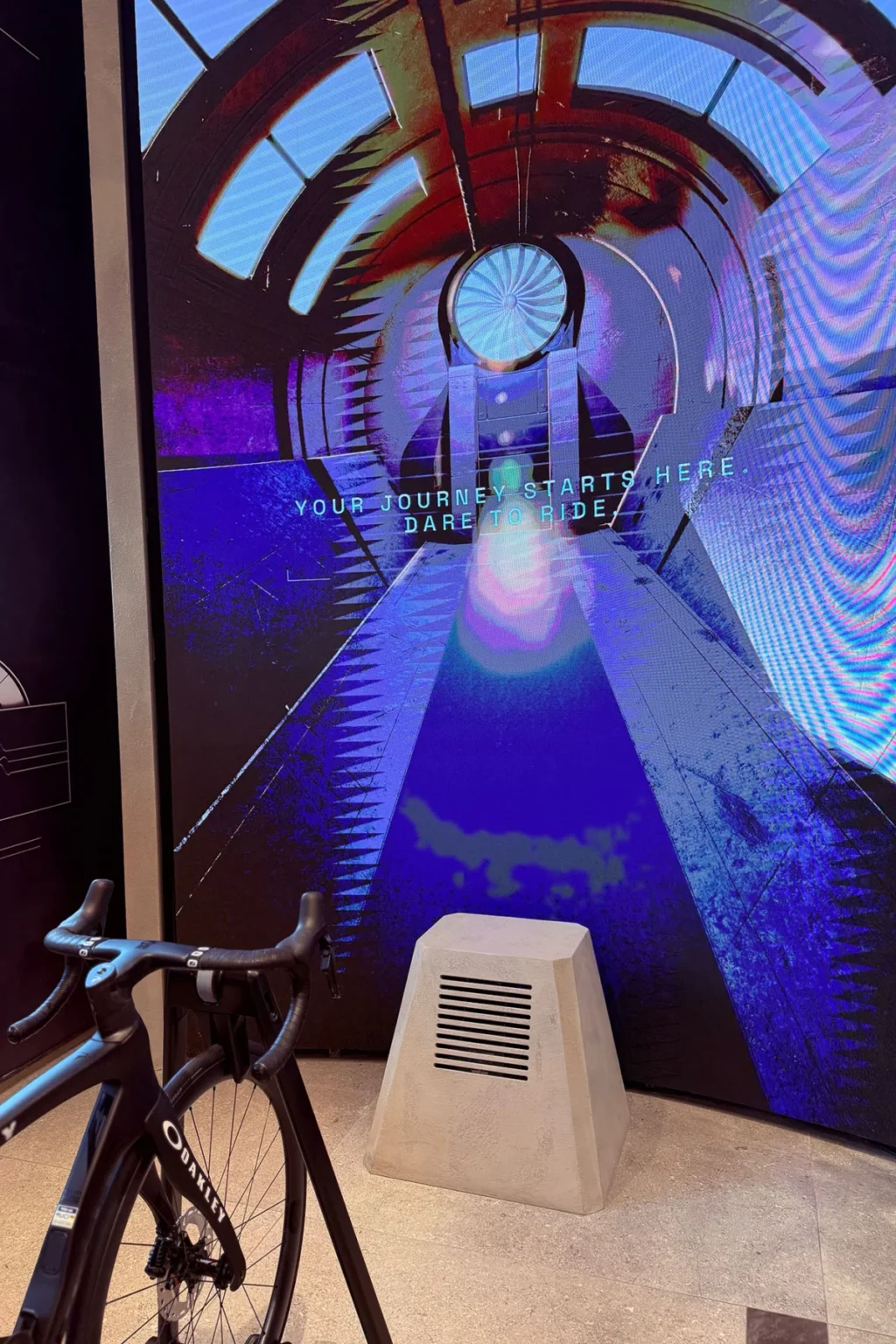
The tour commenced at the Oakley Milano flagship store, a brutalist, bunker-like space showcasing contemporary gear alongside archival 1990s accessories. Beyond retail display, the location highlighted the brand’s technological capabilities, such as the Prizm Interactive Wall and the Performance Chamber. These installations simulate environmental factors like variable lighting, glare, and wind resistance to test how selective wavelength tuning enhances visual contrast across dynamic conditions, from shaded mountain trails to open seas.

Moving into the Zona Tortona design district, the Luxottica Digital Factory and Tortona Experience Center demonstrated the rigorous forecasting methodologies used by the corporation. Long before retail release, multidisciplinary teams analyze global economics, demographic shifts, interior design movements, and international face-shape datasets compiled from thousands of retail locations, including LensCrafters and Sunglass Hut.
Nina Esteves, senior trend and foresight manager at EssilorLuxottica, noted that artificial intelligence and 3D printing are rapidly expanding structural possibilities. These tools allow designers to anticipate neo-neutrals, reshape classic ovals and cat-eyes, and scale runway silhouettes down to commercial markets 18 to 24 months in advance.
Advancements in Optical Science: Transitions and Progressive Lenses
While physical frames dictate style, lens technology continues to undergo profound chemical and ergonomic advancements. Photochromic lenses, once defined by slow-reacting, tobacco-brown tints, have been largely re-engineered. Modern iterations, such as the Transitions Gen S, utilize advanced molecular clusters capable of darkening in approximately 25 seconds and returning to clear in under two minutes, available in eight distinct hues alongside polarized XTRActive variants.
Simultaneously, the stigma surrounding progressive lenses—historically associated with rigid bifocal lines and difficult adjustment periods—is fading due to sophisticated behavioral modeling. According to market reports from Essilor and United Nations data, approximately 2.1 billion people globally suffer from presbyopia, an age-related loss of near vision, with projections reaching 4 billion by 2050. Digital device usage has further accelerated these visual demands.
To combat the neurological stress and physical fatigue associated with presbyopia—such as headaches, vertigo, and nausea—engineers have turned to digital twins. These virtual replicas simulate an individual wearer’s prescription, pupillary distance, facial morphology, and daily head and eye movements. When fitted for advanced products like the Varilux XR Series, proprietary measurement tools record Near Vision Behavior (NVB) and posture. Behavioral AI then predicts gaze shifts to align focal zones naturally, eliminating the traditional "swim effect" and providing seamless transitions across near, intermediate, and long-range distances.

The Integration of Audio: Bridging Vision and Hearing Loss
Perhaps the most significant technological leap in recent years is the convergence of optical frames and hearing enhancement. Released initially in April 2025, Nuance Audio glasses represent a major shift in over-the-counter hearing assistance, integrating directional microphones and acoustic micro-speakers directly into standard-looking spectacle frames at a fraction of the cost of traditional hearing aids.
Public health data underscores the urgency of addressing mild-to-moderate hearing loss. According to presentations by public health officials at EssilorLuxottica’s SWITCH summit in Orlando in March 2026—an event gathering approximately 1,000 vision-care professionals from over 30 countries—roughly 73 million Americans experience hearing loss. When factoring in "hidden hearing loss," where individuals struggle primarily with speech comprehension in noisy environments despite standard audiogram results, that figure rises to one in three adults.
Medical literature, including a 2024 report by the Lancet Commission, consistently links untreated hearing loss to social isolation and an increased risk of cognitive decline. Despite these risks, fewer than a third of affected individuals seek timely intervention, frequently delaying treatment for seven to ten years due to the social stigma associated with visible medical devices.
To combat this hesitation, public figures like actress Jane Lynch have become vocal advocates for hearables, describing how discreet audio-integrated glasses help wearers reengage in social environments without feeling vulnerable or compromised. Following the initial rollout, the company introduced Nuance Audio Plus, offering improved amplification, longer battery life, and refined acoustic controls across multiple frame styles and colors.
Engineering Challenges and Market Implications
Designing smart eyewear presents severe mechanical hurdles. Matteo Battiston, EssilorLuxottica’s chief design officer, points out that embedding printed circuit boards (PCBs), batteries, and directional microphones requires thickening the arms of the frames. This introduces a fundamental engineering conflict: aligning rigid, flat electronic components with the curved, highly variable geometry of the human face, while still accommodating thick, high-index prescription lenses.

Despite these physical constraints, iterative hardware improvements are ongoing. At the 2026 SWITCH summit, the company debuted the Ray-Ban Meta Optics, engineered to support a wider prescription range through modified hinges offering an additional 10 degrees of rotation, adjustable nose pads, and adaptable temple tips. Federico Buffa, chief R&D, product, and marketing officer, summarized the design philosophy: while fully flexible microelectronics remain elusive, mechanical flexibility has allowed the company to bridge the gap between high-tech functionality and conventional aesthetics.
As optical retail continues to incorporate biometric tracking, AI assistance, and sensory augmentation, the traditional pair of glasses is no longer viewed merely as a corrective medical device or a static fashion accessory. Instead, industry developments point toward a future where corrective eyewear serves as an active, interconnected hub for human health—seamlessly managing vision, light adaptation, and auditory perception while preserving personal style.