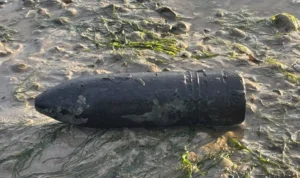



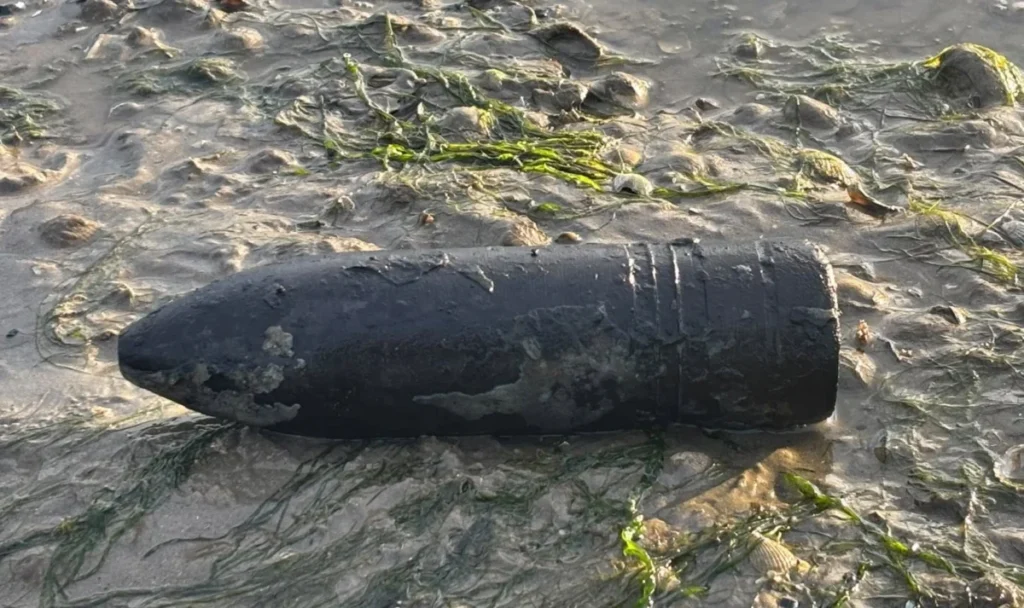
A routine weekend stroll along the picturesque coastline of Southend-On-Sea in Essex, England, took an unexpected and hazardous turn when a vigilant beachgoer stumbled upon a relic of twentieth-century conflict. What initially appeared to be an unusual rock or discarded metallic debris partially buried in the sand was quickly identified as an unexploded military shell dating back to the Second World War. The discovery prompted a swift, coordinated response from local maritime authorities and specialized military explosive ordnance disposal (EOD) teams, culminating in a controlled detonation that safely neutralized the decades-old threat without injury or property damage.
The incident underscores a persistent and dangerous reality across Europe and various global theaters: decades after the conclusion of global hostilities, millions of tons of unexploded ordnance (UXO) remain hidden beneath the soil, embedded in riverbeds, or washed ashore by tidal currents.
The Discovery and Initial Response
The sequence of events began on a Saturday morning when a member of the public was walking along the beach roughly half a mile south of "The Crowstone," a prominent local nineteenth-century obelisk that marks the historical jurisdiction of the Port of London Authority on the Thames Estuary. Noticing an unusual, heavily weathered object protruding from the sand that bore a striking resemblance to a munitions shell, the individual exercised caution and immediately contacted emergency services.
Personnel from HM Coastguard Southend-On-Sea were dispatched to the location during the early morning hours to assess the scene. Upon arriving, coastguard officers verified the existence of the suspicious artifact. Recognizing the potential volatility of the object, the team refrained from disturbing the item and instead captured detailed photographs and precise GPS coordinates. This intelligence was immediately transmitted to the regional Army Explosive Ordnance Disposal (EOD) unit for expert evaluation.
Following a preliminary analysis of the digital imagery, EOD specialists determined that a physical inspection was necessary to ascertain the exact nature, age, and stability of the device. However, due to the coastal geography of the area, the team had to contend with tidal schedules. EOD experts advised that officers maintain a watchful presence while waiting for low tide, which would expose the surrounding beach adequately for a thorough examination and a potential mitigation operation.
The Low-Tide Assessment and Controlled Detonation
As evening approached and the tide receded, exposing vast stretches of damp sand and mudflats, Southend Coastguard Rescue Officers rendezvoused with the Army EOD team at the coordinates of the suspected explosive.
Upon close inspection by military ordnance technicians, the object was formally identified as a high-explosive artillery shell dating from the Second World War, measuring approximately six inches in diameter. Despite resting in a public tidal zone for nearly eighty years, the casing showed severe degradation from saltwater and marine life, yet the internal explosive filler remained a potent hazard.
Given the structural integrity of the shell and the inherent risks associated with transporting unstable, degraded munitions through populated civilian areas, the EOD commanders concluded that the safest course of action was an in situ controlled detonation.
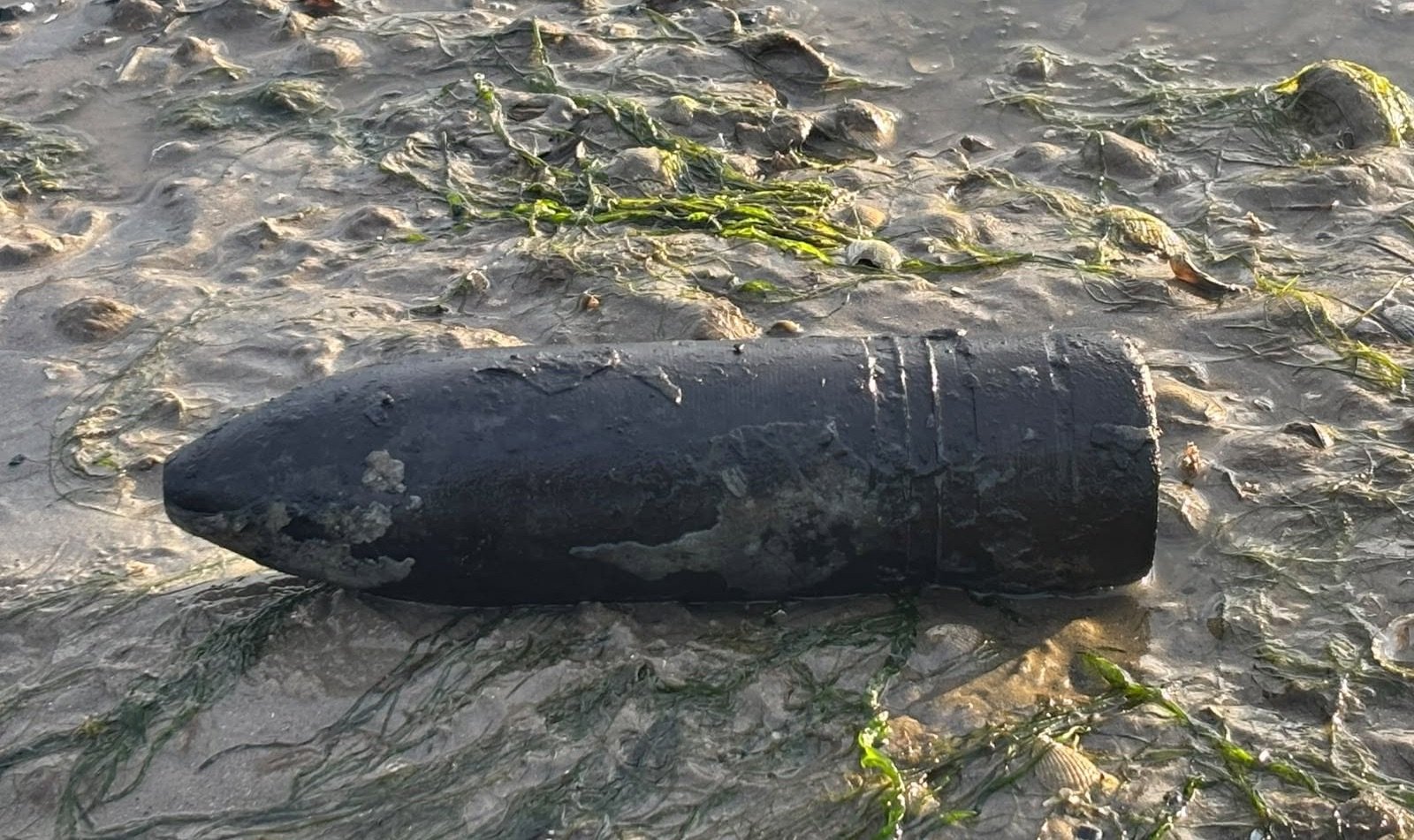
Executing the operation directly on the beach eliminated the dangerous variable of transport. EOD technicians established a secure exclusion zone, halting pedestrian traffic along the immediate shoreline to ensure absolute safety. Once the perimeter was secured, the specialists successfully initiated a controlled explosion. A dramatic video released by HM Coastguard Southend-On-Sea later captured the moment of the detonation, showing a powerful blast that sent a localized plume of sand, water, and debris soaring into the evening sky. No infrastructure was damaged, and no injuries were reported.
The Global Persistence of World War II Munitions
While the neutralization of a six-inch artillery shell on an Essex beach ended without incident, experts emphasize that such discoveries are far from isolated anomalies. More than eighty years after the end of World War II, thousands of tons of unexploded bombs, grenades, landmines, and naval shells continue to be unearthed across the globe annually.
The scale of the phenomenon is immense. During the conflict, the Allied and Axis powers dropped millions of tons of ordnance across Europe, the Pacific, North Africa, and Asia. It is estimated that up to ten percent of all munitions dropped or fired during the war failed to detonate upon impact due to mechanical malfunctions, soft soil, or faulty manufacturing.
In the United Kingdom alone, construction workers, agricultural laborers, and beachgoers encounter thousands of items of UXO every year. Major cities targeted during the Blitz—such as London, Plymouth, Portsmouth, and Southampton—frequently unearth massive aerial bombs. For instance, earlier in the spring, emergency services in Plymouth, UK, were forced to execute a complex, mass evacuation involving thousands of residents to safely defuse and remove a massive 250-kilogram German Hermann aerial bomb.
Conversely, the dangers associated with wartime remnants can sometimes result in catastrophic outcomes when untrained individuals encounter them. A tragic reminder of these lingering hazards occurred earlier this year in Indonesia, where a suspected World War II-era shell accidentally detonated in a coastal fishing village, resulting in five fatalities. That incident highlighted the indiscriminate nature of unstable explosives, which can remain dormant for generations before a minor disturbance triggers their payload.
Official Warnings and Public Protocol
In the wake of the Southend-On-Sea operation, HM Coastguard issued a stern reminder to the public regarding the correct protocol for encountering suspected ordnance. Authorities stress that the passage of decades does not diminish the destructive capability of military explosives; in fact, the chemical stability of many propellants and high explosives degrades over time, making them even more sensitive to friction, heat, and movement.
"As these items can be so dangerous, if you ever see something suspicious or out of place on the beach or in the sea, do not touch it, move it, or take it home," HM Coastguard stated in their public advisory. "Let the experts decide if it is safe."
Beachgoers and outdoor enthusiasts are advised to follow a clear set of steps if they suspect they have found unexploded military hardware:
- Do not touch, kick, or pick up the object. Moving a degraded munition can cause the aging fuze mechanism to activate.
- Note the exact location. Use smartphone GPS coordinates, prominent landmarks, or take a photograph from a safe distance if it can be done without approaching the item.
- Move to a safe distance. Withdraw away from the object to a secure location where you are shielded from potential blast fragments.
- Contact emergency services immediately. Dial the local emergency number (such as 999 in the UK or 911 in the United States) and ask for the Coastguard or police, providing them with precise details of the find.
As coastal erosion continues to reshape shorelines and shifting sands uncover long-buried history, maritime and military authorities remain on high alert. The successful operation in Essex serves as both a testament to the ongoing vigilance of emergency services and a stark reminder of the long shadow cast by twentieth-century conflict upon twenty-first-century landscapes.