





The paradigm of enterprise cloud security has shifted significantly, with identity and access management officially unseating misconfiguration as the foremost security concern for organizations worldwide, according to the latest research from the Cloud Security Alliance (CSA). Released in its landmark Top Threats to Cloud Computing Survey Report 2026, the findings highlight a transformative period in cybersecurity, driven heavily by the rapid enterprise integration of artificial intelligence and an increasingly interconnected software supply chain.
The comprehensive study, compiled by the CSA Top Threats Working Group, gathered insights from 507 qualified cybersecurity professionals. These industry experts evaluated and ranked 23 distinct cloud security issues, ultimately yielding a definitive Top 11 list. Leading the charge are identity management, artificial intelligence vulnerabilities, third-party resources, and application programming interfaces (APIs). This new hierarchy reflects an industry-wide realization that while foundational infrastructure security remains vital, the modern attack surface is increasingly defined by user access permissions, intelligent automation, and complex external integrations.

The Evolving Threat Landscape: A Shift Away from Infrastructure
For years, basic configuration errors and underlying infrastructure vulnerabilities dominated boardroom discussions regarding cloud safety. However, the 2026 survey data illustrates a stark departure from traditional concerns. According to the CSA, threats closely tied to foundational infrastructure and cloud service providers—such as denial-of-service (DoS) attacks, shared technology vulnerabilities, cloud service provider data loss, unauthenticated resource sharing, and limited cloud visibility or observability—have fallen outside the top tier altogether.
Instead, the modern threat matrix focuses on vulnerabilities that exploit human credentials, autonomous systems, and third-party vendors. This evolution underscores a broader industry trend: as cloud service providers (CSPs) harden their core platforms against infrastructure-level attacks, threat actors have pivoted toward the application layer, identity perimeters, and emerging technologies like machine learning models that often lack mature governance frameworks.
The inclusion of AI-related issues for the first time in the survey’s history marks a critical milestone. As organizations rush to deploy generative AI and automated decision-making tools within cloud environments, they are inadvertently introducing novel attack vectors. These include risks associated with prompt injection, data poisoning, inadequate model access controls, and insecure AI supply chains.
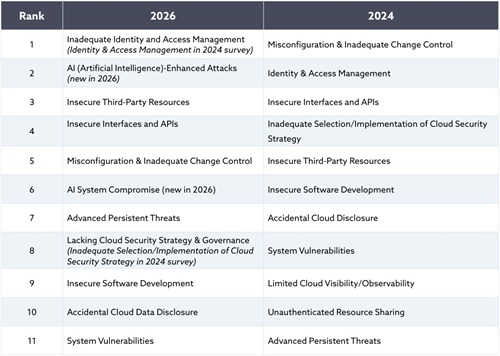
Chronology of Change: Comparing the 2024 and 2026 Rankings
A direct comparison between the CSA’s 2024 survey cycle and the newly published 2026 report provides a clear window into how rapidly enterprise risk priorities have morphed. While the CSA notes that the two reports are structured to show relative shifts in survey cycles rather than a strict one-to-one row mapping, the trajectory of specific security domains tells a compelling story of industry adaptation.
In the 2024 rankings, misconfiguration and inadequate change control held the coveted—and perilous—top spot. Organizations were routinely struggling with public S3 buckets, overly permissive security groups, and manual deployment errors. By 2026, improved automated posture management tools and native cloud security guidance have helped push misconfigurations down to the No. 5 spot.
Simultaneously, identity and access management (IAM), which previously sat at No. 2, has surged to take the crown at No. 1. This ascent mirrors the widespread adoption of zero-trust architectures and the reality that compromised credentials remain the easiest entry point for ransomware operators and advanced persistent threat (APT) groups.

Other notable shifts include the rise of insecure third-party resources, which climbed from No. 5 to No. 3, reflecting the mounting risks associated with outsourced software dependencies and open-source libraries. Furthermore, Advanced Persistent Threats (APTs) climbed significantly from No. 11 to No. 7, demonstrating that sophisticated, nation-state-backed actors are increasingly targeting cloud environments to conduct long-term espionage and intellectual property theft.
Behind the Data: Survey Methodology and Respondent Demographics
The robustness of the CSA Top Threats report relies heavily on its rigorous methodology. The Top Threats Working Group surveyed 507 active security professionals, ranging from chief information security officers (CISOs) and cloud architects to risk management specialists and compliance officers.
Interestingly, the statistical scoring across the top tier revealed a remarkably tight cluster of concern. The scores ranged from a high of 7.95 for the top-ranked identity issue down to 7.45 for the No. 11 threat. This tight clustering indicates that modern security practitioners do not view these risks in isolation; rather, they perceive a dense, interconnected web of vulnerabilities where an identity failure can quickly lead to a third-party breach or an AI-driven data exfiltration event.

The report is specifically designed to be a practical tool for organizational governance. Its target audience spans executive leadership, compliance teams, technology officers, and information security personnel. Each individual threat analysis within the comprehensive report is paired with technical and business impact assessments, real-world case studies, and mapped directly to corresponding CSA security controls. This ensures that organizations are not just informed of theoretical risks, but are equipped with actionable remediation strategies.
Industry Implications and Strategic Recommendations
The elevation of identity and AI to the forefront of cloud security carries profound implications for enterprise budgeting, talent acquisition, and risk management frameworks.
First, the dominance of identity as the primary threat vector mandates a renewed commitment to comprehensive IAM strategies. Organizations must move beyond static passwords and basic multi-factor authentication (MFA) to implement continuous identity verification, granular least-privilege access, and automated lifecycle management for both human and machine identities. As microservices and serverless architectures proliferate, machine-to-machine authentication has become a critical blind spot that attackers are eager to exploit.

Second, the debut of AI-related threats signals that the cybersecurity industry must rapidly upskill to address the unique vulnerabilities of machine learning pipelines. Traditional security tooling is often inadequate for detecting data poisoning, unauthorized model inference, or supply chain compromises within AI libraries. Organizations deploying AI in the cloud must establish dedicated oversight boards, rigorous data governance protocols, and specialized testing frameworks to secure their machine learning investments.
Finally, the high ranking of third-party resources and APIs reinforces the necessity of comprehensive software bill of materials (SBOM) management and rigorous vendor risk assessments. Modern applications are rarely built entirely in-house; they are assembled from thousands of third-party components and integrated via APIs that frequently lack adequate rate-limiting, authentication, or input validation.
Looking Ahead
As cloud computing continues to evolve into the foundational substrate for global commerce and digital infrastructure, the Cloud Security Alliance’s 2026 report serves as both a warning and a roadmap. By shifting focus away from legacy infrastructure concerns and addressing the human, algorithmic, and operational realities of identity and artificial intelligence, enterprise leaders can better navigate the turbulent waters of modern cybersecurity. The organizations that thrive in this new era will be those that treat security not as a static compliance checkbox, but as a dynamic, identity-centric, and AI-aware discipline integral to overall business strategy.